Does Saffron Affect Appetite or Body Weight?
A small trial in women measured both snacking and body weight, but its reported results leave the size and staying power of the weight change unclear.
Saffron research isn’t limited to appetite. In an eight-week placebo-controlled trial of 60 mildly overweight women, a specific saffron stigma extract was linked to less diary-recorded snacking and a statistically greater reduction in measured body weight than placebo. The published abstract doesn’t give the size of the weight change or describe longer-term follow-up, so it can’t tell you whether that result was meaningful or lasting. 2
Less snacking isn’t the same as weight loss
If you’re looking at saffron for weight management, the first question is what a study actually measured. Feeling less inclined to snack is one outcome; a change on the scale is another. Even a measured weight change doesn’t, on its own, show how much came from body fat rather than muscle or water. 1
One directly relevant trial randomly assigned 60 healthy, mildly overweight women to a particular saffron stigma extract, called Satiereal, or a matching placebo for eight weeks. Researchers evaluated body weight and had participants record snacking episodes in daily diaries. Calorie intake was unrestricted. 2
At eight weeks, the extract group had a statistically greater reduction in body weight than the placebo group. They also recorded less frequent snacking. This was a direct weight finding, not weight loss inferred from an appetite question. But the abstract doesn’t state the size of the weight difference. Without that number, statistical significance can’t tell you how noticeable the change might be in everyday life. 2
What the snacking result can and can’t explain
The diaries captured what participants reported about snacking, not a direct measurement of everything they ate. The abstract doesn’t establish that eating fewer snacks caused the difference in weight. Those two findings may fit together, but they remain distinct results. 2
Duration matters, too. Eight weeks can show a short-term difference between groups; it can’t establish sustained weight management. The abstract doesn’t describe follow-up after the trial ended. And because participants weren’t asked to restrict calories, this study wasn’t a test of adding saffron to a structured weight-loss program. 2
Which saffron, and which women?
The trial used one specific extract made from saffron stigmas. It doesn’t establish that saffron used as a spice, or a supplement with a different formulation, would have the same effect. That distinction matters when a product label simply says “saffron.” 2
The participants were women, so the finding is directly about women like those enrolled, not a result borrowed from a mixed-sex sample. But the abstract doesn’t describe results by menstrual or reproductive stage, and the trial didn’t compare women with men. It offers no basis for saying saffron works differently during cycling years, perimenopause, or postmenopause. 2
Another eight-week placebo-controlled trial, this time in 70 people with type 2 diabetes, measured weight and body mass index among several outcomes. Its abstract reports findings for blood sugar and other measures but doesn’t state a weight result or provide a women-specific weight analysis. Measuring weight in a study isn’t the same as finding an effect on weight. 3
The useful distinction is this: one small trial in mildly overweight women reported both less self-recorded snacking and a greater short-term reduction in measured weight with a specific extract. The reported evidence doesn’t yet tell you the size of that weight difference or whether it persists, so it’s a reason to be curious, not a promise of lasting weight loss. 2
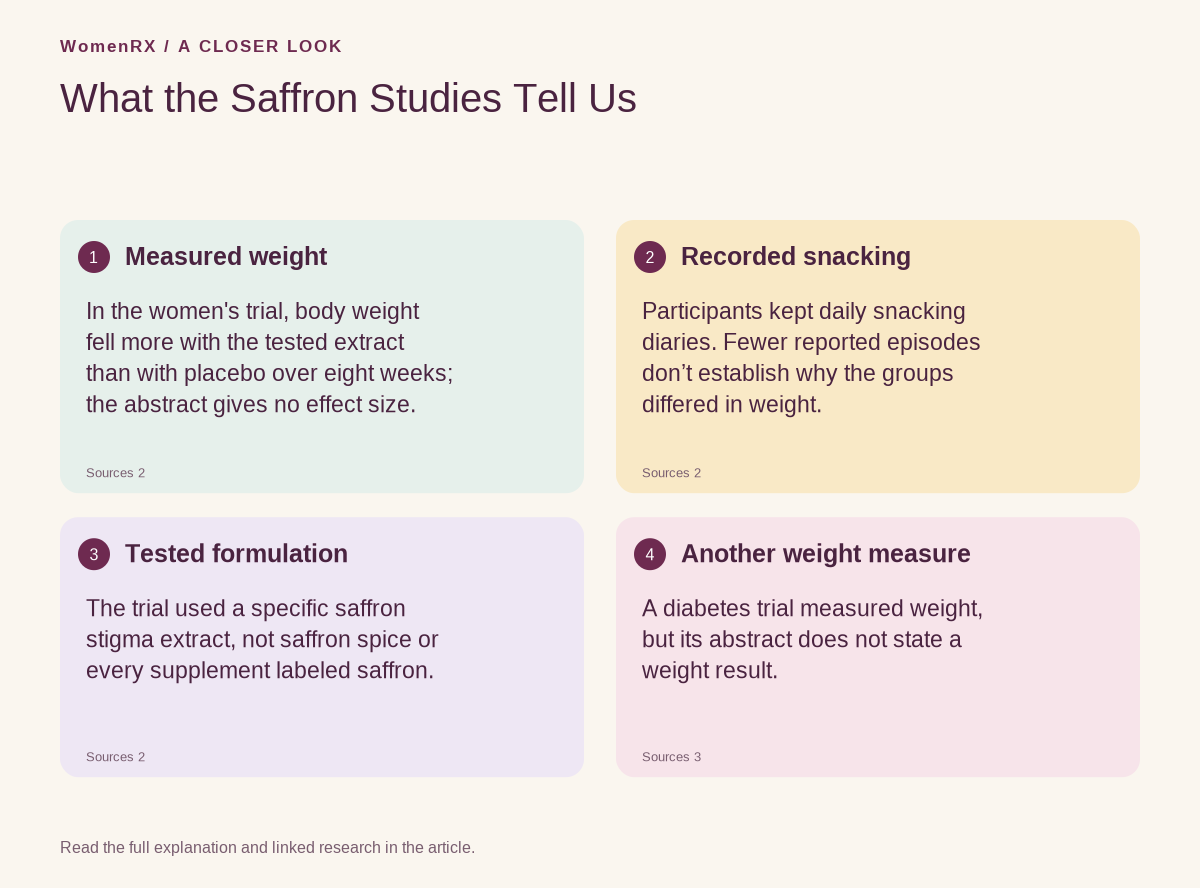
What the Saffron Studies Tell Us
Measured weight: In the women's trial, body weight fell more with the tested extract than with placebo over eight weeks; the abstract gives no effect size.2
Recorded snacking: Participants kept daily snacking diaries. Fewer reported episodes don’t establish why the groups differed in weight.2
Tested formulation: The trial used a specific saffron stigma extract, not saffron spice or every supplement labeled saffron.2
Another weight measure: A diabetes trial measured weight, but its abstract does not state a weight result.3
Read the figure as text
The distinction is between an outcome researchers measured, a result they reported, and what that result can establish.- Measured weight: In the women's trial, body weight fell more with the tested extract than with placebo over eight weeks; the abstract gives no effect size.2
- Recorded snacking: Participants kept daily snacking diaries. Fewer reported episodes don’t establish why the groups differed in weight.2
- Tested formulation: The trial used a specific saffron stigma extract, not saffron spice or every supplement labeled saffron.2
- Another weight measure: A diabetes trial measured weight, but its abstract does not state a weight result.3
Sources you can check
- Body Weight: MedlinePlusAccessed 2026-09-25Return to first citation
- Satiereal, a Crocus sativus L extract, reduces snacking and increases satiety in a randomized placebo-controlled study of mildly overweight, healthy women.Gout B, Bourges C, Paineau-Dubreuil S. · Nutrition research (New York, N.Y.) · 2010Return to first citation
- The effect of saffron (Crocus sativus L.) on glycemia, lipid profile, and antioxidant status in patients with type-2 diabetes mellitus: A randomized placebo-controlled trial.Tajaddini A, Roshanravan N, Mobasseri M, Haleem Al-Qaim Z, Hadi A, Aeinehchi A, Sefid-Mooye Azar P, Ostadrahimi A. · Phytotherapy research : PTR · 2023Return to first citation