CoQ10 and Heart Health: What Has Been Studied?
The most relevant CoQ10 findings concern people already being treated for heart failure, not a general promise of heart-disease prevention.
CoQ10 has mainly been studied as an addition to standard treatment for chronic heart failure. Researchers have measured symptoms, heart function, hospitalizations, and cardiovascular events, with promising but not definitive findings. These studies don’t show that CoQ10 prevents heart disease or replaces prescribed care. Women were included in a major trial subgroup, but its outcomes weren’t reported separately for them. 1 2 4
Start with the heart condition, not the supplement claim
“Heart health” can mean preventing a first cardiovascular event, treating diagnosed heart failure, or improving a measure of how well the heart pumps. Those aren’t interchangeable goals. CoQ10 research most directly addresses chronic heart failure, a condition in which the heart doesn’t pump as well as the body needs. In the trials discussed here, people received CoQ10 alongside their usual treatment, not instead of it. 1 3
If you’re considering CoQ10 because of a family history or a cholesterol result, the heart-failure findings don’t answer whether it will prevent cardiovascular disease for you. A review of primary-prevention research, concerning people without established cardiovascular disease, found too little evidence to draw a conclusion. Nor can a result in heart failure automatically be extended to people who have another cardiovascular condition but not heart failure. 2
What changed in the heart-failure studies?
The Q-SYMBIO trial compared CoQ10 with placebo in people with moderate to severe chronic heart failure, while both groups continued standard therapy. A published analysis looked specifically at its 231 European participants. At three months, that subgroup had no significant differences between groups in the study’s short-term measures: heart-failure functional class, six-minute walking distance, and a blood marker used in heart-failure assessment. 1
At two years, 10 of 108 people assigned to CoQ10 (9%) and 33 of 123 assigned to placebo (27%) had reached the study’s composite major adverse cardiovascular event outcome. That combined outcome included cardiovascular death and hospital stays for worsening heart failure, among other serious events. It is a meaningful finding for this European heart-failure subgroup, but it doesn’t mean that 18% of everyone taking CoQ10 will avoid a heart event. 1
Other trials have measured ejection fraction, the proportion of blood pumped out of a ventricle with each beat, and functional class, which describes how much symptoms limit activity. For example, a four-month trial of 62 people with heart failure compared atorvastatin plus CoQ10 with atorvastatin plus placebo, on top of heart-failure care. Changes in ejection fraction and functional class differed between groups; changes in several other measured outcomes did not. That trial tested an add-on, not whether CoQ10 could replace a statin. 3
Looking across studies helps put individual results in perspective. A systematic review of nutraceutical studies in adults with heart failure concluded that CoQ10 may reduce mortality and hospitalization, but that definite conclusions could not be drawn. The practical distinction is between a possible benefit worth discussing for a particular heart-failure patient and a proven benefit for everyone seeking a healthier heart. 4
What can a woman take from these results?
Women were included in the European Q-SYMBIO subgroup, but men made up 83% of the CoQ10 group and 71% of the placebo group. The reported treatment outcomes weren’t separated by sex. So the event figures describe the subgroup as a whole; they don’t tell us whether women had the same result, a different result, or no result. That uncertainty isn’t evidence that CoQ10 works differently in women. 1
Where does it fit with your medicines?
If you have heart failure, the relevant question isn’t simply “Is CoQ10 good for the heart?” It’s whether adding it makes sense with your diagnosis and current treatment. The heart-failure trials did not test replacing prescribed medicines with CoQ10, and the small atorvastatin trial was not a test of medication interactions. 1 3
Before adding a product, show its label and your medication list to your heart-care prescriber or pharmacist. Ask which outcome you’re hoping to improve, whether the heart-failure evidence applies to your situation, and whether the product raises any concerns with the medicines you take. That conversation is more useful than assuming that a promising trial result applies to every cardiovascular condition or every supplement on the shelf.
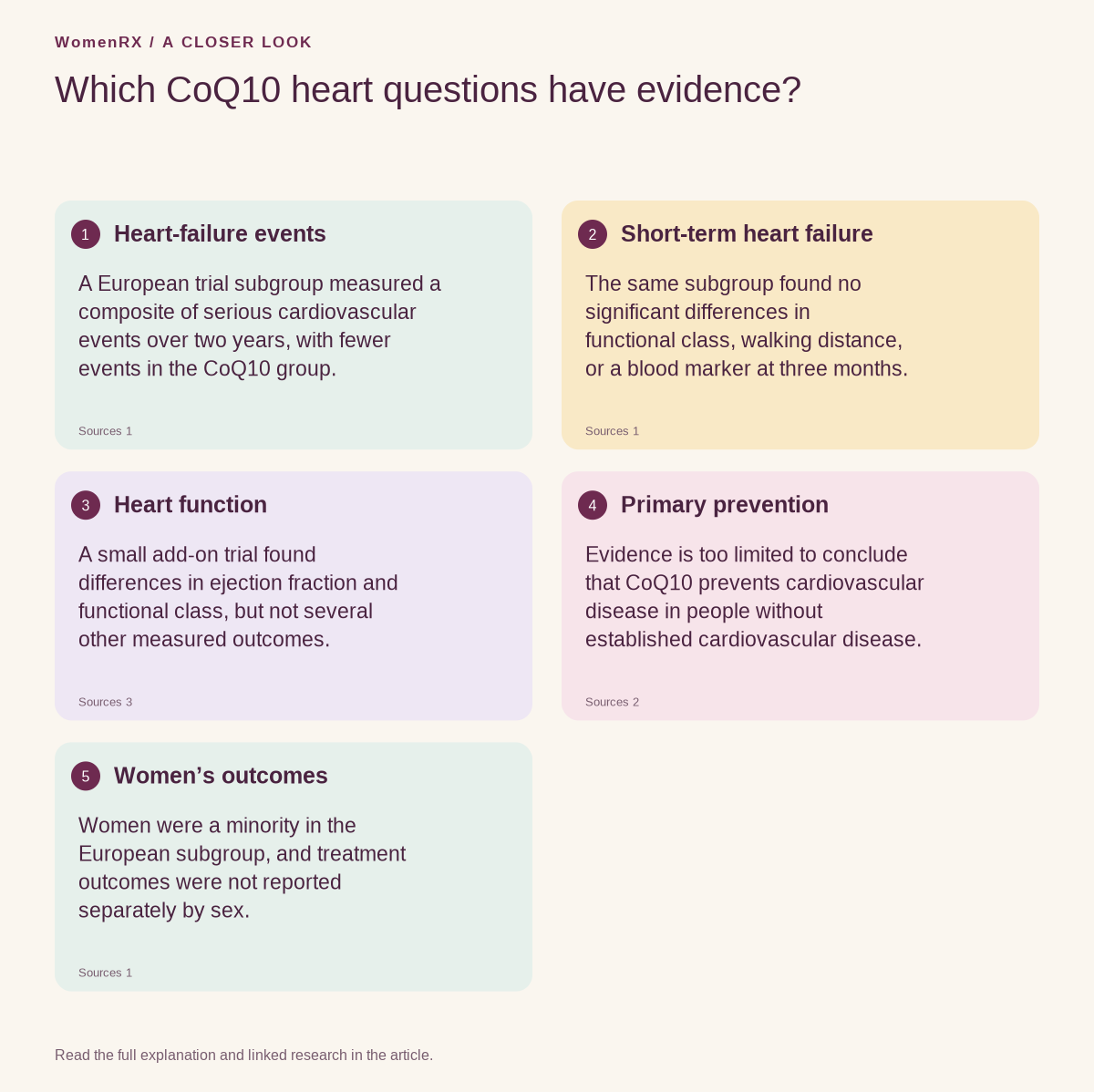
Which CoQ10 heart questions have evidence?
Heart-failure events: A European trial subgroup measured a composite of serious cardiovascular events over two years, with fewer events in the CoQ10 group.1
Short-term heart failure: The same subgroup found no significant differences in functional class, walking distance, or a blood marker at three months.1
Heart function: A small add-on trial found differences in ejection fraction and functional class, but not several other measured outcomes.3
Primary prevention: Evidence is too limited to conclude that CoQ10 prevents cardiovascular disease in people without established cardiovascular disease.2
Women’s outcomes: Women were a minority in the European subgroup, and treatment outcomes were not reported separately by sex.1
Read the figure as text
Different outcomes answer different questions. Heart-failure findings should not be read as a general prevention claim.- Heart-failure events: A European trial subgroup measured a composite of serious cardiovascular events over two years, with fewer events in the CoQ10 group.1
- Short-term heart failure: The same subgroup found no significant differences in functional class, walking distance, or a blood marker at three months.1
- Heart function: A small add-on trial found differences in ejection fraction and functional class, but not several other measured outcomes.3
- Primary prevention: Evidence is too limited to conclude that CoQ10 prevents cardiovascular disease in people without established cardiovascular disease.2
- Women’s outcomes: Women were a minority in the European subgroup, and treatment outcomes were not reported separately by sex.1
Sources you can check
- Effect of coenzyme Q10 in Europeans with chronic heart failure: A sub-group analysis of the Q-SYMBIO randomized double-blind trial.Mortensen AL, Rosenfeldt F, Filipiak KJ. · Cardiology journal · 2019Return to first citation
- Coenzyme Q10 in the treatment of heart failure: A systematic review of systematic reviews.Jafari M, Mousavi SM, Asgharzadeh A, Yazdani N. · Indian heart journal · 2018Return to first citation
- Combination of atorvastatin/coenzyme Q10 as adjunctive treatment in congestive heart failure: A double-blind randomized placebo-controlled clinical trial.Pourmoghaddas M, Rabbani M, Shahabi J, Garakyaraghi M, Khanjani R, Hedayat P. · ARYA atherosclerosis · 2014Return to first citation
- Nutraceuticals in Patients With Heart Failure: A Systematic Review.Hopper I, Connell C, Briffa T, De Pasquale CG, Driscoll A, Kistler PM, Macdonald PS, Sindone A, Thomas L, Atherton JJ. · Journal of cardiac failure · 2020Return to first citation