Choosing an Iron Supplement Starts With the Right Test
Low iron can exist before anemia appears, so choosing a supplement starts with understanding your blood tests and why your iron is low.
Iron deficiency and iron-deficiency anemia aren’t the same: iron stores can be low while hemoglobin remains normal. Testing helps distinguish them and guides whether iron is appropriate. If a supplement is recommended, compare the elemental iron on the label, not just the salt name. Heavy menstrual bleeding, pregnancy, and the period after birth can each change the assessment and follow-up plan. 2 3 5
First, find out what “low iron” means
Iron deficiency can develop in stages. Your iron stores may be depleted before hemoglobin falls; anemia is the later stage in which hemoglobin is low. That distinction matters because a normal hemoglobin result doesn’t, by itself, rule out low iron stores. 2
A clinician may interpret a blood count alongside iron studies such as ferritin, which helps assess iron stores. In some situations, including inflammation, ferritin can be harder to interpret; transferrin saturation may add context. Your results need to be read alongside your health history rather than treated as a stand-alone diagnosis. 3 4
Anemia can have causes other than iron deficiency, including problems with red blood cell production or increased red blood cell destruction. Iron supplements won’t address every cause of anemia, so it’s useful to know what your tests show before choosing a product. 1
Compare the iron on the label
Ferrous sulfate, ferrous fumarate, and ferrous gluconate are common iron salts. They contain different proportions of elemental iron: the NIH Office of Dietary Supplements lists 20% for ferrous sulfate, 33% for ferrous fumarate, and 12% for ferrous gluconate. The Supplement Facts panel lists elemental iron, so you don’t need to calculate it from the salt name. 2
That label detail makes comparisons clearer, but it doesn’t tell you which amount is right for you. If iron has been recommended, ask what elemental iron amount is intended for your results and circumstances, and when the plan should be reassessed. Don’t assume products with different salt names are interchangeable tablet for tablet. 2
Supplemental iron can cause digestive effects such as nausea and constipation, especially at higher amounts. Other forms, including iron amino-acid chelates and polysaccharide-iron complexes, might cause fewer gastrointestinal effects than iron salts. That’s a possibility, not a guarantee that another form will be easier for you or meet your treatment needs. 2
The reason for low iron shapes the plan
If your periods are heavy, raise that alongside the low-iron result. A guideline focused on gynecology and obstetrics emphasizes reducing menstrual blood loss as well as replacing iron. You can ask whether the bleeding itself needs assessment or treatment, rather than making the supplement the whole plan. 5
Pregnancy is a distinct context. Iron deficiency is a common cause of anemia during pregnancy, and changes in blood volume affect how hemoglobin results are interpreted. Trials have found that supplementation can help prevent iron-deficiency anemia in pregnancy. At the same time, the US Preventive Services Task Force found insufficient evidence to determine the net benefit of routine screening and supplementation for pregnant people without symptoms. That uncertainty about a routine approach doesn’t settle what to do with your own symptoms or abnormal results. 2 3
After birth, don’t assume that a result taken around delivery tells the whole story. Ferritin can fluctuate in that period, and inflammation can complicate its interpretation. If you’re being evaluated postpartum, ask how the timing of your test affects what it means and whether another test is needed. 3
Make follow-up part of the decision
Replacing iron and finding out why it’s low go together. Blood loss is one possible contributor; low intake and problems with absorption can also play a part. If you’re offered a supplement, useful questions are: What do my hemoglobin and iron studies each show? What cause are we considering? How much elemental iron is intended? And which results will tell us whether the plan is working? 1 2
Also ask what to do if digestive effects make the supplement difficult to take, and agree on follow-up timing for your situation. If your iron remains low, revisiting both the treatment plan and the underlying cause is more useful than simply switching products on your own.
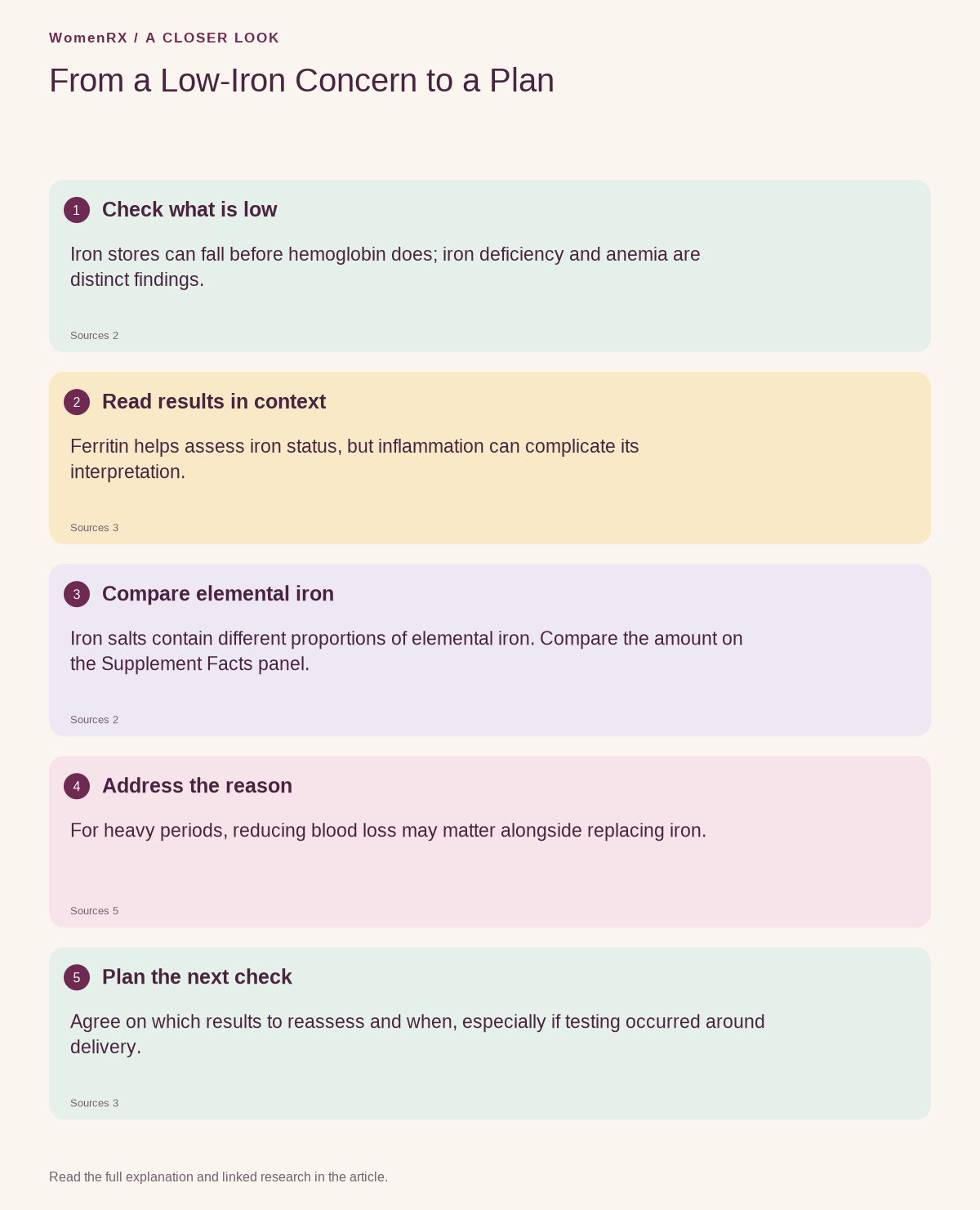
From a Low-Iron Concern to a Plan
Check what is low: Iron stores can fall before hemoglobin does; iron deficiency and anemia are distinct findings.2
Read results in context: Ferritin helps assess iron status, but inflammation can complicate its interpretation.3
Compare elemental iron: Iron salts contain different proportions of elemental iron. Compare the amount on the Supplement Facts panel.2
Address the reason: For heavy periods, reducing blood loss may matter alongside replacing iron.5
Plan the next check: Agree on which results to reassess and when, especially if testing occurred around delivery.3
Read the figure as text
Follow the distinction between a low-iron concern, a test result, a supplement choice, and a plan to address the cause.- Check what is low: Iron stores can fall before hemoglobin does; iron deficiency and anemia are distinct findings.2
- Read results in context: Ferritin helps assess iron status, but inflammation can complicate its interpretation.3
- Compare elemental iron: Iron salts contain different proportions of elemental iron. Compare the amount on the Supplement Facts panel.2
- Address the reason: For heavy periods, reducing blood loss may matter alongside replacing iron.5
- Plan the next check: Agree on which results to reassess and when, especially if testing occurred around delivery.3
Sources you can check
- Anemia | MedlinePlusAccessed 2026-09-25Return to first citation
- Iron - Health Professional Fact SheetAccessed 2026-09-25Return to first citation
- Ferritin as a diagnostic point-of-care marker in iron deficiency anemia: a narrative review and clinical implications.Dimen JN, Sunoqrot M, Hobbs C, Cherayil E, Sharma D, Ahmadzia HK. · Annals of translational medicine · 2026Return to first citation
- Factors Associated with Delayed Diagnosis of Iron Deficiency Anemia in Egyptian Patients: A Retrospective Cohort Study.AlMoshary M, Bakhsh E, Esmaeil HAA, Qushmaq NA, Alharbi AA, Alzarea EA, Abdalhabib EK, AlGhamdi MS. · Healthcare (Basel, Switzerland) · 2026Return to first citation
- No. 469 Iron Deficiency and Iron Deficiency Anemia in Obstetrics and Gynaecology.Chen I, Khamisa K, Murji A, Coolen J, Evans D, Lett R, Rittenberg D, Lett C, Special Contributors:. · Journal of obstetrics and gynaecology Canada : JOGC = Journal d'obstetrique et gynecologie du Canada : JOGC · 2026Return to first citation