Choosing an Iron Supplement Starts With Knowing Why
Blood tests and the reason your iron is low matter more than finding a universally “best” pill.
Feeling tired or having periods doesn’t, by itself, tell you whether you need iron. Blood tests help identify anemia, and treatment depends on its cause. If iron deficiency is confirmed, compare oral options by how well you tolerate the plan and how your response will be checked. Heavy menstrual bleeding and pregnancy deserve their own assessment. 1 2 4
First, find out what needs treating
Iron helps your body make hemoglobin, the protein that carries oxygen in your blood. Anemia can leave you tired, cold, dizzy, or short of breath, but those symptoms don’t tell you whether low iron is the cause. Anemia can also result from other problems with red blood cell production or from red blood cells being destroyed too quickly. Blood tests help establish the diagnosis, and treatment depends on the type of anemia. 1
A conversation about testing may include your hemoglobin, which relates to anemia, and ferritin, which reflects iron stores. Both are used to assess response in studies of iron-deficiency anemia; a single result shouldn’t be treated as a complete explanation for why your iron may be low. 4 5
Heavy periods are one possible source of blood loss. If your bleeding has become very heavy or changed substantially, bring up the bleeding itself, not just the possibility of taking iron. Treating low iron without considering ongoing blood loss leaves part of the question unanswered. 1 2
Compare forms by the plan you can follow
Ferrous sulfate, ferrous fumarate, and ferrous gluconate are oral iron preparations used in adults. There isn’t a sound basis here for ranking one as the best choice for everyone. A more useful comparison is whether the proposed form and schedule fit your test results and whether you can tolerate it well enough to follow the treatment plan. 5
Stomach and bowel effects can make that last point surprisingly practical. NHS guidance on ferrous sulfate suggests taking it with or just after food if side effects are a problem. If a product is making you feel unwell, tell the person managing your treatment rather than quietly abandoning it; you can discuss whether the form or schedule needs changing. 3
Frequency also involves a tradeoff, not a rule to copy from someone else. In a prospective observational study of premenopausal women with iron-deficiency anemia, hemoglobin rose in groups taking ferrous sulfate twice daily, once daily, or every other day over three months. Gastrointestinal side effects were more common in the twice-daily group. Because the schedules weren’t randomly assigned, the study doesn’t establish which schedule will work best for you. 5
Ask how your response will be checked. If results aren’t improving as expected, that’s a reason to revisit the diagnosis and possible causes, as well as whether the treatment has been manageable to take. 1 5
Pregnancy changes the comparison
If you’re pregnant, the choice between oral and intravenous iron is a different conversation from choosing an over-the-counter pill for suspected menstrual iron loss. A systematic review of 10 randomized trials involving 5,311 pregnant participants found that intravenous iron generally replenished ferritin faster than oral iron and often raised hemoglobin faster. But the largest pragmatic trials did not consistently find that those laboratory gains improved major maternal or newborn outcomes. The studies used different entry criteria and regimens, so the results don’t point to one approach for every pregnancy. 4
After childbirth, your needs may differ again. Pregnancy trial results shouldn’t substitute for assessing your own symptoms, bleeding, and test results postpartum. 1 4
Check the exact product against what else you take
Before settling on an iron plan, show a pharmacist or the clinician managing your treatment the exact product label and your current medicines and supplements. Ask whether anything you take affects how to use that product, and what to do if side effects interfere. That gets you an answer about your actual combination rather than an unverified, one-size-fits-all spacing rule.
One change worth taking seriously while using ferrous sulfate: if your stool is black and tar-like, red, or visibly bloody, particularly if you feel unwell, seek prompt medical advice rather than assuming it’s an ordinary iron side effect. 3
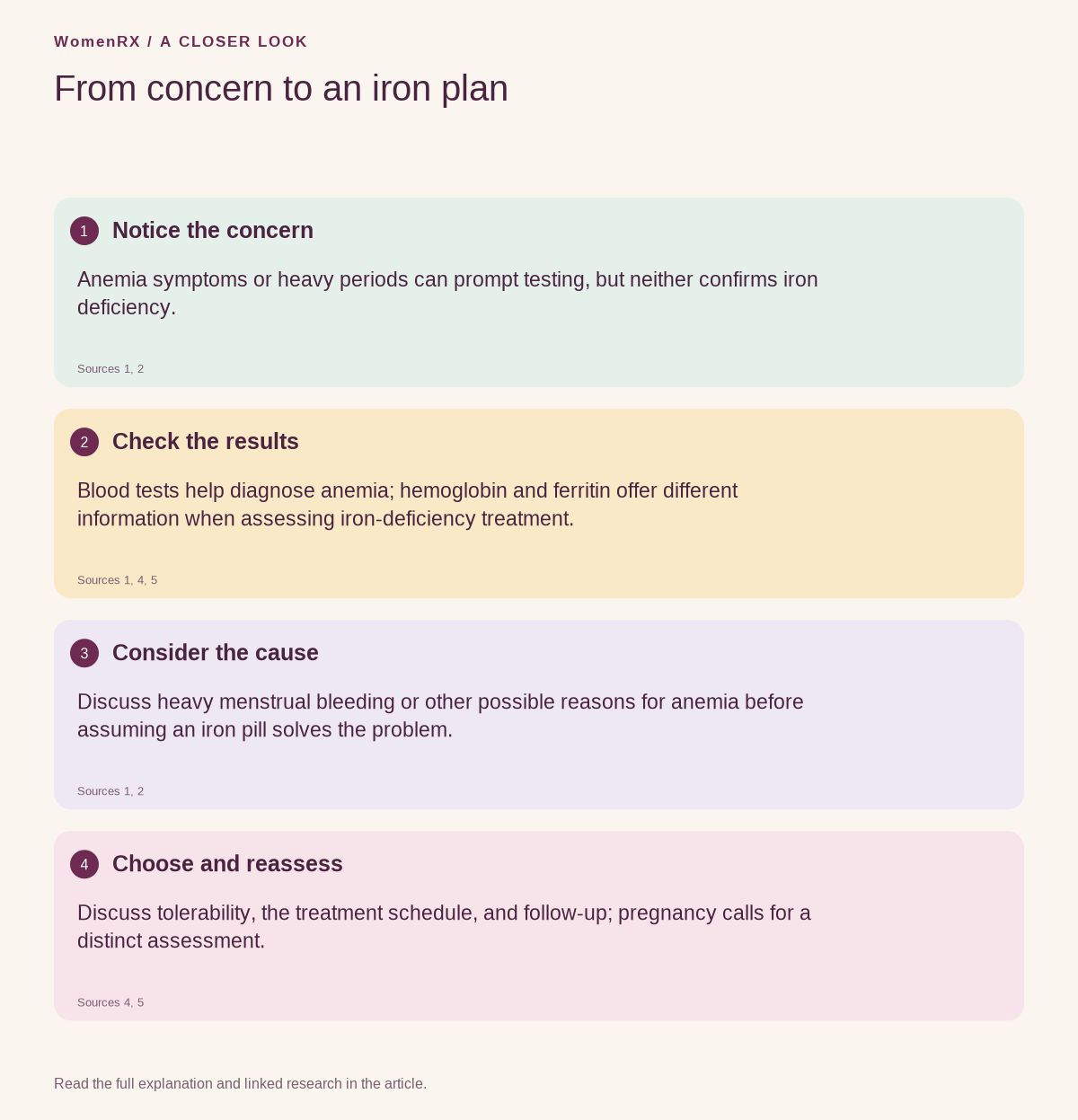
From concern to an iron plan
Notice the concern: Anemia symptoms or heavy periods can prompt testing, but neither confirms iron deficiency.12
Check the results: Blood tests help diagnose anemia; hemoglobin and ferritin offer different information when assessing iron-deficiency treatment.145
Consider the cause: Discuss heavy menstrual bleeding or other possible reasons for anemia before assuming an iron pill solves the problem.12
Choose and reassess: Discuss tolerability, the treatment schedule, and follow-up; pregnancy calls for a distinct assessment.45
Read the figure as text
The steps that make a supplement choice more useful than a pill ranking.- Notice the concern: Anemia symptoms or heavy periods can prompt testing, but neither confirms iron deficiency.12
- Check the results: Blood tests help diagnose anemia; hemoglobin and ferritin offer different information when assessing iron-deficiency treatment.145
- Consider the cause: Discuss heavy menstrual bleeding or other possible reasons for anemia before assuming an iron pill solves the problem.12
- Choose and reassess: Discuss tolerability, the treatment schedule, and follow-up; pregnancy calls for a distinct assessment.45
More questions, answered
Can heavy periods be a reason to ask about iron testing?
Yes. Heavy periods can contribute to anemia, though they don’t prove iron deficiency. If bleeding is very heavy or has changed substantially, raise that change alongside the question of blood tests. 1 2
Sources you can check
- Anemia | MedlinePlusAccessed 2026-09-25Return to first citation
- Menstruation | Period | MedlinePlusAccessed 2026-09-25Return to first citation
- Side effects of ferrous sulfate - NHSAccessed 2026-09-25Return to first citation
- Intravenous and Oral Iron Strategies for Iron-Deficiency Anemia in Pregnancy: A Systematic Review of Randomized Controlled Trials From a Hematology Perspective.Guerra Toro HI, Jaramillo AP, Pazmino G, Caceres VM. · Cureus · 2026Return to first citation
- The effect of oral ferrous sulfate use in different posology on laboratory values and clinical findings related to iron metabolism in anemia due to iron deficiency.Yüksel M, Aydoğan M, Doğan Ö, Yüksel MK. · Medicine · 2025Return to first citation