Can You Take Glycine Long Term? What the Studies Cover
A few nights, a few months and years of daily use are different questions. Here is what the human research can tell you.
Human glycine studies do not establish a daily dose proven safe for years of routine use. A systematic review found that studies in healthy adults lasted up to 14 days; studies in clinical populations lasted up to four months. 14 Those time frames help explain why a sleep-study dose is not a long-term safety guarantee.
Start with what “long term” means to you
If glycine has become part of your bedtime routine, the useful question is not just how many grams are in a scoop. It is how long you expect to take it, what you hope it will change, and what evidence matches that use.
A systematic review searched four research databases through April 2022 and included 50 human studies. Healthy-adult studies lasted from a single administration to 14 days; studies involving health conditions lasted up to four months. Two studies included both types of participants, so the population counts overlap. The review excluded interventions combining glycine with another compound. 14
A result for a specific illness does not automatically describe daily use by an otherwise healthy woman. Likewise, results from a combination product cannot identify what glycine contributed on its own. Keep population, formulation and duration together when comparing a claim with a study.
A bedtime amount is a study detail
One small crossover experiment analyzed seven men after three nights of restricted sleep. They received 3 g of glycine or placebo before bedtime. Some next-day fatigue and performance measures improved, but the fatigue finding was not consistent across the first and third days. This was a brief sleep-restriction experiment, not a months-long safety study in women. 11
That distinction changes how to read a product recommendation. “Used in a sleep study” identifies a tested situation. It does not mean the same amount is established for every sleep problem or for indefinite use.
A separate acute study tested 9 g and reported digestive symptoms but no serious acute adverse events. The abstract does not provide a long-term side-effect rate. Taking a larger single amount without a serious event is not a substitute for studying repeated use. 12
What to do with an established routine
Before automatically buying another container, write down three things: the grams you actually take, how long you have taken them, and the change you can point to. “I hoped it would help me feel better” is harder to evaluate than a particular sleep or daytime concern.
Check whether the product is glycine alone or a blend. If it contains other active ingredients, keep their names and amounts with your notes. Products sold under similar descriptions can differ from the preparations used in studies. 13
If you develop side effects, stop the supplement and contact your clinician or pharmacist. That is general supplement guidance, not evidence that glycine caused a particular symptom. Mention other medicines and supplements so the actual combination can be assessed. 13
Pregnancy and breastfeeding need their own answer
Neither the seven-man sleep experiment nor the acute-dose study provides a pregnancy or breastfeeding dose. General supplement guidance also warns that many products have not been tested in these groups. A number borrowed from a sleep study does not close that gap. 111213
You do not need to turn a small early study into a permanent rule for yourself. The practical decision is whether there is a clear reason to keep taking the exact product, whether it is helping that reason, and what remains unknown about the duration you have in mind.
Put duration beside the dose
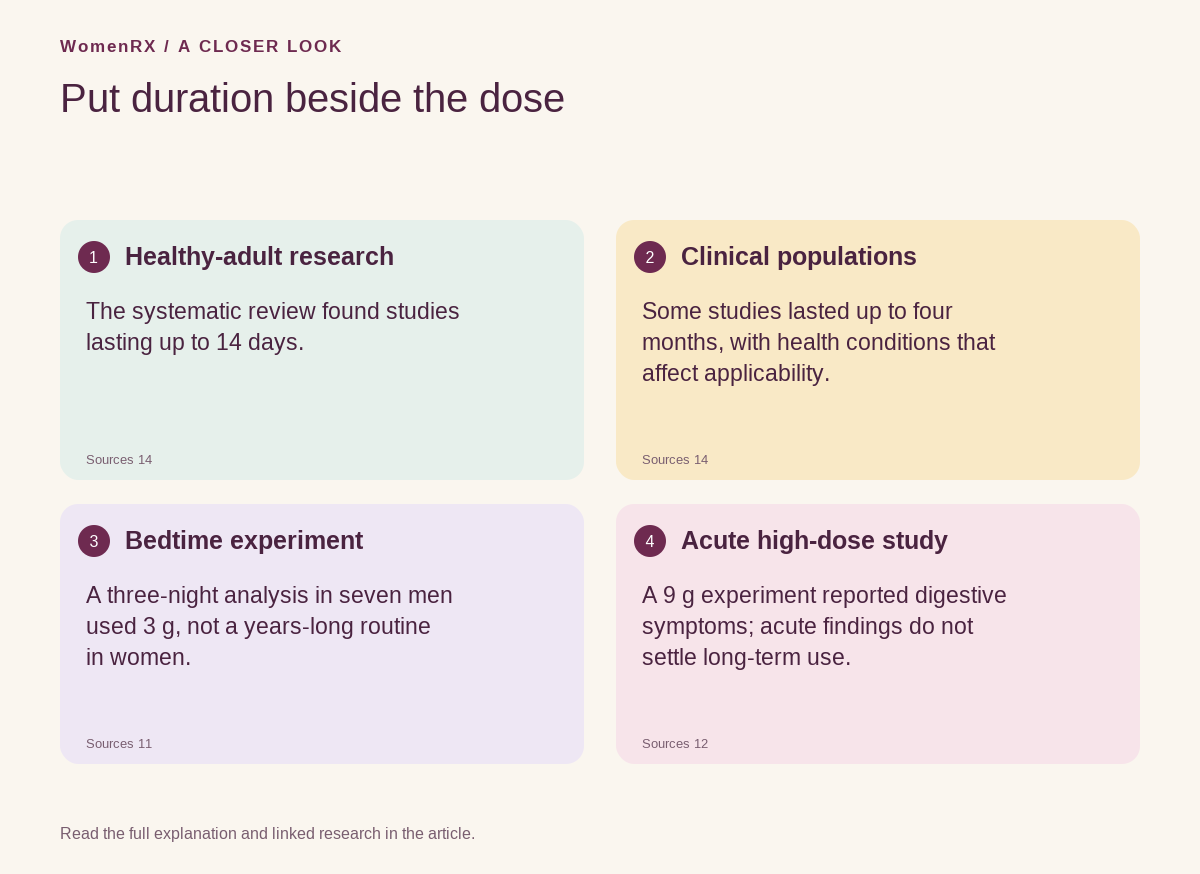
Healthy-adult research: The systematic review found studies lasting up to 14 days.14
Clinical populations: Some studies lasted up to four months, with health conditions that affect applicability.14
Bedtime experiment: A three-night analysis in seven men used 3 g, not a years-long routine in women.11
Acute high-dose study: A 9 g experiment reported digestive symptoms; acute findings do not settle long-term use.12
Read the figure as text
Different study lengths answer different questions.- Healthy-adult research: The systematic review found studies lasting up to 14 days.14
- Clinical populations: Some studies lasted up to four months, with health conditions that affect applicability.14
- Bedtime experiment: A three-night analysis in seven men used 3 g, not a years-long routine in women.11
- Acute high-dose study: A 9 g experiment reported digestive symptoms; acute findings do not settle long-term use.12
Sources you can check
- The Effects of Glycine on Subjective Daytime Performance in Partially Sleep-Restricted Healthy VolunteersAccessed 2026-09-26Return to first citation
- Assessment of Acute Adverse Events of Glycine Ingestion at a High Dose in Human Volunteers (2006)Accessed 2026-09-26Return to first citation
- NCCIH: Using Dietary Supplements WiselyAccessed 2026-09-26Return to first citation
- The effect of glycine administration on physiological systems in human adults: a systematic reviewAccessed 2026-09-26Return to first citation