Apple Cider Vinegar Every Day: What Safety Studies Show
An eight-week study found more tooth wear with a twice-daily vinegar drink, but the vinegar type was not specified. Short-term studies cannot establish the safety of years of daily apple cider vinegar use.
Short-term studies cannot establish whether daily apple cider vinegar use is safe over years. In one eight-week trial, healthy adults drinking diluted vinegar twice a day had an increase in measured tooth wear compared with a low-acid vinegar pill group; the vinegar type was not specified, so the result cannot be attributed specifically to apple cider vinegar.2 Using vinegar in food is a different exposure, but the short-term trials do not establish a safe long-term amount or answer general medicine-interaction questions.245
The clearest concern is repeated contact with teeth
Vinegar is acidic. In a randomized study of healthy adults, one group drank a mixture of two tablespoons of vinegar in a cup of water twice daily at mealtimes. A comparison group took a commercial vinegar pill containing much less acetic acid. After eight weeks, the drink group’s average dental erosion score had increased 18% from its own starting score; the pill group’s average score did not change. The vinegar type was not specified, so this finding cannot be attributed specifically to apple cider vinegar.2
That 18% describes a change in the group’s average score, not the percentage of people who developed damaged teeth. The study also doesn’t show whether a smaller drink, a different way of consuming vinegar, or longer use would produce the same result. But it does answer one practical question: diluting vinegar in water did not eliminate measurable tooth-wear risk in this twice-daily routine.2
If you’ve made vinegar drinks a habit and are concerned about your teeth, consider bringing it up at your next dental visit. Regular dental visits are part of standard oral care.1
A splash in food is not the routine that was tested
Apple cider vinegar is used as a flavoring in food. The daily-use studies examined more deliberate exposures, including measured amounts of liquid vinegar and capsules.345 A splash in a salad dressing is not interchangeable with a twice-daily drink, and a capsule is not automatically equivalent to either one. The tooth-wear trial’s pill comparison, for example, contained far less acetic acid than the drink. It cannot tell you that capsules in general are safer, or that every way of using vinegar in food carries no risk.2
Amount and duration matter, but there’s no established harm threshold in these studies. The useful distinction is between enjoying vinegar as an ingredient and taking it regularly with a health goal in mind. The latter deserves a closer look at what benefit you expect, what form you’re using, and what has actually been tested.
Short metabolic trials don’t settle long-term safety
An eight-week randomized trial in adults with type 2 diabetes compared 30 mL of apple cider vinegar daily plus healthy-diet advice with the same diet advice alone. It reported differences in some blood-sugar and cholesterol measures. It was a study of metabolic outcomes over eight weeks, not proof that taking vinegar for years is safe or that it can replace diabetes treatment.3
A systematic review of randomized trials likewise examined blood-sugar and lipid measures, not long-term adverse effects as its central question. Its adult studies did not establish a women-specific safety result.4 More recently, a 12-week trial tested apple cider vinegar capsules against placebo in women with polycystic ovary syndrome who were receiving metformin. Its findings apply to that particular group and short period; they don’t establish the safety of routine capsules for everyone.5 Mild gastrointestinal discomfort or intolerance has been reported with apple cider vinegar use in some people, though the available information does not establish how often it occurs with daily use.5
What if you take medicine or have another health condition?
Don’t read the metformin trial as an interaction test. Both groups were receiving metformin, so the trial can compare outcomes with and without the added capsules in that setting. It cannot rule out interactions with other medicines or with different vinegar products.5 The eight-week liquid-vinegar trial excluded people using insulin, as well as those with reflux or gastric ulcers. It therefore cannot answer how well that routine would be tolerated in those groups.3
Pregnant and breastfeeding people were also excluded from that liquid-vinegar trial.3 That exclusion is a limit on what the trial can tell us, not evidence that ordinary food use is harmful. If you’re considering daily vinegar specifically to change your blood sugar while taking medication, the meaningful next move is to discuss that plan with the person managing your treatment rather than adjusting medicine based on vinegar research. The studies measured possible benefits over weeks; they did not establish a long-term safety plan or verified medicine-interaction guidance.345
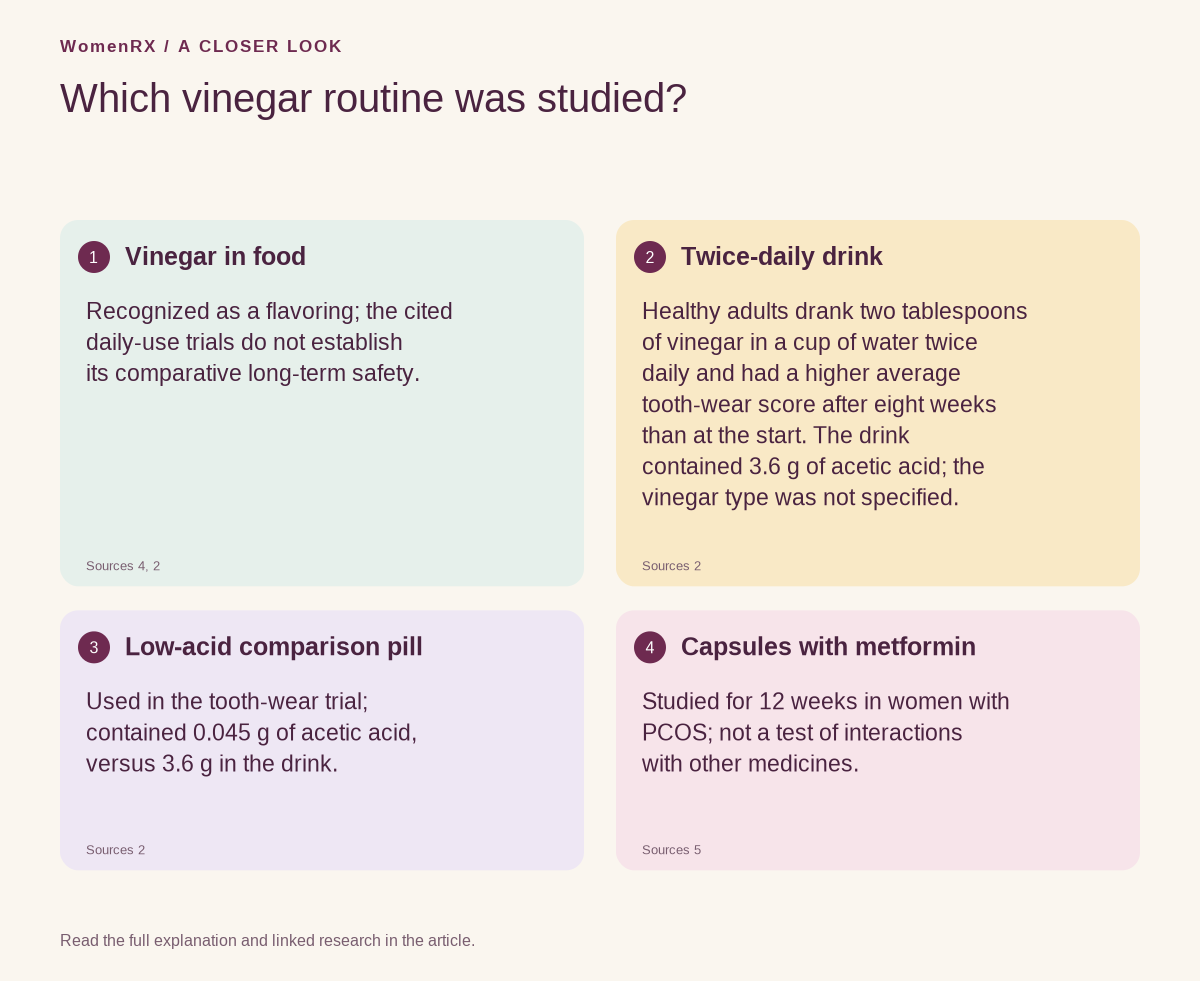
Which vinegar routine was studied?
Vinegar in food: Recognized as a flavoring; the cited daily-use trials do not establish its comparative long-term safety.42
Twice-daily drink: Healthy adults drank two tablespoons of vinegar in a cup of water twice daily and had a higher average tooth-wear score after eight weeks than at the start. The drink contained 3.6 g of acetic acid; the vinegar type was not specified.2
Low-acid comparison pill: Used in the tooth-wear trial; contained 0.045 g of acetic acid, versus 3.6 g in the drink.2
Capsules with metformin: Studied for 12 weeks in women with PCOS; not a test of interactions with other medicines.5
Read the figure as text
Form and frequency change what each study can tell you about daily use.- Vinegar in food: Recognized as a flavoring; the cited daily-use trials do not establish its comparative long-term safety.42
- Twice-daily drink: Healthy adults drank two tablespoons of vinegar in a cup of water twice daily and had a higher average tooth-wear score after eight weeks than at the start. The drink contained 3.6 g of acetic acid; the vinegar type was not specified.2
- Low-acid comparison pill: Used in the tooth-wear trial; contained 0.045 g of acetic acid, versus 3.6 g in the drink.2
- Capsules with metformin: Studied for 12 weeks in women with PCOS; not a test of interactions with other medicines.5
Sources you can check
- Dental Health: MedlinePlusAccessed 2026-09-25Return to first citation
- Evidence That Daily Vinegar Ingestion May Contribute to Erosive Tooth Wear in Adults.Anderson S, Gonzalez LA, Jasbi P, Johnston CS. · Journal of medicinal food · 2021Return to first citation
- The improvement effect of apple cider vinegar as a functional food on anthropometric indices, blood glucose and lipid profile in diabetic patients: a randomized controlled clinical trial.Jafarirad S, Elahi MR, Mansoori A, Khanzadeh A, Haghighizadeh MH. · Frontiers in clinical diabetes and healthcare · 2023Return to first citation
- The effect of apple cider vinegar on lipid profiles and glycemic parameters: a systematic review and meta-analysis of randomized clinical trials.Hadi A, Pourmasoumi M, Najafgholizadeh A, Clark CCT, Esmaillzadeh A. · BMC complementary medicine and therapies · 2021Return to first citation
- Adjunctive effects of apple cider vinegar on metabolic syndrome and insulin resistance in polycystic ovary syndrome patients receiving metformin: a randomized clinical trial.Najafi A, Jahanian Sadatmahalleh S, Moini A, Nasiri M, Hajimoosayi F. · Scientific reports · 2026Return to first citation