Apple Cider Vinegar: Is There a Useful Daily Amount?
One diabetes trial tested 30 mL a day, but that finding doesn’t establish a daily amount for everyone.
These studies do not establish a general daily amount of apple cider vinegar for blood sugar, weight, or digestion. In one eight-week trial involving adults with type 2 diabetes, 30 mL a day was linked to a greater reduction in A1C than the control group, but that’s a tested amount, not a general recommendation. A small study also found that vinegar slowed stomach emptying further in people who already had diabetic gastroparesis.23
What the blood-sugar trial actually tested
The most useful number here is 30 mL per day, because that’s the amount tested for eight weeks in a randomized trial of adults with type 2 diabetes. Both groups received the same healthy-diet advice; one group also consumed apple cider vinegar. A1C fell more in the vinegar group than in the control group. Fasting blood glucose fell in both groups, but the reported analysis found a statistically significant drop only within the vinegar group. That within-group result alone doesn’t show how much vinegar helped compared with the control group.2
A1C reflects average blood glucose over about three months. An eight-week A1C finding is worth studying further, but it doesn’t tell you whether taking vinegar for months or years improves diabetes outcomes. The same trial also reported an increase in its insulin-resistance measure in the vinegar group, so its results aren’t a simple story of improved insulin sensitivity.12
If you use vinegar in a dressing, you’re using a food ingredient, not following a proven blood-sugar regimen. And a gummy or capsule isn’t automatically equivalent to the liquid vinegar tested in these studies. The trial amount describes what researchers gave participants; it isn’t a target you need to reach.2
For digestion, slower isn’t necessarily better
Vinegar is sometimes promoted as a digestive aid, but the directly relevant study here points to a situation where slower digestion could be unwelcome. In a pilot study, 10 people with type 1 diabetes and gastroparesis, a condition involving delayed stomach emptying, drank 30 mL of apple cider vinegar mixed with 200 mL of water before breakfast for two weeks. After a test meal, the median gastric emptying rate was 17% with vinegar versus 27% without it. The study was small, and the order of the two conditions wasn’t randomized.3
That finding doesn’t mean vinegar will cause gastroparesis in someone who doesn’t have it. It does mean that a person who already has delayed stomach emptying shouldn’t assume vinegar will settle her digestion. For someone managing type 1 diabetes, a change in how quickly food leaves the stomach may also complicate the match between food and insulin, as the pilot study’s authors noted.3
What about weight, teeth, reflux, and medicines?
The blood-sugar result doesn’t answer whether apple cider vinegar affects weight. The reported results from that trial don’t give a usable weight outcome or establish an amount to take for weight. If weight is your main reason for considering a daily supplement, this trial doesn’t give you a weight-related amount to choose.2
Nor do these reported findings measure tooth-enamel damage or show whether vinegar aggravates reflux. The vinegar used in the gastroparesis pilot was acidic (pH 2.8-3). Mixing it with water was part of the study, not a tested way to protect teeth. If enamel is a concern, skipping a daily vinegar drink avoids adding repeated exposure to that acidic beverage; these studies cannot identify a tooth-safe dilution.3 If you have reflux or a gastric ulcer, the eight-week diabetes trial offers no reassurance about a daily drink: it excluded people with those conditions. If drinking vinegar worsens your symptoms, don’t continue it as a health routine.2
The diabetes trial included adults who managed type 2 diabetes with diet and/or glucose-lowering medicine, but its reported results don’t identify a safe vinegar routine for each medicine. Low blood glucose can occur in people taking certain diabetes medicines, and it can be dangerous. If you take one, a change you’re making specifically to influence blood sugar is worth discussing with the person who helps manage your diabetes, rather than treating vinegar as a substitute for your usual care.12
Finally, the eight-week trial excluded people who were pregnant or lactating. It doesn’t establish a daily supplemental amount for pregnancy or breastfeeding, and it doesn’t show a women-specific benefit at other life stages.2
The practical distinction is simple: vinegar can be an ingredient you enjoy in food, while a daily drink or supplement is a deliberate health routine. The human findings give a reason to investigate blood sugar further and a specific caution for existing gastroparesis. These two studies don’t establish a general daily amount for blood sugar, weight, or digestion.23
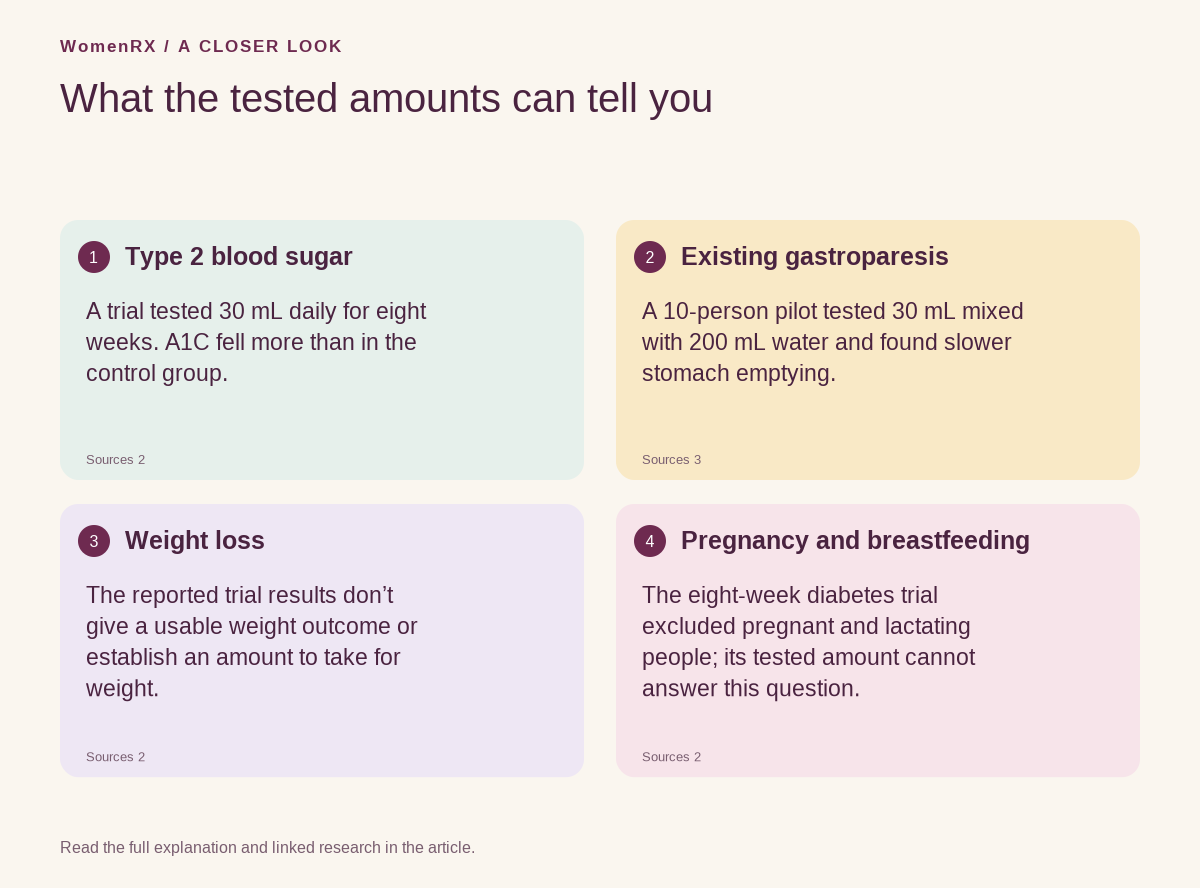
What the tested amounts can tell you
Type 2 blood sugar: A trial tested 30 mL daily for eight weeks. A1C fell more than in the control group.2
Existing gastroparesis: A 10-person pilot tested 30 mL mixed with 200 mL water and found slower stomach emptying.3
Weight loss: The reported trial results don’t give a usable weight outcome or establish an amount to take for weight.2
Pregnancy and breastfeeding: The eight-week diabetes trial excluded pregnant and lactating people; its tested amount cannot answer this question.2
Read the figure as text
The same 30 mL amount appeared in two different studies, but the participants, purposes, and conclusions were different. Neither study sets a general daily amount.- Type 2 blood sugar: A trial tested 30 mL daily for eight weeks. A1C fell more than in the control group.2
- Existing gastroparesis: A 10-person pilot tested 30 mL mixed with 200 mL water and found slower stomach emptying.3
- Weight loss: The reported trial results don’t give a usable weight outcome or establish an amount to take for weight.2
- Pregnancy and breastfeeding: The eight-week diabetes trial excluded pregnant and lactating people; its tested amount cannot answer this question.2
Sources you can check
- Blood Glucose | Blood Sugar | Diabetes | MedlinePlusAccessed 2026-09-25Return to first citation
- The improvement effect of apple cider vinegar as a functional food on anthropometric indices, blood glucose and lipid profile in diabetic patients: a randomized controlled clinical trial.Jafarirad S, Elahi MR, Mansoori A, Khanzadeh A, Haghighizadeh MH. · Frontiers in clinical diabetes and healthcare · 2023Return to first citation
- Effect of apple cider vinegar on delayed gastric emptying in patients with type 1 diabetes mellitus: a pilot study.Hlebowicz J, Darwiche G, Björgell O, Almér LO. · BMC gastroenterology · 2007Return to first citation