Apple Cider Vinegar: What Outcomes Were Measured, and When?
The relevant trials checked blood sugar or metabolic measures after weeks, not on a schedule that can tell you when vinegar should start working.
These two trials do not establish a dependable “works in X days” timeline for apple cider vinegar. One randomized trial in adults with type 2 diabetes measured fasting glucose and A1C before and after eight weeks; a separate trial in women with PCOS and metabolic syndrome measured outcomes after 12 weeks while participants also took metformin. The studies don’t establish a reliable time to weight loss or show that a particular vinegar component caused an effect. 2 3
The clock in a study is not an onset time
A trial that measures an outcome at eight or 12 weeks can tell you what researchers checked at the end of that period. It can’t tell you the exact day a change began, whether it lasted, or what would happen with a different product or routine. In these two apple cider vinegar (ACV) trials, outcomes were assessed after weeks of use, not on a schedule that establishes when a change starts. 2 3
It also matters what was measured. A fasting blood glucose test, an A1C test, a weight measurement, and a short-term reading after a meal are different outcomes. A result on one doesn’t automatically mean the others changed too.
What the trials measured
In a randomized trial involving adults with type 2 diabetes, participants assigned to ACV used 30 mL daily. Researchers measured fasting glucose, insulin, A1C, insulin resistance, and blood fats before and after eight weeks. Fasting glucose decreased in both the ACV and control groups, though the within-group decrease was statistically significant only in the ACV group. The trial also found a difference between groups in A1C after eight weeks. A statistical difference doesn’t, by itself, predict how much an individual’s A1C might change. 3
A separate randomized trial studied 94 women with PCOS, insulin resistance, and metabolic syndrome. Participants received either ACV capsules or placebo for 12 weeks, and both groups were also receiving metformin. The trial reported a higher rate of metabolic-syndrome resolution in the ACV group, along with changes in insulin resistance and other outcomes. That’s a finding in a specific group receiving an additional treatment, not evidence that vinegar alone has the same effect for everyone. 2
These studies measured outcomes at the end of their treatment periods. They don’t establish a reliable day-by-day timeline for a post-meal glucose reading, and they don’t show that weight loss should happen by a particular date.
Vinegar, acetic acid, and the tested regimen aren’t interchangeable
ACV contains acetic acid, but a study of ACV doesn’t isolate acetic acid’s effect from the rest of the vinegar or from the way it was taken. The diabetes trial used liquid vinegar; the PCOS trial used capsules. Their results therefore aren’t a direct comparison of liquid versus capsules, or proof that acetic acid by itself explains any reported outcome. 2 3
That distinction matters if you’re comparing a study with a product on a shelf. These studies tested particular forms and routines. They don’t show that every vinegar, capsule, or supplement has the same composition or effect.
What about weight?
The two trials above don’t provide a clear, consistent basis for estimating when ACV causes weight loss. The diabetes trial measured blood sugar and blood fats, but its reported findings don’t establish a weight-loss timeline. The PCOS trial measured anthropometric outcomes, but its reported findings don’t establish a general weight-loss timeline either. 2 3
So if your main goal is weight change, don’t treat a few weeks of use as a test with a guaranteed result. Weight can be affected by many factors, and scale weight itself includes more than body fat. 1
What this means if you’re checking blood sugar
The eight-week trial examined ACV as a dietary intervention; it did not establish that ACV can replace diabetes treatment. Its end-of-study result also can’t tell you what to expect from a particular glucose reading. 3
For women, the PCOS trial is directly relevant to a narrow group: participants had PCOS, insulin resistance, and metabolic syndrome, and ACV was added to metformin. It can’t tell us whether the same result applies to women without those conditions. The diabetes results described here aren’t broken out by sex. The results discussed here do not establish pregnancy-related safety. 2 3
The most useful takeaway is simple: these trials assessed outcomes after eight or 12 weeks, but neither gives a reliable personal “time to work.” They also don’t settle whether ACV produces meaningful weight loss or how quickly a short-term glucose measure might change.
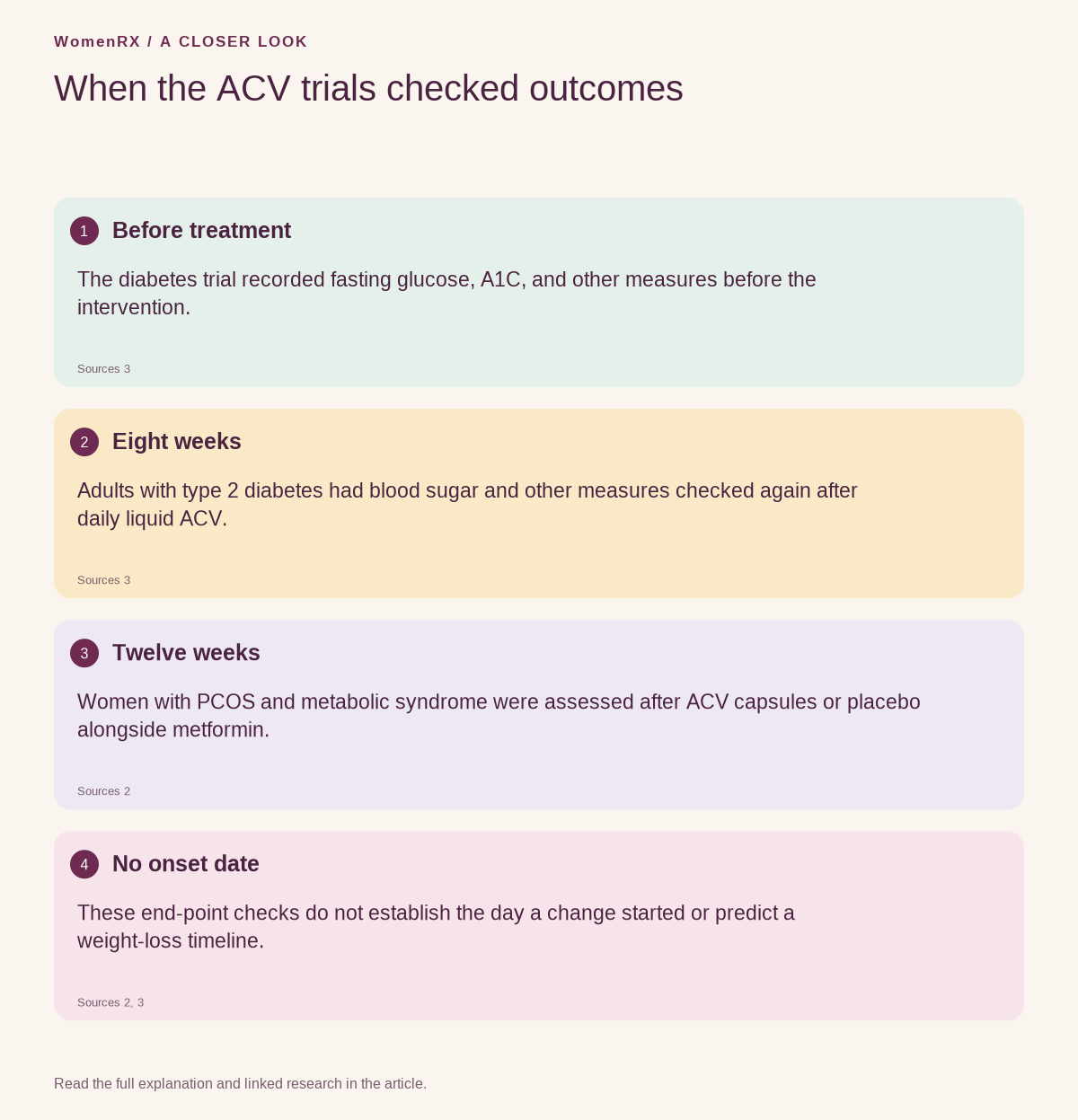
When the ACV trials checked outcomes
Before treatment: The diabetes trial recorded fasting glucose, A1C, and other measures before the intervention.3
Eight weeks: Adults with type 2 diabetes had blood sugar and other measures checked again after daily liquid ACV.3
Twelve weeks: Women with PCOS and metabolic syndrome were assessed after ACV capsules or placebo alongside metformin.2
No onset date: These end-point checks do not establish the day a change started or predict a weight-loss timeline.23
Read the figure as text
These are the reported end-of-treatment measurement points, not proven times when an effect begins.- Before treatment: The diabetes trial recorded fasting glucose, A1C, and other measures before the intervention.3
- Eight weeks: Adults with type 2 diabetes had blood sugar and other measures checked again after daily liquid ACV.3
- Twelve weeks: Women with PCOS and metabolic syndrome were assessed after ACV capsules or placebo alongside metformin.2
- No onset date: These end-point checks do not establish the day a change started or predict a weight-loss timeline.23
More questions, answered
Does a study of apple cider vinegar prove acetic acid is what caused the result?
No. The diabetes trial tested apple cider vinegar as a whole, and the PCOS trial tested ACV capsules. Neither isolates acetic acid from other components or compares it directly with vinegar-free acetic acid. 2 3
Sources you can check
- Body Weight: MedlinePlusAccessed 2026-09-25Return to first citation
- Adjunctive effects of apple cider vinegar on metabolic syndrome and insulin resistance in polycystic ovary syndrome patients receiving metformin: a randomized clinical trial.Najafi A, Jahanian Sadatmahalleh S, Moini A, Nasiri M, Hajimoosayi F. · Scientific reports · 2026Return to first citation
- The improvement effect of apple cider vinegar as a functional food on anthropometric indices, blood glucose and lipid profile in diabetic patients: a randomized controlled clinical trial.Jafarirad S, Elahi MR, Mansoori A, Khanzadeh A, Haghighizadeh MH. · Frontiers in clinical diabetes and healthcare · 2023Return to first citation