Taking CoQ10 for Months? Check the Evidence and Your Medicines
Short studies offer some reassurance about CoQ10, but they can’t settle questions about years of use or every medicine combination.
CoQ10 has been studied for weeks to a few months in particular conditions, not established as safe for years of general use. Reported side effects include stomach upset, nausea, diarrhea, and rash, though their frequency is unclear. If you take warfarin, review CoQ10 with your anticoagulation prescriber or pharmacist before starting, stopping, or changing it: the interaction findings are limited and don’t give a clear answer for everyone. 147
What has actually been studied?
The length of a study matters when you’re deciding whether to keep taking something. A review of supplement trials in people with multiple sclerosis found only one CoQ10 trial and called for better-powered, long-term research. It cannot tell you that a CoQ10 product taken for general wellness is safe to use indefinitely. 1
One study followed CoQ10 use for three months: a small pilot trial in children with juvenile idiopathic arthritis. Participants received CoQ10 or placebo alongside standard treatment, and the researchers reported minor side effects. That’s information about an add-on in a specific condition, not a safety finding that transfers to adults taking CoQ10 for years. 5
A review focused on infertility treatments listed stomach upset, reduced appetite, nausea, diarrhea, and skin rash among reported CoQ10 effects. It also noted that the frequency of these effects wasn’t clearly established. If a symptom appeared after you started CoQ10, its timing is worth including in a review of your medicines rather than assuming it’s unrelated. 7
Why warfarin deserves a closer look
Warfarin is the medicine combination to raise explicitly, even though the findings don’t point neatly in one direction. In a randomized crossover trial, 24 people on stable, long-term warfarin treatment received CoQ10, ginkgo, and placebo in separate four-week periods. INR was kept in the target range with warfarin adjustments, and average warfarin dose did not differ during the CoQ10 and placebo periods. The trial included 14 women and 10 men but did not report a separate result for women. Its size and duration leave room for an effect it could not detect. 4
A different study examined 79 people already experiencing above-target anticoagulation while taking vitamin K antagonists. It reported an association between CoQ10 use and bleeding complications in that selected group. Because it was not a trial of starting CoQ10, it cannot show that CoQ10 caused the bleeding or estimate what would happen to someone whose anticoagulation is stable. 3
Those results are not interchangeable: one tested a short period of CoQ10 use under monitored warfarin treatment; the other looked at people who already had an anticoagulation problem. Neither supports treating the combination as reliably harmless or assuming CoQ10 will cause bleeding. If you use warfarin, tell the person managing it about your exact CoQ10 product before you start, stop, or change the supplement. Don’t adjust prescribed treatment to accommodate CoQ10 on your own. 34
Other prescriptions and add-on use
CoQ10 has also appeared in studies alongside treatment for particular conditions. Being studied as an add-on does not mean it replaces that treatment or has been checked against every medicine you might take. 56
In a New Zealand analysis of supplement and medicine use, researchers flagged potential interactions involving CoQ10. They cautioned that the clinical significance of many supplement-medicine interactions remained uncertain because the underlying reports were limited. The study does not provide a dependable list of CoQ10 combinations that are safe or unsafe for an individual. A pharmacist can check your actual medicine list and product rather than relying on the supplement name alone. 2
If pregnancy could be part of the picture
A retrospective study in women with PCOS looked at CoQ10 combined with a fertility medicine. It assessed fertility-treatment outcomes, not the safety of continuing CoQ10 during pregnancy or breastfeeding. A review of supplements used in infertility care likewise described safety information in that field as scarce. If you’re trying to conceive, pregnant, or breastfeeding, bring CoQ10 into the discussion about your treatment rather than extending findings from fertility studies to those different circumstances. 67
Make the review about your use, not CoQ10 in general
Bring the bottle or a clear label photo. Note the amount you take, how often, when you started, and what you hoped it would help with. Include prescriptions, over-the-counter medicines, and other supplements. These details distinguish, for example, a recent add-on to a treatment plan from a product you’ve taken for months without a clear reason to continue. They also give your pharmacist or prescriber a concrete question to answer: does this product, alongside these medicines, still make sense for you?
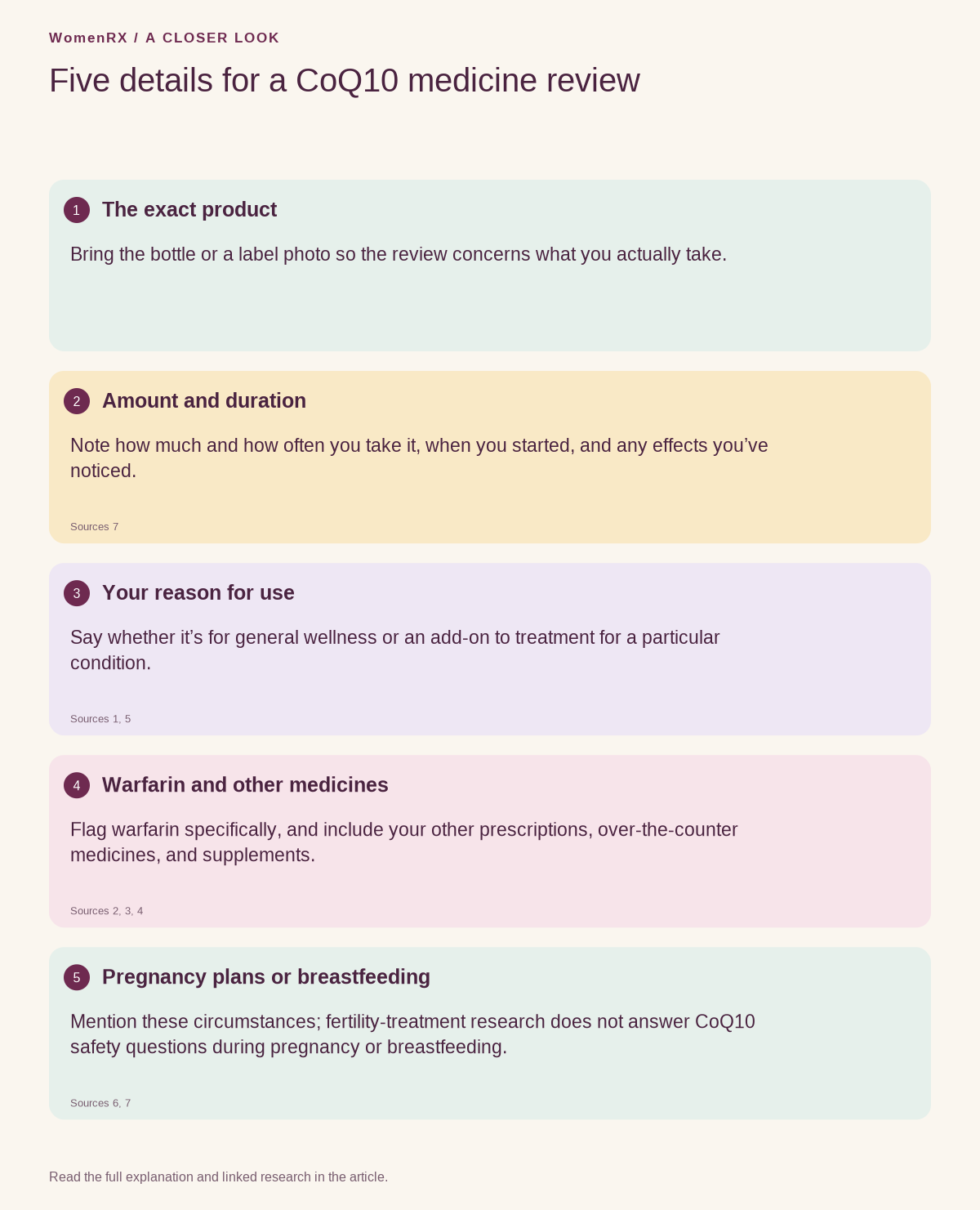
Five details for a CoQ10 medicine review
The exact product: Bring the bottle or a label photo so the review concerns what you actually take.
Amount and duration: Note how much and how often you take it, when you started, and any effects you’ve noticed.7
Your reason for use: Say whether it’s for general wellness or an add-on to treatment for a particular condition.15
Warfarin and other medicines: Flag warfarin specifically, and include your other prescriptions, over-the-counter medicines, and supplements.234
Pregnancy plans or breastfeeding: Mention these circumstances; fertility-treatment research does not answer CoQ10 safety questions during pregnancy or breastfeeding.67
Read the figure as text
Use the same details when speaking with a pharmacist or prescriber. This is a conversation guide, not a test of whether CoQ10 is safe.- The exact product: Bring the bottle or a label photo so the review concerns what you actually take.
- Amount and duration: Note how much and how often you take it, when you started, and any effects you’ve noticed.7
- Your reason for use: Say whether it’s for general wellness or an add-on to treatment for a particular condition.15
- Warfarin and other medicines: Flag warfarin specifically, and include your other prescriptions, over-the-counter medicines, and supplements.234
- Pregnancy plans or breastfeeding: Mention these circumstances; fertility-treatment research does not answer CoQ10 safety questions during pregnancy or breastfeeding.67
More questions, answered
Does a normal INR mean CoQ10 cannot affect my warfarin?
No. In the small crossover trial, INR was kept within the target range through warfarin adjustments, and average warfarin dose did not differ during four weeks of CoQ10 versus placebo. That finding is reassuring within the trial’s limits, not a guarantee for longer use or for every person. 4
Sources you can check
- The effect of emerging nutraceutical interventions for clinical and biological outcomes in multiple sclerosis: A systematic review.Marx W, Hockey M, McGuinness AJ, Lane M, Christodoulou J, van der Mei I, Berk M, Dean OM, Taylor B, Broadley S, Lechner-Scott J, Jacka FN, Lucas RM, Ponsonby AL, RELIEF Trial team. · Multiple sclerosis and related disorders · 2020Return to first citation
- Assessing Natural Health Product-Drug Interactions and Coding Feasibility: Analysis of a New Zealand General Population Dataset from an Online Market Research Panel.Lee EL, Ogle F, Nagra J, Ye SS, Harrison J, Barnes J. · Drug safety · 2026Return to first citation
- Effect of Some Risk Factors on Over-Anticoagulation Disorders and Bleeding in Patients Receiving Anticoagulant Therapy with Overdosage of Vitamin K Antagonist.Dung Chu S, Thi Tran M. · Vascular health and risk management · 2023Return to first citation
- [Effect of Coenzyme Q10 and Ginkgo biloba on warfarin dosage in patients on long-term warfarin treatment. A randomized, double-blind, placebo-controlled cross-over trial].Engelsen J, Nielsen JD, Hansen KF. · Ugeskrift for laeger · 2003Return to first citation
- Promising efficacy of coenzyme Q10 supplementation as adjunctive therapy in juvenile idiopathic arthritis: a randomized-controlled pilot study.Elsherif N, Shousha G, Sabri NA, Shawki MA. · Immunopharmacology and immunotoxicology · 2026Return to first citation
- Letrozole versus coenzyme Q10 plus Clomiphene citrate for women with Polycystic Ovarian Syndrome: An efficacy and safety analysis.Hou J, Chang Q. · Biomolecules & biomedicine · 2025Return to first citation
- Therapeutic Roles and Safety Profiles of Non-Vitamin Antioxidant Supplements in Female Infertility: A Narrative Review.Davoudi-Monfared E, Fotouk Kiaie SM, Ebrahimi M. · Journal of family & reproductive health · 2026Return to first citation