CoQ10 Side Effects and Medication Interactions to Check
CoQ10 can cause mild digestive upset or insomnia, and warfarin, insulin, and cancer treatment deserve a closer look before you start it.
CoQ10 may cause mild digestive upset or insomnia. It may also interact with warfarin or insulin and may not be compatible with some cancer treatments.8 Pregnancy and breastfeeding need a separate decision: adult safety findings don’t establish safety for you or your baby. If any of these situations applies, check the specific supplement and your treatment plan with the clinician or pharmacist involved before starting it.34
What counts as a CoQ10 side effect?
Mild digestive upset and insomnia may occur with CoQ10. Serious side effects have not been reported in the safety overview from the National Center for Complementary and Integrative Health (NCCIH), but that is not a guarantee that everyone can take it without problems.8
There’s also a useful distinction between a symptom reported during a study and one caused by the supplement. In a four-week trial of healthy adults, researchers recorded abdominal pain and soft stools but did not attribute those events to CoQ10.7 A review of heart-failure trials found the evidence on adverse events inconclusive.5 Neither finding gives a dependable personal risk estimate, especially if you take medicines or have a condition that wasn’t represented in a healthy-adult trial.
If a new symptom appears after you start CoQ10, its timing is worth noting. Timing alone can’t tell you whether CoQ10, another medicine, or something unrelated is responsible. The more consequential safety question may be what else you’re taking.
Three treatment situations worth checking first
Warfarin. NCCIH identifies a possible interaction between CoQ10 and warfarin, an anticoagulant. That makes this a medication-specific question, not a reason to stop your prescribed blood thinner. Before adding CoQ10, ask the clinician or pharmacist managing your warfarin how the supplement fits with your treatment.8
Insulin. NCCIH also identifies a possible interaction with insulin.8 There’s a reason to take the question seriously without assuming CoQ10 will cause low blood sugar: a review of trials in people with type 2 diabetes found possible reductions in glucose measures, but none of its included trials reported adverse events. It therefore cannot tell us how often low blood sugar or a medication interaction occurred.6 Insulin itself can cause low blood glucose.1 If you use it, ask how adding CoQ10 might affect the glucose plan you already follow rather than changing your insulin on your own.
Cancer treatment. NCCIH says CoQ10 may not be compatible with some types of cancer treatment.8 A small randomized trial in women receiving paclitaxel for breast cancer studied CoQ10 alongside that particular treatment; it does not establish compatibility with every cancer drug or treatment plan.4 Bring the exact supplement to your oncology team before taking it during treatment.
These cautions have different levels of detail behind them. They are reasons to check a specific combination, not proof that every person taking warfarin, insulin, or cancer treatment will have an adverse event.8
Pregnancy and breastfeeding aren’t covered by adult safety findings
A short trial in healthy adults cannot answer whether CoQ10 is safe in pregnancy or while breastfeeding. The paclitaxel trial, for example, excluded pregnant and breastfeeding women.74 That gap matters even if you’ve taken CoQ10 before without noticing a side effect.
If you’re pregnant or could become pregnant, discuss supplements before starting or stopping them; MedlinePlus includes supplements in its pregnancy-and-medicines guidance.3 If you’re breastfeeding, ask about CoQ10 specifically rather than assuming that a general adult safety finding applies to your baby. General breastfeeding guidance notes that substances taken by a nursing parent can sometimes pass into breast milk, but it does not establish whether CoQ10 does so or what effect it might have.2
The useful next move is a focused review: name the CoQ10 product you’re considering, the medicines or cancer treatment you receive, and whether you’re pregnant or breastfeeding. That gives the person overseeing your care a concrete question to answer without asking you to abandon a prescribed treatment.
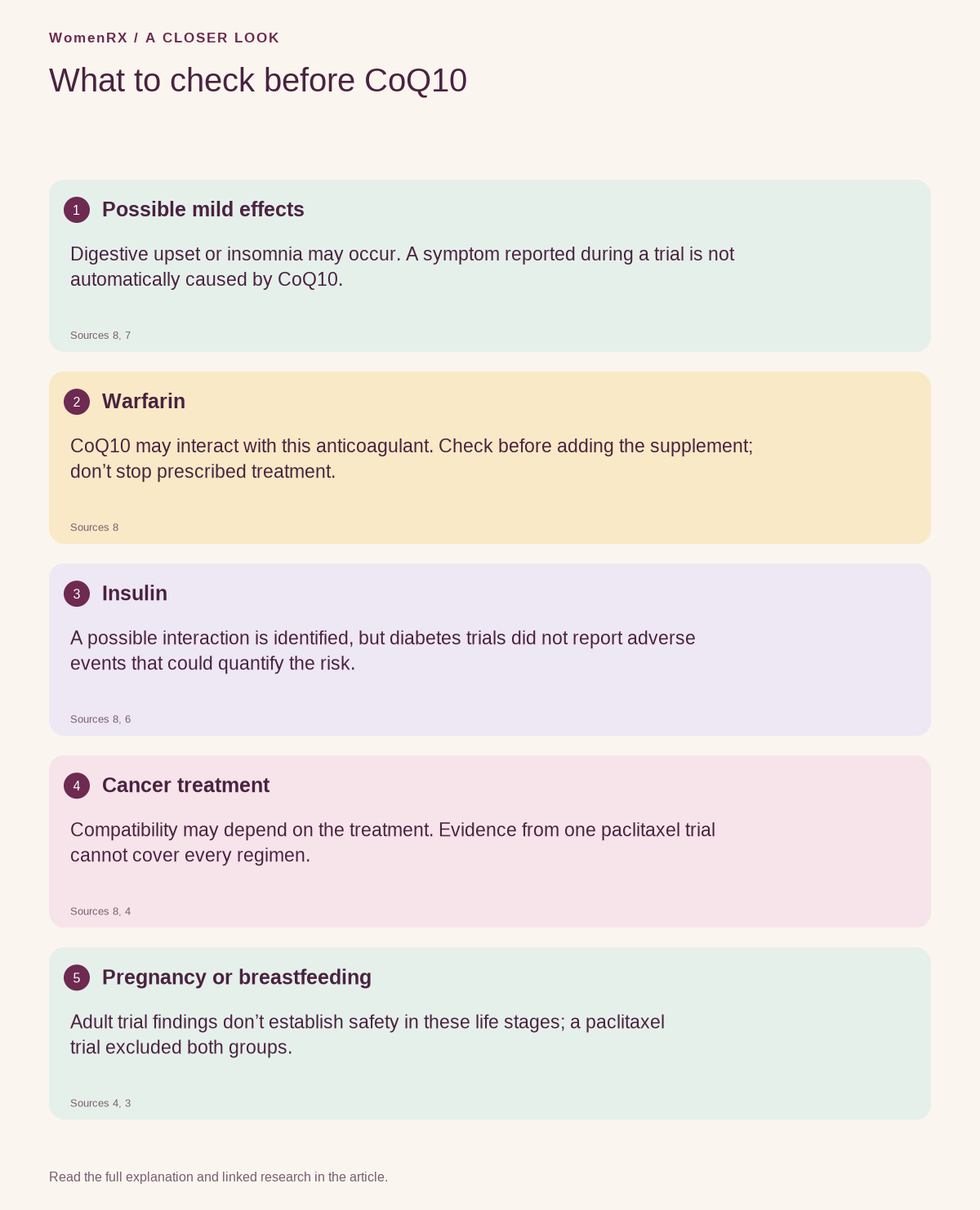
What to check before CoQ10
Possible mild effects: Digestive upset or insomnia may occur. A symptom reported during a trial is not automatically caused by CoQ10.87
Warfarin: CoQ10 may interact with this anticoagulant. Check before adding the supplement; don’t stop prescribed treatment.8
Insulin: A possible interaction is identified, but diabetes trials did not report adverse events that could quantify the risk.86
Cancer treatment: Compatibility may depend on the treatment. Evidence from one paclitaxel trial cannot cover every regimen.84
Pregnancy or breastfeeding: Adult trial findings don’t establish safety in these life stages; a paclitaxel trial excluded both groups.43
Read the figure as text
A focused safety review based on the treatment or life stage that applies to you, not a diagnostic score.- Possible mild effects: Digestive upset or insomnia may occur. A symptom reported during a trial is not automatically caused by CoQ10.87
- Warfarin: CoQ10 may interact with this anticoagulant. Check before adding the supplement; don’t stop prescribed treatment.8
- Insulin: A possible interaction is identified, but diabetes trials did not report adverse events that could quantify the risk.86
- Cancer treatment: Compatibility may depend on the treatment. Evidence from one paclitaxel trial cannot cover every regimen.84
- Pregnancy or breastfeeding: Adult trial findings don’t establish safety in these life stages; a paclitaxel trial excluded both groups.43
More questions, answered
Does taking a statin mean I need CoQ10?
No. Although CoQ10 is often discussed for statin-related muscle pain, NCCIH says the overall evidence does not support it as a way to reduce that pain. Don’t replace a prescribed statin with CoQ10 on that assumption.8
Sources you can check
- Hypoglycemia: MedlinePlusAccessed 2026-09-25Return to first citation
- Breastfeeding | Benefits of Breastfeeding | MedlinePlusAccessed 2026-09-25Return to first citation
- Pregnancy and Medicines | MedlinePlusAccessed 2026-09-25Return to first citation
- Coenzyme Q10 as an adjunctive strategy to reduce paclitaxel-induced toxicities in breast cancer: a randomized controlled trial.Hassoub G, El-Bassiouny NA, Abdelkader Y, Badawy AA, Kassem AB. · BMC pharmacology & toxicology · 2026Return to first citation
- Coenzyme Q10 for heart failure.Al Saadi T, Assaf Y, Farwati M, Turkmani K, Al-Mouakeh A, Shebli B, Khoja M, Essali A, Madmani ME. · The Cochrane database of systematic reviews · 2021Return to first citation
- Effectiveness of Coenzyme Q10 Supplementation for Type 2 Diabetes Mellitus: A Systematic Review and Meta-Analysis.Zhang SY, Yang KL, Zeng LT, Wu XH, Huang HY. · International journal of endocrinology · 2018Return to first citation
- Safety assessment of coenzyme Q10 (Kaneka Q10) in healthy subjects: a double-blind, randomized, placebo-controlled trial.Ikematsu H, Nakamura K, Harashima S, Fujii K, Fukutomi N. · Regulatory toxicology and pharmacology : RTP · 2006Return to first citation
- Coenzyme Q10 | NCCIHAccessed 2026-09-25Return to first citation