Can Magnesium Supplements Cause Flushing or Hot Flashes?
Flushing is reported with magnesium toxicity and some medical magnesium treatments, but that doesn’t establish that ordinary supplements cause menopausal hot flashes.
The connection depends on the kind of magnesium and the setting. Facial flushing is listed as a possible sign of magnesium toxicity, and flushing has been reported during magnesium sulfate treatment in medical care. Those findings don’t show that a typical oral supplement causes hot flashes. Check the product’s elemental magnesium amount, other ingredients, and the timing of your symptoms. 1 2
First, separate supplements from medical treatment
Magnesium supplements are taken by mouth, while magnesium sulfate may also be given as a supervised medical treatment. These are different situations. The NIH Office of Dietary Supplements lists facial flushing among possible signs of magnesium toxicity, but that doesn’t tell us how often flushing happens with routine oral supplement use. 1
Flushing has also been reported in studies of magnesium sulfate treatment for women with pre-eclampsia or eclampsia. A Cochrane review found low-certainty evidence from one trial that a shorter postpartum treatment regimen may reduce flushing compared with a 24-hour regimen. That finding concerns medical treatment after pregnancy, not menopause or everyday supplements. 2
So if warmth, redness, or sweating started after you began taking magnesium, the timing is worth reviewing. It doesn’t prove the supplement caused the episode, and these findings don’t establish that oral magnesium causes menopausal hot flashes.
Read the label as a whole
Start with the Supplement Facts panel. It lists elemental magnesium, not the total weight of the magnesium-containing compound. Note the amount and the form, such as citrate or oxide. Magnesium forms differ in how well they dissolve and are absorbed, but those differences don’t show that one form is more likely to cause flushing. 1
Then check the full ingredient list. Record other ingredients without assuming they caused the symptoms. The goal is to review the product you actually took, rather than attributing a reaction to magnesium based on the front label alone.
Also include other products that may contain magnesium. Some antacids and laxatives contain it, so a supplement may not be your only source. 1
Match the product to the episode
Write down when you took the product, when the warmth or sweating began, how long it lasted, and whether it happened again. Include the product name, magnesium form, elemental amount, and any other listed ingredients. This gives a pharmacist or clinician specific details to review, without treating timing as proof of cause.
If the product was prescribed or is part of a medical treatment, ask the prescriber what to do rather than changing that treatment on your own. If you have difficulty breathing or an irregular heartbeat along with flushing, seek urgent medical care; these are among the serious symptoms described in magnesium toxicity. 1
A useful review keeps three questions separate: Was the magnesium an oral supplement or a medical treatment? What did the full label list? And did the symptoms repeatedly follow taking it, or might the timing have been coincidental? That distinction matters especially during menopause, when a warm spell can’t be attributed to a supplement from timing alone.
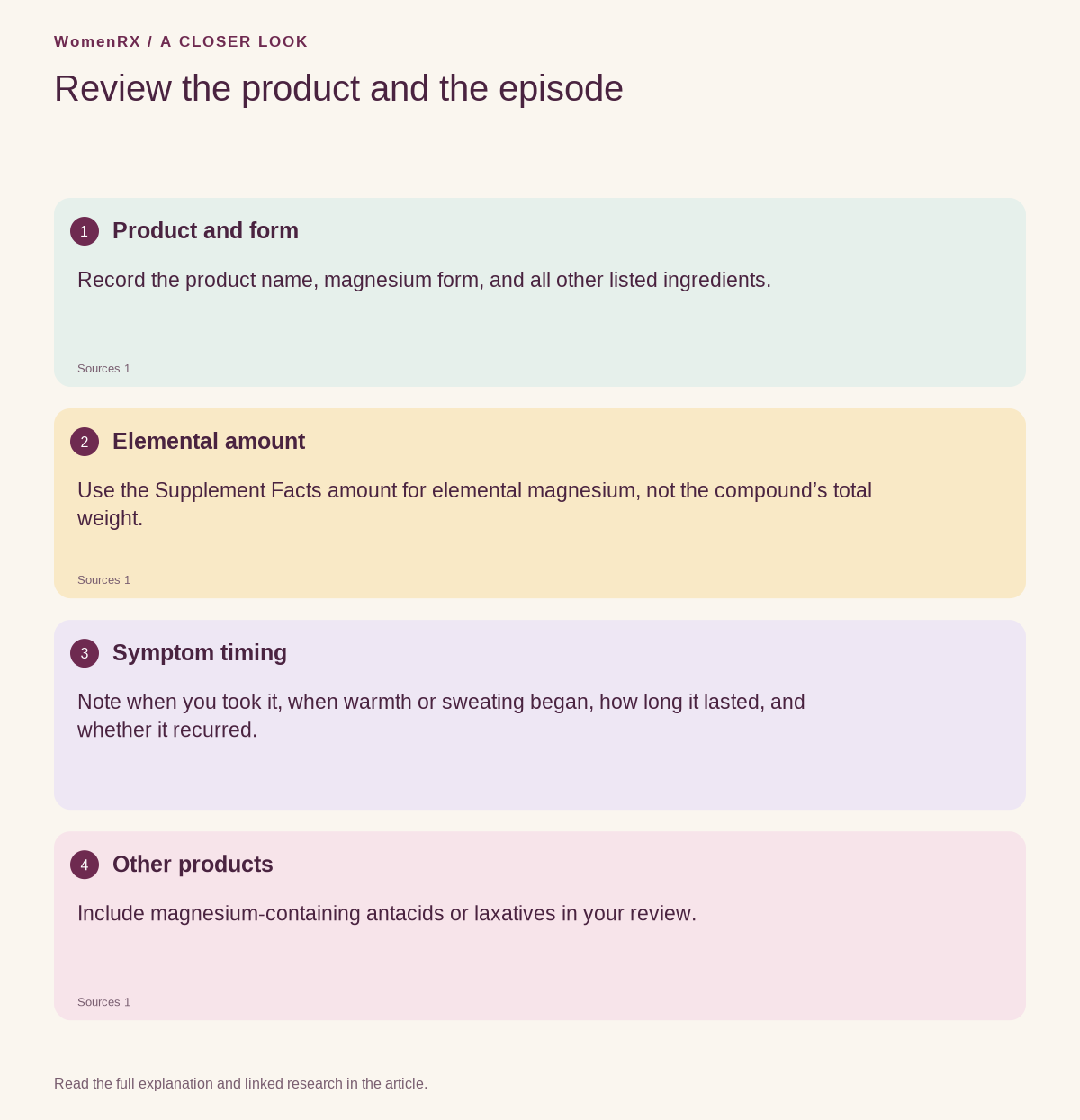
Review the product and the episode
Product and form: Record the product name, magnesium form, and all other listed ingredients.1
Elemental amount: Use the Supplement Facts amount for elemental magnesium, not the compound’s total weight.1
Symptom timing: Note when you took it, when warmth or sweating began, how long it lasted, and whether it recurred.
Other products: Include magnesium-containing antacids or laxatives in your review.1
Read the figure as text
Use these details to describe what you took and when symptoms occurred, without assuming that timing proves the cause.- Product and form: Record the product name, magnesium form, and all other listed ingredients.1
- Elemental amount: Use the Supplement Facts amount for elemental magnesium, not the compound’s total weight.1
- Symptom timing: Note when you took it, when warmth or sweating began, how long it lasted, and whether it recurred.
- Other products: Include magnesium-containing antacids or laxatives in your review.1
Sources you can check
- Magnesium - Health Professional Fact SheetAccessed 2026-09-25Return to first citation
- Alternative magnesium sulphate regimens for women with pre-eclampsia and eclampsia.Diaz V, Long Q, Oladapo OT. · The Cochrane database of systematic reviews · 2023Return to first citation