Can Fiber Supplements Help Bloating, or Make It Worse?
The effect depends partly on the fiber type and whether constipation or gas is driving your symptoms.
A fiber supplement may help if constipation is part of your bloating, but it can also add gas, especially if you increase fiber quickly or choose a highly fermentable type. Soluble fiber has evidence of benefit for some IBS symptoms, though findings about bloating aren’t specific to psyllium or a guarantee of relief. If you try a supplement, start low, increase slowly, and reassess. 1 3 4 5
First ask what your bowels are doing
Bloating often comes with constipation, but it can also happen with gas, diarrhea, IBS, food intolerance, or other conditions. 2 Fiber is more likely to be a useful experiment when stools are hard or infrequent, or you strain or feel you haven’t fully emptied. 5 6 If gas and distension are already your main problem, adding a fermentable fiber may make you feel worse. 4
Fiber can affect stool bulk and consistency, and some fibers form a gel that can help regulate stool. But “fiber” isn’t one uniform ingredient: its physical properties and how readily gut bacteria ferment it can change the effect. 3 4
The fiber type can change the tradeoff
Psyllium is a soluble fiber that is moderately fermentable. A review of fiber in IBS describes it as producing less gas than rapidly fermented fibers and reports benefits for overall IBS symptoms. Separately, a systematic review found that soluble fiber overall was associated with reduced bloating and improved stool consistency; those findings weren’t established specifically for psyllium. The systematic review notes variation in the studies and a need for more high-quality trials. 3 4
Highly fermentable fibers can produce gas more quickly. In people with IBS, rapid gas production may contribute to abdominal discomfort, distension, or flatulence. So if you notice that a fiber product increases gas or pressure, more fiber isn’t automatically better. 4
Partially hydrolyzed guar gum (PHGG) has been studied in people with constipation-predominant IBS. In one four-week study of 68 people, symptoms and bowel measures improved overall. The reported subgroup findings were mixed: bowel movement frequency improved in women, while bloating improvement was reported in men, people younger than 45, and those with BMI below 25. This small study doesn’t establish a general bloating benefit for women. 7
A cautious way to try a supplement
If constipation seems to be part of the picture, consider a soluble fiber rather than assuming any fiber product will do. Increase fiber gradually: a quick increase can trigger gas, bloating, and cramps, and a review of IBS fiber trials recommends starting low and increasing slowly. There’s no need to push through worsening discomfort. 1 4 5
Keep the test simple: note the product, whether stools are hard or infrequent, and whether bloating or gas changes as you introduce it. If symptoms worsen, pause the increase and reconsider whether that type of fiber suits your pattern. Review the result rather than continuing by default; fiber may have a role for some IBS symptoms, but it isn’t a stand-alone answer for every cause of bloating. 4 5
When bloating deserves a closer look
Bloating that is frequent, persistent, or not improving after dietary changes is worth discussing with a clinician. Don’t assume it’s just a reaction to fiber or a normal part of your cycle: bloating can have several causes, and some people do notice it around their period. Seek medical assessment especially if it comes with unintentional weight loss or blood in your stool. Bloating with vomiting, abdominal pain, diarrhea or constipation, or fever also warrants prompt attention. If your stomach is swollen and you have sudden, severe abdominal pain, seek emergency care. 2
The practical bottom line: a gradual trial of soluble fiber may make sense when constipation is part of your symptoms. If bloating is severe, persistent, or paired with concerning symptoms, investigate the cause instead of simply adding more fiber.
Fiber type and bloating
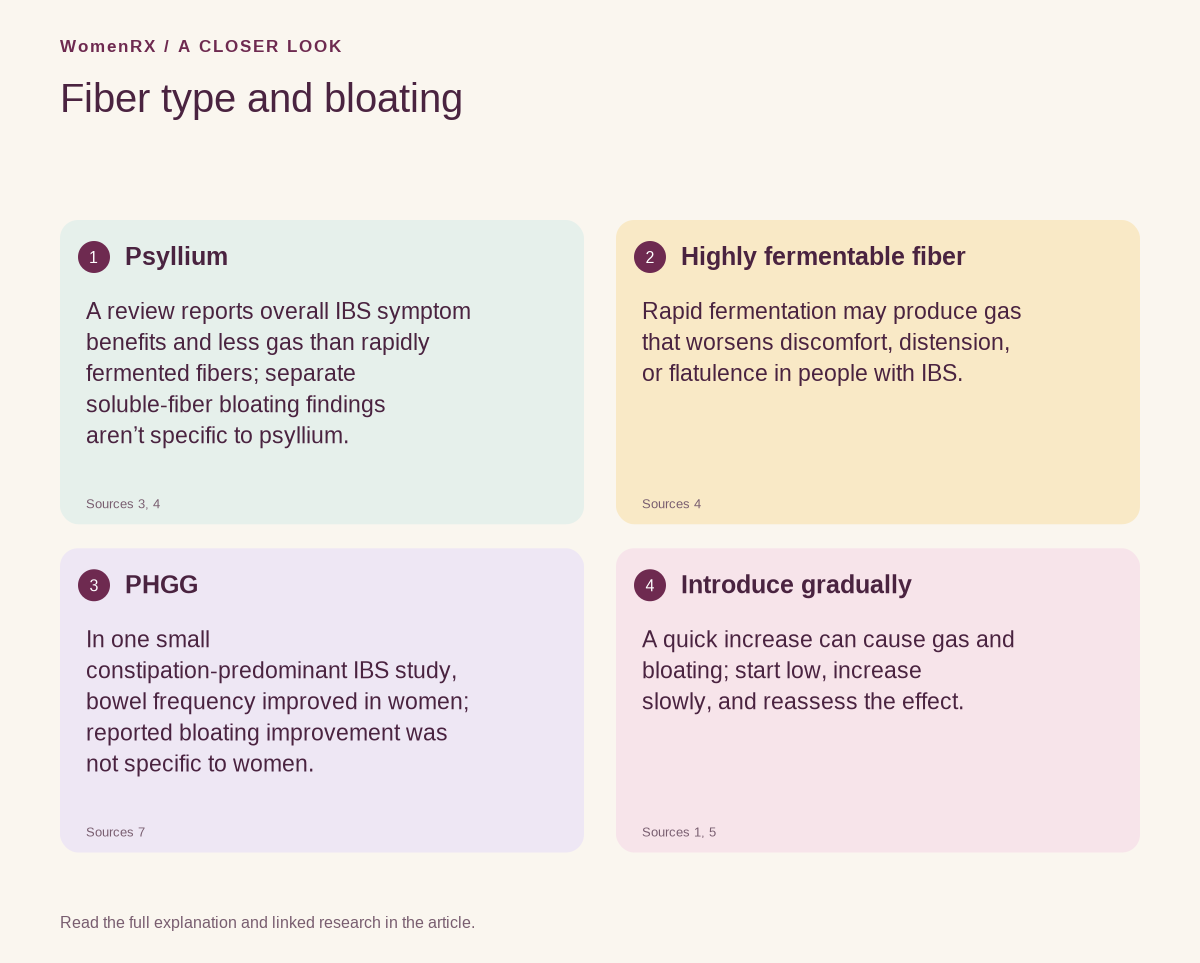
Psyllium: A review reports overall IBS symptom benefits and less gas than rapidly fermented fibers; separate soluble-fiber bloating findings aren’t specific to psyllium.34
Highly fermentable fiber: Rapid fermentation may produce gas that worsens discomfort, distension, or flatulence in people with IBS.4
PHGG: In one small constipation-predominant IBS study, bowel frequency improved in women; reported bloating improvement was not specific to women.7
Introduce gradually: A quick increase can cause gas and bloating; start low, increase slowly, and reassess the effect.15
Read the figure as text
Different fibers can have different effects. This comparison links the types discussed in the article with the evidence and a cautious way to interpret symptoms.- Psyllium: A review reports overall IBS symptom benefits and less gas than rapidly fermented fibers; separate soluble-fiber bloating findings aren’t specific to psyllium.34
- Highly fermentable fiber: Rapid fermentation may produce gas that worsens discomfort, distension, or flatulence in people with IBS.4
- PHGG: In one small constipation-predominant IBS study, bowel frequency improved in women; reported bloating improvement was not specific to women.7
- Introduce gradually: A quick increase can cause gas and bloating; start low, increase slowly, and reassess the effect.15
More questions, answered
Does fiber help IBS bloating?
It may help some people, particularly when constipation is also present, but it isn’t a guaranteed bloating treatment. A review reported benefits for soluble fiber overall, while noting variation in study results and the need for better trials. Those findings don’t establish that psyllium specifically relieves bloating. 3 4
Should I keep taking fiber if it makes me more bloated?
Not automatically. A rapid increase can cause gas and bloating, and some fibers ferment more readily than others. Reassess the type and pace of change rather than assuming you need to push through worsening symptoms. 1 4 5
Sources you can check
- Dietary Fiber: MedlinePlusAccessed 2026-09-25Return to first citation
- Bloating - NHSAccessed 2026-09-25Return to first citation
- The Effect of Polyphenols, Minerals, Fibers, and Fruits on Irritable Bowel Syndrome: A Systematic Review.Chiarioni G, Popa SL, Ismaiel A, Pop C, Dumitrascu DI, Brata VD, Duse TA, Incze V, Surdea-Blaga T. · Nutrients · 2023Return to first citation
- Dietary fiber in irritable bowel syndrome (Review).El-Salhy M, Ystad SO, Mazzawi T, Gundersen D. · International journal of molecular medicine · 2017Return to first citation
- The role of fiber in the treatment of irritable bowel syndrome: therapeutic recommendations.Zuckerman MJ. · Journal of clinical gastroenterology · 2006Return to first citation
- Clinical Practice Guideline: Irritable bowel syndrome with constipation and functional constipation in the adult.Mearin F, Ciriza C, Mínguez M, Rey E, Mascort JJ, Peña E, Cañones P, Júdez J. · Revista espanola de enfermedades digestivas · 2016Return to first citation
- Partially hydrolyzed guar gum in the treatment of irritable bowel syndrome with constipation: effects of gender, age, and body mass index.Russo L, Andreozzi P, Zito FP, Vozzella L, Savino IG, Sarnelli G, Cuomo R. · Saudi journal of gastroenterology : official journal of the Saudi Gastroenterology Association · 2015Return to first citation