Calcium Benefits: What It Can Support and What It Cannot Guarantee
Calcium helps maintain bone, but taking more isn’t the same as proving you’ll avoid a fracture.
Calcium is a building block of bone, and getting enough supports bone maintenance. But evidence that supplements prevent fractures is much less certain: a large review found too few, too-small studies to draw a clear conclusion about calcium alone, while calcium combined with vitamin D did not significantly reduce fractures in the studied community-dwelling adults. Whether a supplement makes sense depends partly on your usual intake and health situation. 1 3
Bone support and fracture prevention are different claims
Your body stores almost all of its calcium in bones and teeth. Calcium intake matters for maintaining bone, and prolonged deficiency can weaken bones. That makes calcium a necessary part of bone health, but it doesn’t mean that adding a supplement will prevent a fracture. A nutrient’s role in the body and a treatment’s demonstrated effect on fractures are different questions. 1 2
That distinction shows up in the research. A US evidence review of randomized trials in community-dwelling adults aged 50 and older found only two studies of calcium alone, with 339 participants in total; results were too imprecise to establish whether calcium alone prevents fractures. In the same review, calcium taken with vitamin D did not significantly reduce total or hip fractures in the studied populations. Those combination results can’t tell us what calcium alone would do. 3
The review was about primary prevention in community-dwelling adults. It excluded people with known osteoporosis, a previous fracture, or known vitamin D deficiency. So its findings don’t settle whether calcium supplements help those groups, and they shouldn’t be used to decide osteoporosis treatment. 3
Your starting intake changes the question
A supplement may help fill a gap if your usual food intake is low. It can’t be assumed to add fracture protection for someone already getting enough. In practice, the useful first question is often not “Should I take calcium?” but “About how much am I already getting from food, drinks, and any supplements?”
For healthy adults, the recommended daily amount is 1,000 mg for women ages 19-50 and 1,200 mg for women over 50. These are total daily intake targets, not supplement amounts. The recommended amount also differs during adolescence; pregnancy and breastfeeding don’t raise the target above the amount for the same age group. 1
Food can contribute through milk, yogurt, cheese, calcium-fortified drinks or tofu, and some fish eaten with their bones. For example, the NIH lists a cup of milk or fortified soy milk at about 299 mg and a half-cup of tofu made with calcium sulfate at about 253 mg. Looking at labels and considering your usual meals can help you see whether there may be a shortfall. 1
Why menopause matters, without making supplements automatic
After menopause, lower estrogen contributes to bone loss. The recommended calcium intake rises from 1,000 mg per day for women through age 50 to 1,200 mg for women over 50. That higher target reflects bone-maintenance needs; it doesn’t prove that every postmenopausal woman benefits from taking a supplement or that supplements alone prevent fractures. 1
The evidence review’s community-dwelling population also isn’t a direct answer for someone with diagnosed osteoporosis or a previous fragility fracture. Those situations call for decisions based on fracture risk and the overall care plan, not a general-population supplement result. 3
A practical way to decide about a supplement
Start with your usual intake, including fortified foods and calcium-containing antacids or other supplements. If your intake seems low, consider whether a food source could close the gap; a supplement is another way calcium can be obtained, but it isn’t automatically better for bones. 1 2
If you do use a calcium supplement, know that some people experience gas, bloating, or constipation. Calcium carbonate appears more likely to cause these effects than calcium citrate, especially in older adults, according to the NIH reference. That’s a practical tradeoff to weigh alongside the uncertain fracture-prevention evidence. 1
The clearest takeaway is modest but useful: calcium supports bone maintenance, and meeting your age-specific intake target matters. A supplement can help address low intake, but current evidence here doesn’t show that calcium alone reliably prevents fractures in women as a group.
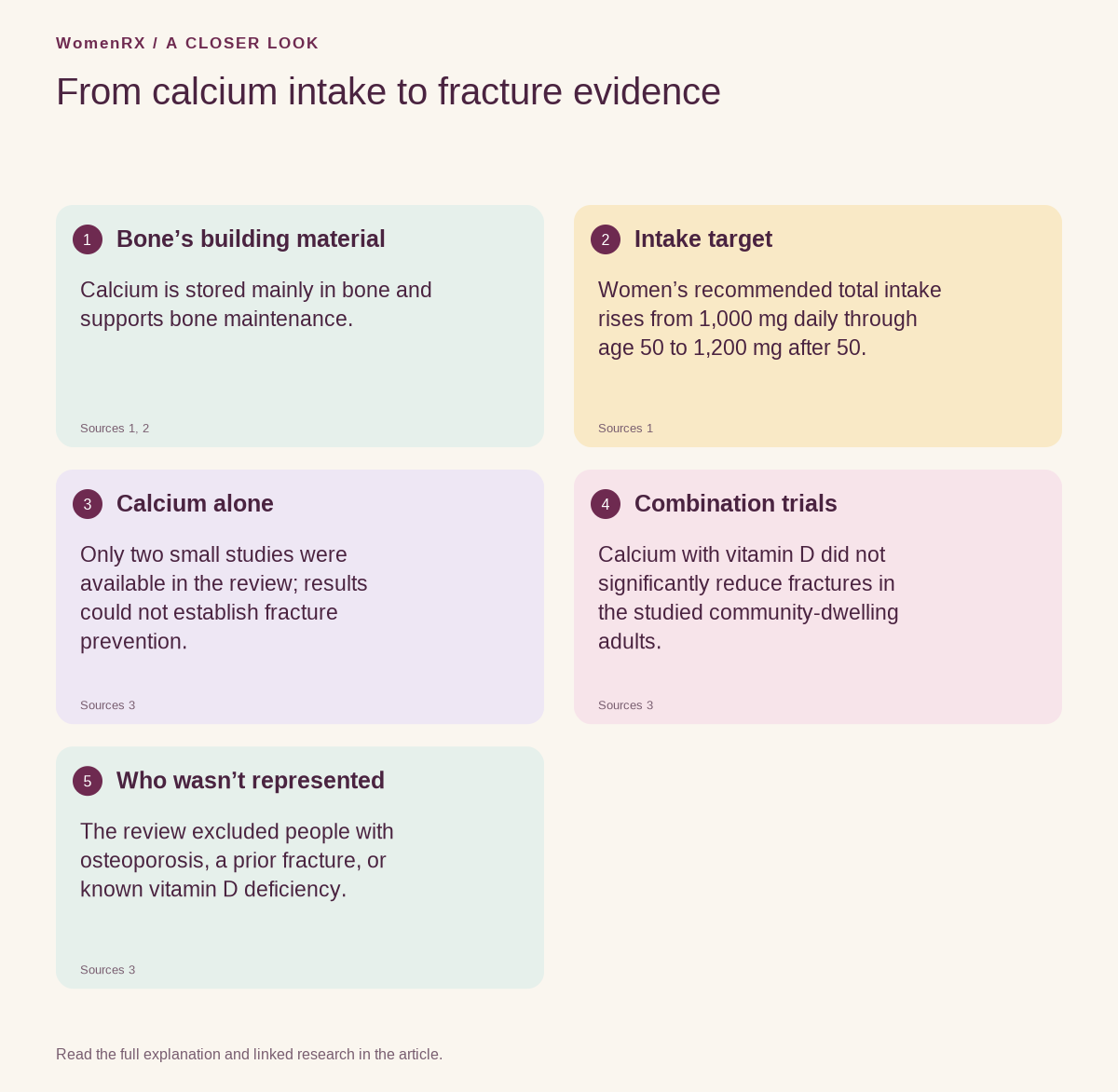
From calcium intake to fracture evidence
Bone’s building material: Calcium is stored mainly in bone and supports bone maintenance.12
Intake target: Women’s recommended total intake rises from 1,000 mg daily through age 50 to 1,200 mg after 50.1
Calcium alone: Only two small studies were available in the review; results could not establish fracture prevention.3
Combination trials: Calcium with vitamin D did not significantly reduce fractures in the studied community-dwelling adults.3
Who wasn’t represented: The review excluded people with osteoporosis, a prior fracture, or known vitamin D deficiency.3
Read the figure as text
These are connected but distinct steps: calcium supports bone, while whether supplements prevent fractures depends on the outcome and population studied.- Bone’s building material: Calcium is stored mainly in bone and supports bone maintenance.12
- Intake target: Women’s recommended total intake rises from 1,000 mg daily through age 50 to 1,200 mg after 50.1
- Calcium alone: Only two small studies were available in the review; results could not establish fracture prevention.3
- Combination trials: Calcium with vitamin D did not significantly reduce fractures in the studied community-dwelling adults.3
- Who wasn’t represented: The review excluded people with osteoporosis, a prior fracture, or known vitamin D deficiency.3
More questions, answered
Does a calcium supplement work better than calcium from food?
Both food and supplements provide calcium, but the fracture-prevention evidence described here does not establish that calcium supplements prevent fractures better than food sources. The first practical step is to estimate your total intake, rather than assume a pill adds a separate bone benefit. 1 3
Does the evidence apply if I have osteoporosis or have already broken a bone?
Not directly. The reviewed trials of primary prevention excluded people with known osteoporosis or a prior fracture, so their findings don’t answer whether calcium supplements help in those circumstances. 3
Sources you can check
- Calcium - Health Professional Fact SheetAccessed 2026-09-25Return to first citation
- Calcium | MedlinePlusAccessed 2026-09-25Return to first citation
- Vitamin D, Calcium, or Combined Supplementation for the Primary Prevention of Fractures in Community-Dwelling Adults: Evidence Report and Systematic Review for the US Preventive Services Task Force.Kahwati LC, Weber RP, Pan H, Gourlay M, LeBlanc E, Coker-Schwimmer M, Viswanathan M. · JAMA · 2018Return to first citation