Anxiety During Menopause: Which Non-Drug Approaches Help?
CBT has encouraging evidence for anxiety during perimenopause, while other approaches have less consistent results or have been studied for different symptoms.
Cognitive behavioral therapy (CBT) has the clearest direct evidence among the non-drug approaches studied for anxiety during perimenopause. In one small study, anxiety fell more with CBT than with a symptom-information pamphlet. A Korean pilot also found a difference in anxiety scores compared with usual care, but its reported results don’t establish which group had lower anxiety. Mindfulness-based approaches look promising, though results vary. 536
What feels like anxiety may have more than one part
A hot flash, a poor night’s sleep, and persistent worry can happen together during the menopause transition. They’re still different problems. An approach that helps you cope with hot flashes hasn’t necessarily been shown to treat anxiety, and better sleep doesn’t automatically resolve worry. Keeping those outcomes separate makes the research more useful. 26
It also leaves room for your own history. If you’ve had an anxiety disorder before, mention that when discussing new or changing symptoms. An assessment can consider your symptoms and medical history and check whether another health problem may be contributing. 1
CBT offers the clearest direct signal for anxiety
CBT is a form of talk therapy that works with patterns of thought and behavior. For anxiety, it can focus on the worries and situations that are difficult for you, rather than treating every menopause symptom as the same problem. 1
In a study of 53 perimenopausal women attending an Indian gynecology clinic, both a short CBT program and a pamphlet about perimenopausal symptoms were followed by improvements. Anxiety fell more in the CBT group after six weeks. A separate pilot trial assigned 40 Korean women to an eight-week CBT program or usual gynecologic care and found a statistically significant difference between groups in anxiety scores. The reported results don’t establish which group had lower anxiety or by how much. These are encouraging findings, not proof that one CBT program works equally well for everyone. 53
A smaller case series followed women in perimenopause and postmenopause receiving individual CBT for mood symptoms. Anxiety scores were lower by the eighth session, but without a comparison group, that change cannot be attributed to CBT alone. 4
If worry itself is the main problem, ask whether a CBT program can focus on your specific anxieties and needs. The studies are small, and they do not establish a single best format or how long any benefit lasts. 1356
Choose an approach for the symptom you want to change
Hot flashes and night sweats: The Menopause Society recommends CBT as a nonhormone approach for vasomotor symptoms. That recommendation is about those symptoms, not a finding that menopause-focused CBT treats an anxiety disorder. If hot-flash distress is central to what’s bothering you, it may still be a relevant option. 2
Insomnia: A systematic review of 12 studies of psychological interventions in peri- and postmenopausal women found the most consistent results for CBT and CBT for insomnia, particularly for insomnia outcomes. Addressing sleep can be worthwhile in its own right, but insomnia-focused treatment should not be mistaken for anxiety-focused treatment when persistent worry is the concern. 6
Mindfulness and acceptance-based approaches: The same review found promising, but more variable, results for psychological and sleep symptoms. The programs, outcome measures, and follow-up periods differed enough that the reviewers did not pool the findings into one estimate of benefit. These approaches may appeal to you, but the evidence is less consistent than it is for CBT. 6
Relaxation, yoga, exercise, and supplements: Be precise about the claim being made. The Menopause Society’s review did not recommend relaxation, yoga, exercise, or herbal supplements as treatments for hot flashes and night sweats. It was not a review of anxiety treatment, so that finding cannot tell you whether these approaches help anxiety. Nor is a supplement established as safe or effective for anxiety simply because it’s sold as “natural.” 2
Know when anxiety needs its own assessment
Occasional anxious feelings are different from worry that doesn’t go away, grows worse, feels hard to control, or interferes with work, relationships, or everyday life. Those patterns are reasons to seek an assessment rather than keep trying self-help approaches alone. Anxiety disorders have established treatment options, including psychotherapy, medication, or both; getting assessed doesn’t commit you to one of them. 1
You can start by explaining which part is most disruptive: the worry, interrupted sleep, hot flashes, or a combination. If you’ve previously been treated for anxiety, say so. That helps keep menopause in the picture without assuming it explains everything. 1
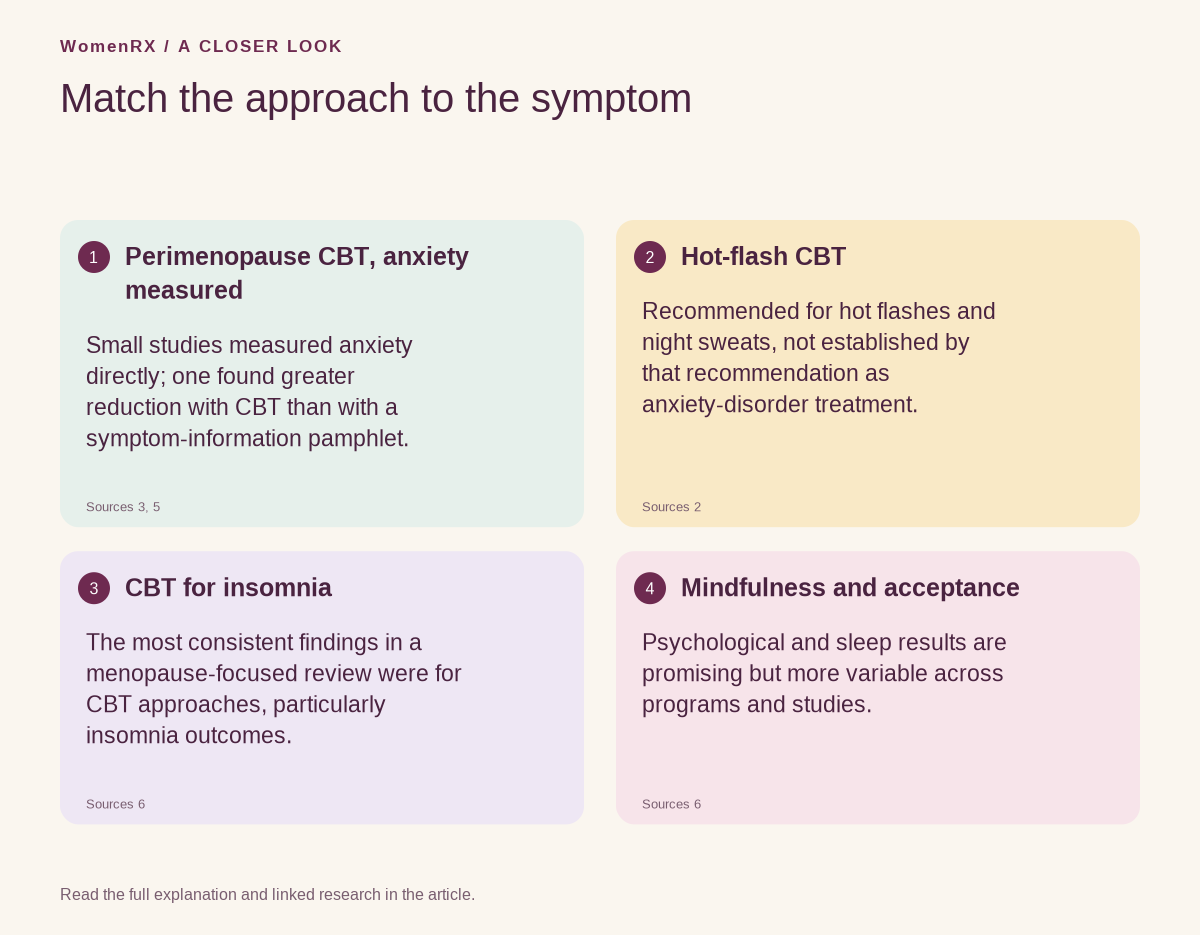
Match the approach to the symptom
Perimenopause CBT, anxiety measured: Small studies measured anxiety directly; one found greater reduction with CBT than with a symptom-information pamphlet.35
Hot-flash CBT: Recommended for hot flashes and night sweats, not established by that recommendation as anxiety-disorder treatment.2
CBT for insomnia: The most consistent findings in a menopause-focused review were for CBT approaches, particularly insomnia outcomes.6
Mindfulness and acceptance: Psychological and sleep results are promising but more variable across programs and studies.6
Read the figure as text
These approaches have been studied for different outcomes, so their findings are not interchangeable.- Perimenopause CBT, anxiety measured: Small studies measured anxiety directly; one found greater reduction with CBT than with a symptom-information pamphlet.35
- Hot-flash CBT: Recommended for hot flashes and night sweats, not established by that recommendation as anxiety-disorder treatment.2
- CBT for insomnia: The most consistent findings in a menopause-focused review were for CBT approaches, particularly insomnia outcomes.6
- Mindfulness and acceptance: Psychological and sleep results are promising but more variable across programs and studies.6
More questions, answered
Is CBT for hot flashes the same as CBT for anxiety?
Not necessarily. CBT recommended for hot flashes targets vasomotor symptoms; CBT for anxiety focuses on the thoughts and behaviors connected to your particular fears or worries. Ask what a program is designed to treat before assuming results for one symptom apply to the other. 21
Sources you can check
- Anxiety: MedlinePlusAccessed 2026-09-25Return to first citation
- The 2023 nonhormone therapy position statement of The North American Menopause Society.Menopause (New York, N.Y.) · 2023Return to first citation
- Efficacy of cognitive behavioral therapy for menopausal symptoms and quality of life in Korean perimenopausal women: A pilot randomized controlled trial.Kim DS, Kim NY, Han DH, Kim HJ, Yu ES, Kim SM. · Maturitas · 2024Return to first citation
- Eight-session manualized cognitive behavioral therapy for anxiety and depression symptoms in perimenopause and postmenopause: a pilot study.Hantsoo L, Friedman-Wheeler DG, Lofland G, Harrison SA, Smith G, Shen W. · Menopause (New York, N.Y.) · 2026Return to first citation
- Effectiveness of Cognitive Behavioral Therapy in Managing Physical and Psychological Distress in Women during the Perimenopausal Phase.Bassi R, Bajaj MK, Goel B. · Journal of mid-life health · 2025Return to first citation
- Cognitive-behavioral, acceptance-based, and mindfulness-based interventions for psychological and sleep-related symptoms during menopause: a systematic review.de Dios Tapia A, Rueda-Extremera M, Cantero-García M. · Acta psychologica · 2026Return to first citation