Why Migraine Patterns Can Shift in Perimenopause
Changing cycles can make migraine less predictable, but perimenopause doesn’t make every person’s attacks worse.
As periods become irregular, the hormonal shifts around them can also become less predictable. Reviews link estrogen variability during perimenopause with changes in migraine, but attacks don’t always worsen or improve. 5 7 A headache diary can help identify patterns. 2 Compare headache days with bleeding days and note whether your usual attack treatment still works. Discuss attacks that are worsening or difficult to control. 4
Why a familiar pattern may become harder to read
If your migraine used to arrive around your period, irregular bleeding can make that timing less obvious. Menstrual migraine commonly occurs just before or during a period, and some people have attacks at predictable points in their cycle. When cycles become less regular, that familiar calendar cue may be less useful. 3 4
Hormones may be part of the change. Reviews describe fluctuating estrogen during perimenopause as one possible influence on migraine frequency and predictability. But this is not a simple “more estrogen means more migraine” story: hormone levels vary, and other parts of midlife, including sleep disturbance and mood symptoms, may also complicate the picture. The available research does not establish one pattern that applies to everyone. 5 7
A small case-control study illustrates why individual patterns matter. It compared 44 perimenopausal participants with migraine, split between those whose migraine began before perimenopause and those whose migraine began during it, with 22 age-matched controls. The researchers found associations between lower estradiol levels and higher migraine severity scores in the migraine groups. That finding cannot show that lower estrogen caused more severe migraine, or predict what will happen to any one person. 6
Perimenopause isn’t a guaranteed worsening phase
Some people may have more frequent or less predictable attacks during the transition; others may not. One 2026 review describes improvement after menopause as common but variable, while another review says migraine without aura often improves after menopause and migraine with aura may persist. Those are broad trends, not a forecast for an individual. 5 7
This distinction can help you make sense of change without dismissing it as “just hormones.” A migraine that is becoming more frequent, more severe, or harder to control is a reason to review the plan, whether or not the change lines up with bleeding. General migraine guidance also recommends discussing attacks that are severe or getting worse, last longer than usual, happen more than once a week, or are difficult to control. 4
Make an irregular cycle useful information
For a short stretch, note headache days, bleeding days, migraine symptoms, and what treatment you used and how well it worked. Include attacks that happen without bleeding, too. A headache diary can help reveal timing and other patterns. 2 4 When periods are irregular, recording the bleeding itself gives you another point of comparison rather than assuming each attack is cycle-related.
The purpose isn’t to prove that hormones caused an attack. It’s to see whether a pattern is emerging and to make a treatment conversation more specific. If your usual treatment for an attack isn’t helping, ask about acute options, such as a triptan or an NSAID, and whether treatment for nausea would help with that symptom. 4 7 If attacks have become frequent or severe, prevention is a separate discussion: options include medicines such as beta-blockers or topiramate, chosen with your broader health in mind. 3 7
If you’re considering menopause hormone therapy
Menopausal hormone therapy is a separate decision from migraine treatment. Reviews describe its effects on migraine as variable and identify limited evidence specific to migraine during perimenopause. If you’re considering it for menopause symptoms, include your migraine pattern in that discussion rather than assuming hormone therapy will improve attacks or that it is a migraine treatment. 5 7
A sudden headache that is extremely painful needs immediate medical help. 4 Headache with a stiff neck, fever, confusion, loss of consciousness, or pain in the eye or ear also warrants urgent attention. These signs should not be written off as a change in hormones. 1
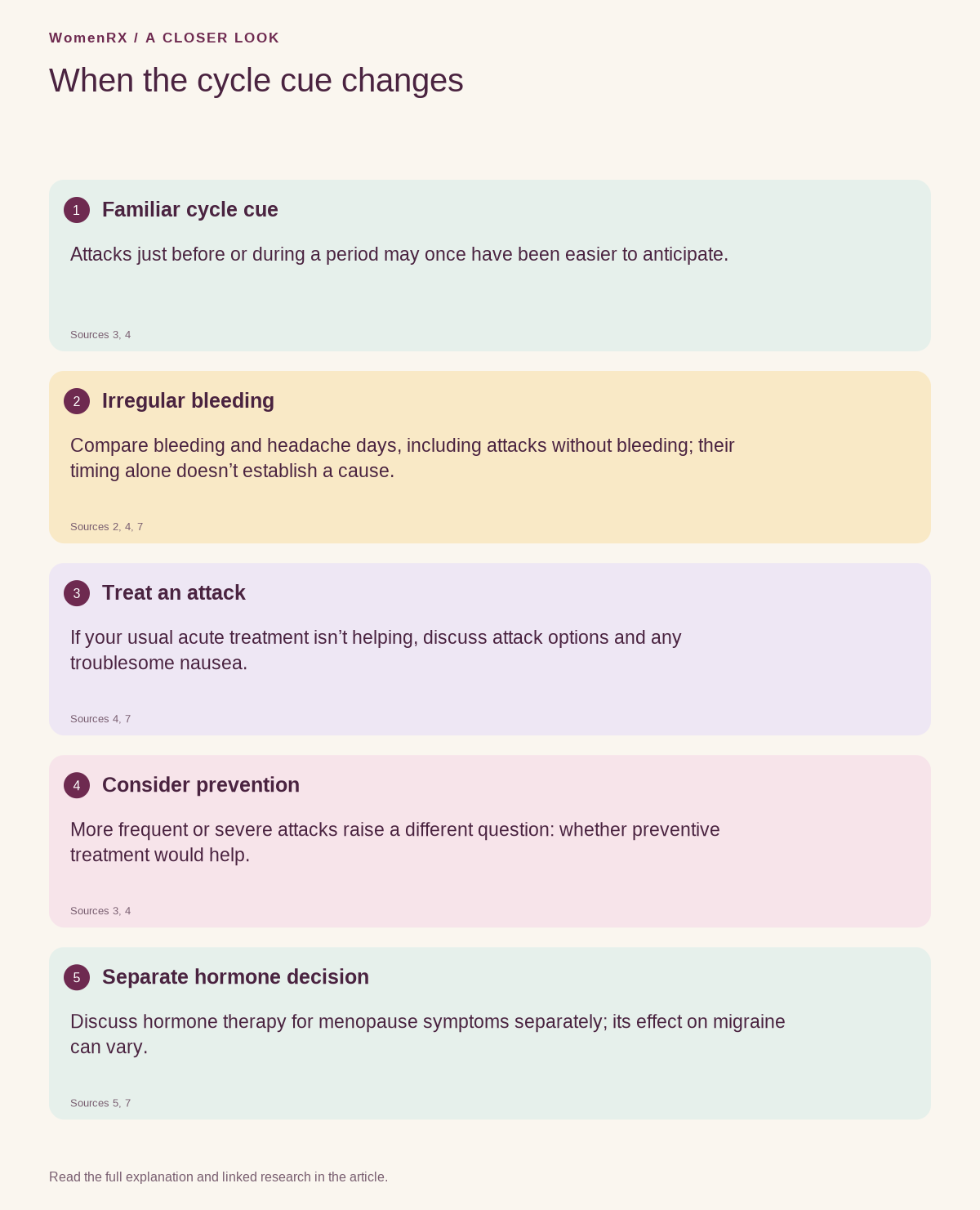
When the cycle cue changes
Familiar cycle cue: Attacks just before or during a period may once have been easier to anticipate.34
Irregular bleeding: Compare bleeding and headache days, including attacks without bleeding; their timing alone doesn’t establish a cause.247
Treat an attack: If your usual acute treatment isn’t helping, discuss attack options and any troublesome nausea.47
Consider prevention: More frequent or severe attacks raise a different question: whether preventive treatment would help.34
Separate hormone decision: Discuss hormone therapy for menopause symptoms separately; its effect on migraine can vary.57
Read the figure as text
A less predictable period can change how you recognize a migraine pattern. These are separate questions to consider as that pattern changes.- Familiar cycle cue: Attacks just before or during a period may once have been easier to anticipate.34
- Irregular bleeding: Compare bleeding and headache days, including attacks without bleeding; their timing alone doesn’t establish a cause.247
- Treat an attack: If your usual acute treatment isn’t helping, discuss attack options and any troublesome nausea.47
- Consider prevention: More frequent or severe attacks raise a different question: whether preventive treatment would help.34
- Separate hormone decision: Discuss hormone therapy for menopause symptoms separately; its effect on migraine can vary.57
More questions, answered
Does migraine usually improve after menopause?
It often improves for some people, but that isn’t guaranteed. Reviews describe improvement as variable, and migraine with aura may persist. Your own pattern matters more than a general trend. 4 5 7
Can I track migraine if my periods are irregular?
Yes. A headache diary may help you spot patterns. 2 You can also note bleeding days alongside headache days, symptoms, and treatment response, without assuming every attack is caused by a cycle change.
Sources you can check
- Headache | MedlinePlusAccessed 2026-09-25Return to first citation
- Headaches - NHSAccessed 2026-09-25Return to first citation
- Migraine | MedlinePlusAccessed 2026-09-25Return to first citation
- Migraine - NHSAccessed 2026-09-25Return to first citation
- Perimenopausal migraine: a narrative review.Kamourieh S, MacGregor EA. · Climacteric : the journal of the International Menopause Society · 2026Return to first citation
- Clinical characteristics of perimenopausal migraine and its correlation to hormonal levels.El-Ghoneimy LT, Elfayoumy NM, Helmy H, Elaguizy MMS, Nasser AMA, Abdelghany H. · The journal of headache and pain · 2026Return to first citation
- Migraine across the menopausal transition and beyond: A narrative review.Korn TF, Bernstein C. · Headache · 2026Return to first citation