Menopausal Hormone Therapy: Side Effects and Bleeding Patterns
Headaches, breast tenderness, and spotting may be manageable, but your treatment plan determines which changes deserve a closer look.
Menopausal hormone therapy can cause headaches, breast tenderness, bloating, dizziness, acne, or spotting. Severe or persistent effects deserve a treatment review.23 Report unexpected postmenopausal bleeding promptly, especially if your product instructions call for it.17 Chest pain with breathlessness or sudden trouble speaking or moving needs emergency care; pain and swelling in one leg needs prompt medical attention.16

First, know which hormones you’re taking
The side-effect discussion starts with your actual regimen, not with a single list for “HRT.” Systemic estrogen may be taken alone or with a progestogen, such as progesterone. If you have a uterus, a progestogen is generally needed alongside systemic estrogen to protect the uterine lining. After a hysterectomy, estrogen-only treatment may be an option. The distinction also matters when interpreting research on longer-term risks: findings for one combination of hormones cannot automatically be applied to another.57
How you take estrogen matters, too. Reviews find that oral estrogen is associated with higher blood-clot risk than transdermal estrogen, such as a patch. That makes route a useful question if clot risk is part of your treatment discussion. It doesn’t mean a patch removes every risk, or that changing routes will necessarily fix a headache or another day-to-day side effect.45
Changes you might notice day to day
Some people have no noticeable side effects. Others develop symptoms that overlap with menopause itself, which can make the cause hard to pin down. Headaches can occur with estrogen; acne can occur with a progestogen. Headaches and acne often ease after a few weeks, but severe side effects deserve a conversation sooner, and those that continue beyond about three months warrant a review of the treatment plan.3
Breast tenderness, bloating, and dizziness are also worth mentioning if they bother you. To put those examples in context, a three-year placebo-controlled trial reported breast tenderness in 27% of postmenopausal participants receiving conjugated estrogens plus oral progesterone, compared with 6% receiving placebo. Bloating was reported by 12% versus 5%, and dizziness by 15% versus 9%. Those figures describe that studied combination, not the expected rate with every estrogen patch or progesterone regimen; the trial also cannot tell us which hormone caused an individual symptom.2
A useful follow-up question is specific: Could the timing or type of my treatment explain this change, and would a different dose, hormone formulation, or route be worth discussing? Changing the type or route is among the approaches used when side effects persist. For example, switching from a tablet to a patch may be part of that discussion, rather than something you need to work out on your own.3
Bleeding deserves its own conversation
Spotting can happen in the first months after starting hormone therapy. With continuous combined therapy, irregular bleeding or spotting is common during the first four to six months. A sequential regimen, in which a progestogen is taken for part of the month, can produce a withdrawal bleed after that part of the regimen ends. These are different patterns, so the name and schedule of your treatment matter when you describe what’s happening.3
A predictable withdrawal bleed at the expected point in a sequential regimen is different from bleeding that’s new, unscheduled, or changed from your usual pattern. Ask your prescriber what bleeding pattern to expect with your regimen and when they want you to get in touch about a change. When describing bleeding, say whether it’s spotting or heavier bleeding, when it started, and whether it follows the sequential schedule.3 The instructions for Bijuva, a specific estrogen-plus-progesterone product, say to report any postmenopausal vaginal bleeding as soon as possible.1
Changes that shouldn’t wait for a routine review
Chest pain with breathlessness, or sudden difficulty speaking or moving an arm or leg, calls for emergency care. These can be signs of a clot in the lung, a heart problem, or a stroke. Pain, redness, or swelling in one leg, particularly the calf, needs prompt medical attention because it may signal a deep vein clot.6 The instructions for the oral estrogen-plus-progesterone product Bijuva also flag sudden new severe headache and changes in vision or speech as warning signs to report right away.1 A new breast lump needs a prompt call to your prescriber, too.1 These are different from a mild headache or breast tenderness that you can discuss at a treatment review.
Longer-term risks for a treatment review
Blood clots, stroke, and heart disease belong in a treatment-risk conversation; they aren’t the common, day-to-day effects described above.14 In a large trial of oral conjugated estrogens plus medroxyprogesterone acetate, participants had more deep vein thromboses than those taking placebo: 25 versus 14 events per 10,000 women-years over an average follow-up of 5.6 years. The women in that trial were, on average, 63 years old. Those numbers are useful context for that specific treatment and population, not a personal forecast for someone using transdermal estradiol or a different progestogen.1
Breast cancer findings also differ by regimen. In the trial of oral conjugated estrogens plus medroxyprogesterone acetate, invasive breast cancer occurred more often than with placebo over an average 5.6 years. In a separate trial of oral conjugated estrogens alone, investigators did not find an increased incidence of invasive breast cancer compared with placebo over an average 7.1 years. That doesn’t mean every estrogen-only product prevents breast cancer or that every combination carries the same risk; the trials studied particular treatments in different groups of postmenopausal women.17
A review of your treatment should therefore cover more than whether a side effect is tolerable. Your prescriber needs to know about changes that are severe, continue, or interfere with daily life. You can also use that review to clarify what bleeding pattern to expect and when they want you to get in touch about changes.3
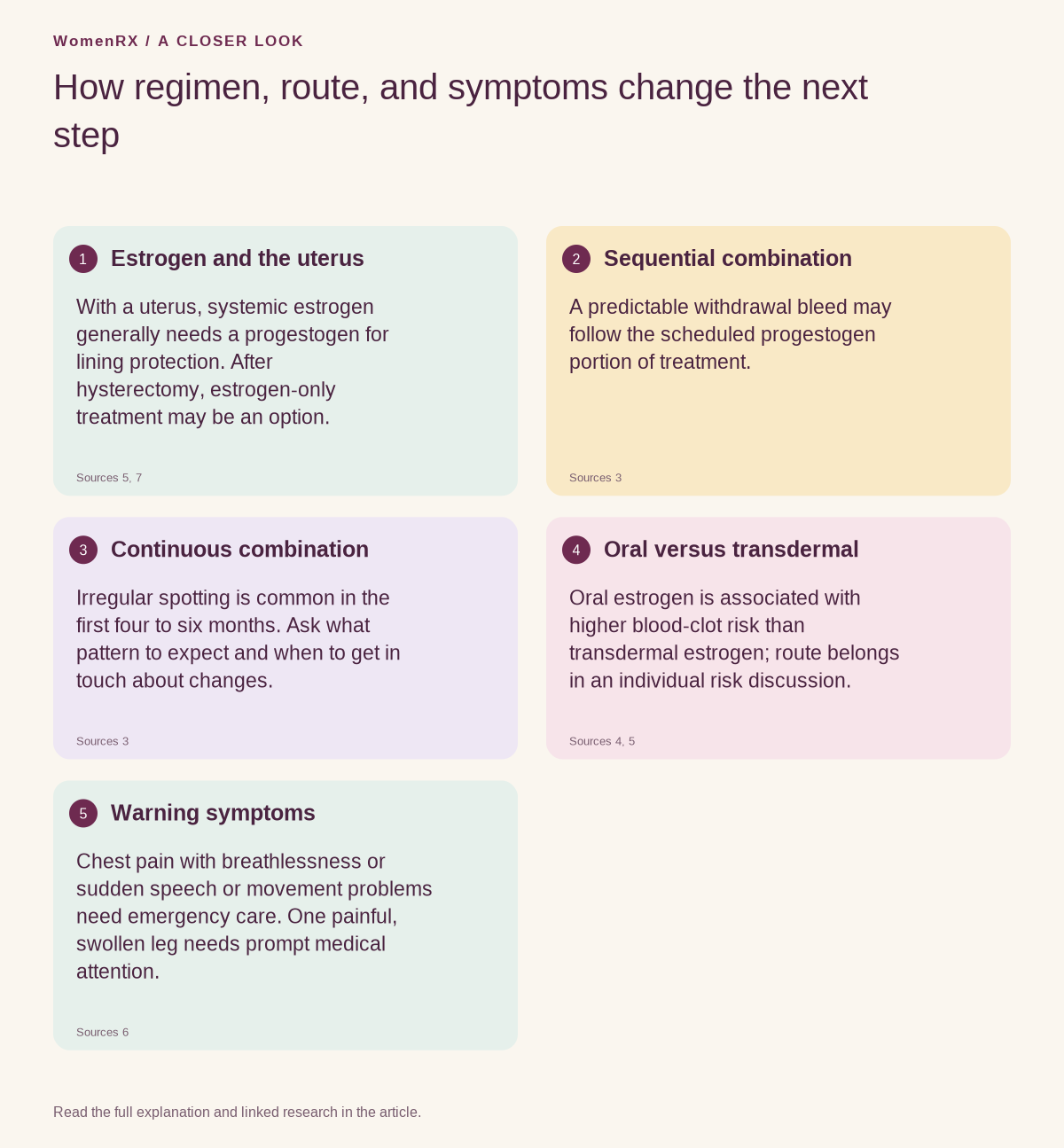
How regimen, route, and symptoms change the next step
Estrogen and the uterus: With a uterus, systemic estrogen generally needs a progestogen for lining protection. After hysterectomy, estrogen-only treatment may be an option.57
Sequential combination: A predictable withdrawal bleed may follow the scheduled progestogen portion of treatment.3
Continuous combination: Irregular spotting is common in the first four to six months. Ask what pattern to expect and when to get in touch about changes.3
Oral versus transdermal: Oral estrogen is associated with higher blood-clot risk than transdermal estrogen; route belongs in an individual risk discussion.45
Warning symptoms: Chest pain with breathlessness or sudden speech or movement problems need emergency care. One painful, swollen leg needs prompt medical attention.6
Read the figure as text
Compare expected bleeding patterns and treatment-risk questions, then separate warning symptoms that need prompt or emergency attention.- Estrogen and the uterus: With a uterus, systemic estrogen generally needs a progestogen for lining protection. After hysterectomy, estrogen-only treatment may be an option.57
- Sequential combination: A predictable withdrawal bleed may follow the scheduled progestogen portion of treatment.3
- Continuous combination: Irregular spotting is common in the first four to six months. Ask what pattern to expect and when to get in touch about changes.3
- Oral versus transdermal: Oral estrogen is associated with higher blood-clot risk than transdermal estrogen; route belongs in an individual risk discussion.45
- Warning symptoms: Chest pain with breathlessness or sudden speech or movement problems need emergency care. One painful, swollen leg needs prompt medical attention.6
Sources you can check
- BIJUVA (ESTRADIOL AND PROGESTERONE) CAPSULE [MAYNE PHARMA] | US prescribing information and patient instructionsAccessed 2026-09-25Return to first citation
- PROMETRIUM (PROGESTERONE) CAPSULE [ACERTIS PHARMACEUTICALS, LLC] | US prescribing information and patient instructionsAccessed 2026-09-25Return to first citation
- Side effects of hormone replacement therapy (HRT) - NHSAccessed 2026-09-25Return to first citation
- Menopausal Hormone Therapy and Cardiovascular Risk: Current Evidence and Clinical Implications.Buzduga CM, Bobu AM, Covali R, Costea CF, Cucu AI, Graur M, Patrascanu E, Solomon-Condriuc I, Carauleanu A. · Medical sciences (Basel, Switzerland) · 2026Return to first citation
- Menopausal Hormone Therapy-Risks, Benefits and Emerging Options: A Narrative Review.Arnautu AM, Nimigean VR, Nacea-Radu CA, Tilici DM, Paun DL. · International journal of molecular sciences · 2025Return to first citation
- Side effects of oestrogen tablets, patches, gel and spray - NHSAccessed 2026-09-25Return to first citation
- DIVIGEL (ESTRADIOL) GEL [VERTICAL PHARMACEUTICALS, LLC] | US estradiol gel prescribing information and patient instructionsAccessed 2026-09-25Return to first citation