Which Sugars Count Toward Current Guidance?
Current US guidance sets a per-meal added-sugars limit, while free sugars include some foods that an Added Sugars label won’t capture.
The 2025-2030 US Dietary Guidelines say a meal should contain no more than 10 grams of added sugars; they don’t give a daily added-sugars percentage in that guidance.4 Added sugar includes honey or syrup added to food, but not sugar naturally present in whole fruit or plain milk.4 Free sugars are broader: they also include sugar naturally present in 100% fruit juice.3
Start with the type of sugar, not the sweetness
A sweet taste doesn’t tell you whether a food counts toward a sugar limit. The distinction is where the sugar comes from and, for fruit, whether it remains in the fruit’s structure.
Added sugars include sugar put into a food during processing, cooking or at the table. Honey and syrups count, even when they sound more natural than table sugar. Free sugars are a broader category: they include added sugars and the sugars naturally present in unsweetened fruit juice. The UK definition also includes sugars in fruit and vegetable smoothies, purées, pastes, powders and extruded products, plus sugars in drinks other than dairy-based drinks, such as unsweetened oat drinks. The sugars naturally present in whole or cut fruit and plain milk are outside both categories.23
That’s why an orange and a glass of 100% orange juice get different answers. The orange’s naturally present sugar doesn’t count as free sugar; the juice’s does. Likewise, plain milk contains lactose but no added sugar simply because it tastes a little sweet. Sweetened milk may contain both naturally present lactose and added sugar.23
Which benchmarks can you compare against?
The 2025-2030 US Dietary Guidelines say that no amount of added sugars is recommended as part of a healthy diet and that one meal should contain no more than 10 grams of added sugars. They also advise avoiding sugar-sweetened beverages. The 10-gram figure is a per-meal limit, not a daily allowance or a threshold below which every food becomes nutritious.4
You may also see an older US benchmark of less than 10% of daily calories from added sugars. That came from the 2020-2025 Dietary Guidelines, so don’t mistake it for the current guidance’s per-meal measure.124 For free sugars, a 2025 dietary analysis describes WHO recommendations of less than 10% of daily calories and a conditional suggestion of less than 5%. Those percentages apply to the broader free-sugars category, not just the Added Sugars line on a US label.23
The distinction matters with juice and blended fruit. You could have no added sugar in a serving of 100% juice and still have free sugar from it. Neither definition asks you to count the sugar inside an intact apple as though it were sugar added to a drink.23
The current US per-meal guidance doesn’t specify a separate limit for women.4 A US analysis of children’s and adults’ diets found that higher added-sugar intake went along with lower overall diet quality and lower intake of several nutrients, but its reported diet-quality results combine women and men. It’s an association, not a test showing that a particular cutoff prevents disease in an individual woman.2
What the label can tell you, and what it can’t
On a packaged food, the Nutrition Facts label includes an Added Sugars line.1 It helps you identify sugar added to a product rather than naturally present sugar. Check the grams of added sugar per serving and how many servings you actually have. For the current US per-meal comparison, add the added sugars from everything you have at that meal, including sugar or honey you add yourself. For example, if a food lists 8 grams of added sugar per serving and you have two servings at one meal, that food contributes 16 grams to the meal, above the guideline’s 10-gram figure.4 You can also check the ingredient list for sweeteners such as sugar, honey and syrups. Then compare products you’d actually use in the same way, such as two yogurts or two bottled coffees, rather than assuming every food with total sugar is equally high in added sugar.14
For example, plain yogurt contains lactose even if it has no added sugar. A sweetened yogurt can have both lactose and added sugars, so its added-sugars line helps you distinguish between them.123 There’s a useful tradeoff here: a food with some added sugar may also provide nutrients. An analysis of US diets found that major added-sugar sources differed in their contribution to nutrients, supporting a closer look at sugary drinks and sweets rather than treating every food with added sugar as interchangeable.2
The label has one important blind spot if you’re using a free-sugars goal. Unsweetened 100% fruit juice contributes free sugars even though its naturally present juice sugars aren’t counted as added sugars. An Added Sugars value of zero therefore doesn’t mean the juice has no free sugars.23 Under the UK definition, an unsweetened fruit smoothie or purée can likewise contribute free sugars without added sugars; naturally present sugars in an unsweetened oat drink count as free sugars too.3 Fruit juice concentrate used as a sweetening ingredient, by contrast, can count as added sugar. So read the product description as well as the number: 100% juice and a fruit drink with added sweetener can both contribute free sugars, but their added-sugars lines may look different.23
For a practical first comparison, look at the drinks you have most often. Soda, fruit drinks and tea were prominent added-sugar sources in a US dietary analysis; sweetened coffee is another place to look for added sugar.12 Keep whole fruit and plain milk in a separate mental category. That gives you a more useful picture than trying to avoid anything that contains sugar at all.23
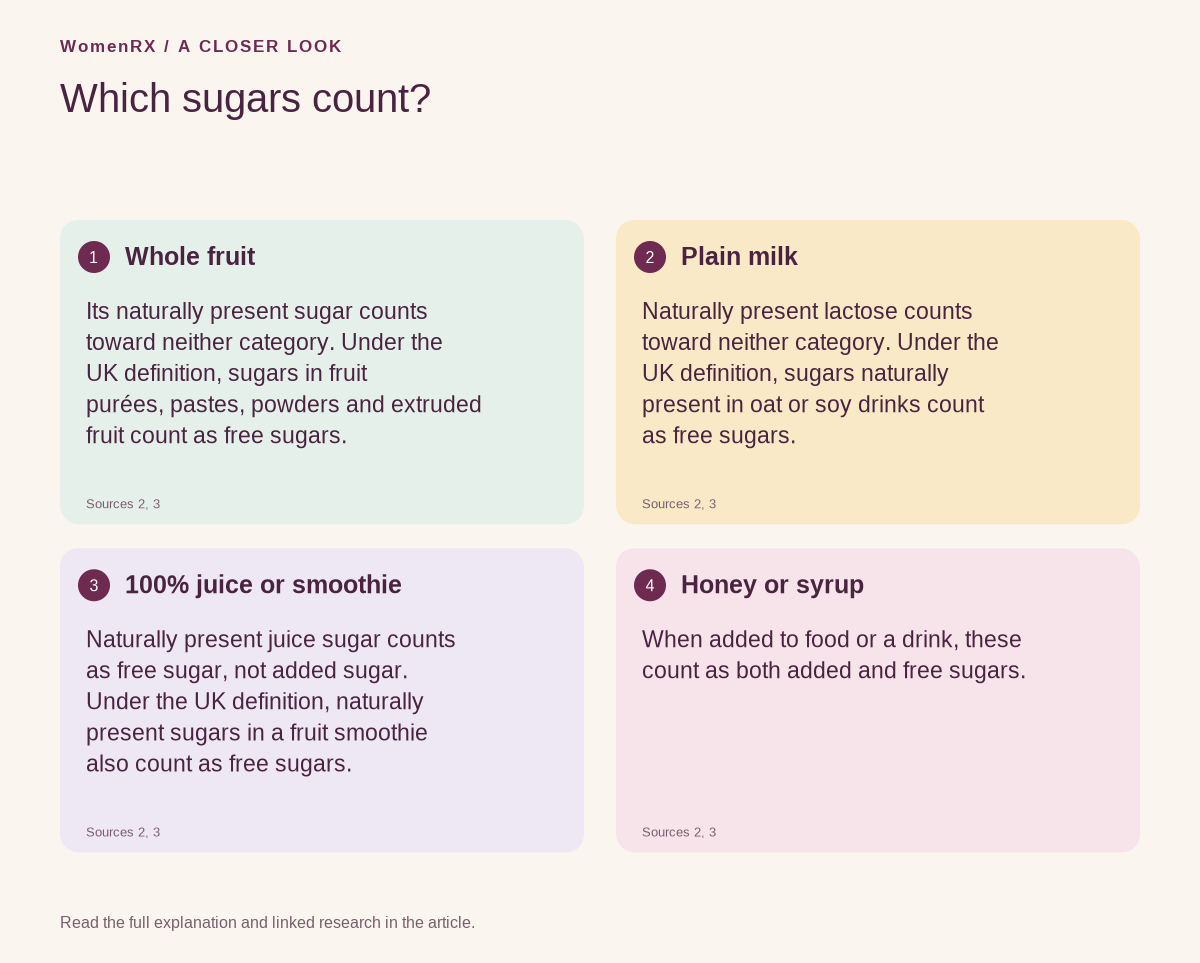
Which sugars count?
Whole fruit: Its naturally present sugar counts toward neither category. Under the UK definition, sugars in fruit purées, pastes, powders and extruded fruit count as free sugars.23
Plain milk: Naturally present lactose counts toward neither category. Under the UK definition, sugars naturally present in oat or soy drinks count as free sugars.23
100% juice or smoothie: Naturally present juice sugar counts as free sugar, not added sugar. Under the UK definition, naturally present sugars in a fruit smoothie also count as free sugars.23
Honey or syrup: When added to food or a drink, these count as both added and free sugars.23
Read the figure as text
The answer changes depending on whether you’re comparing added sugars or the broader free-sugars category.- Whole fruit: Its naturally present sugar counts toward neither category. Under the UK definition, sugars in fruit purées, pastes, powders and extruded fruit count as free sugars.23
- Plain milk: Naturally present lactose counts toward neither category. Under the UK definition, sugars naturally present in oat or soy drinks count as free sugars.23
- 100% juice or smoothie: Naturally present juice sugar counts as free sugar, not added sugar. Under the UK definition, naturally present sugars in a fruit smoothie also count as free sugars.23
- Honey or syrup: When added to food or a drink, these count as both added and free sugars.23
Sources you can check
- The Presence of Added Sugars and Other Sweeteners in Food and Beverage Products Advertised on Television in the United States, 2022.Schermbeck RM, Leider J, Powell LM. · Nutrients · 2024Return to first citation
- Added Sugar Sources and Their Impact on Diet Quality and Nutrient Intakes: An Analysis Across Added Sugar Intake Levels in United States Children and Adults.Tucker M, Garcia-Jackson B, Fulgoni VL. · Current developments in nutrition · 2025Return to first citation
- A definition of free sugars for the UK.Swan GE, Powell NA, Knowles BL, Bush MT, Levy LB. · Public health nutrition · 2018Return to first citation
- Dietary Guidelines for Americans, 2025-2030Accessed 2026-09-25Return to first citation