Which Estrogen Is Being Measured, and What Does the Result Mean?
“Estrogen” is a family name, so the specific hormone, test method, and reason for testing all matter.
Estrogen is an umbrella term, not one lab result. Estradiol and estrone are distinct estrogens measured separately, while unconjugated estriol can be part of pregnancy screening. Before interpreting or comparing results, check the exact analyte, units, lab reference interval, test method, and reason for testing. Method can matter when estradiol levels are low. 1 2
Start with the exact name
“Estrogen” refers to a group of hormones. Your report may specify estradiol or estrone, which are distinct estrogens that can be measured separately. Unconjugated estriol is another named analyte, used in maternal serum screening during pregnancy. A result for one isn’t a measurement of the others. 1 2
Look at the test name on the report, not just a general heading or shorthand that says “estrogen.” Then check the units, the laboratory’s reference interval, and the test method if it’s listed. Those details help you understand what the number describes. Don’t compare results until you’ve checked that you’re looking at the same analyte and units.
Why the testing question matters
The same word can appear in tests used for different reasons. During pregnancy, unconjugated estriol may be one of several maternal serum screening markers. Its meaning belongs in the context of pregnancy and the rest of the screening information, not as a stand-alone estradiol result. Guidance on maternal serum markers describes confirming gestational age and considering maternal, fetal, or placental explanations before classifying an abnormal marker as unexplained. 2
In the cycling years, perimenopause, or after menopause, the hormone name alone still doesn’t tell you what a result means. Start with the question the test was ordered to answer and the reference interval printed by the lab. A value without that context can’t be interpreted reliably as a general “normal estrogen level.”
When the method may matter
Very low estradiol concentrations can be difficult to measure accurately. A laboratory-method study describes limitations of immunoassays at low concentrations and reports that liquid chromatography-tandem mass spectrometry (LC-MS/MS) can offer greater specificity and, in some cases, sensitivity. The study evaluated an analytical method; it doesn’t mean every result needs a different test. But if a low estradiol result seems unexpected, whether the method is appropriate for that concentration is a useful question to ask. 1
A quick check before comparing results
Before comparing a current estrogen result with an older one or a number you’ve seen elsewhere, check:
- Analyte: Does the report name estradiol, estrone, unconjugated estriol, or another specific substance?
- Units: Are the values expressed in the same units?
- Method: Is the method identified, and is it relevant when the result is at a low concentration? 1
- Reference interval and reason for testing: What range did this lab provide, and was the result part of pregnancy screening or ordered for another question? 2
If the report only says “estrogen,” ask which hormone the test measured. If it names estradiol but the result is low, ask whether the method used can measure accurately at that level. Those details are more useful than comparing the number with a range that may describe a different analyte, method, or testing context.
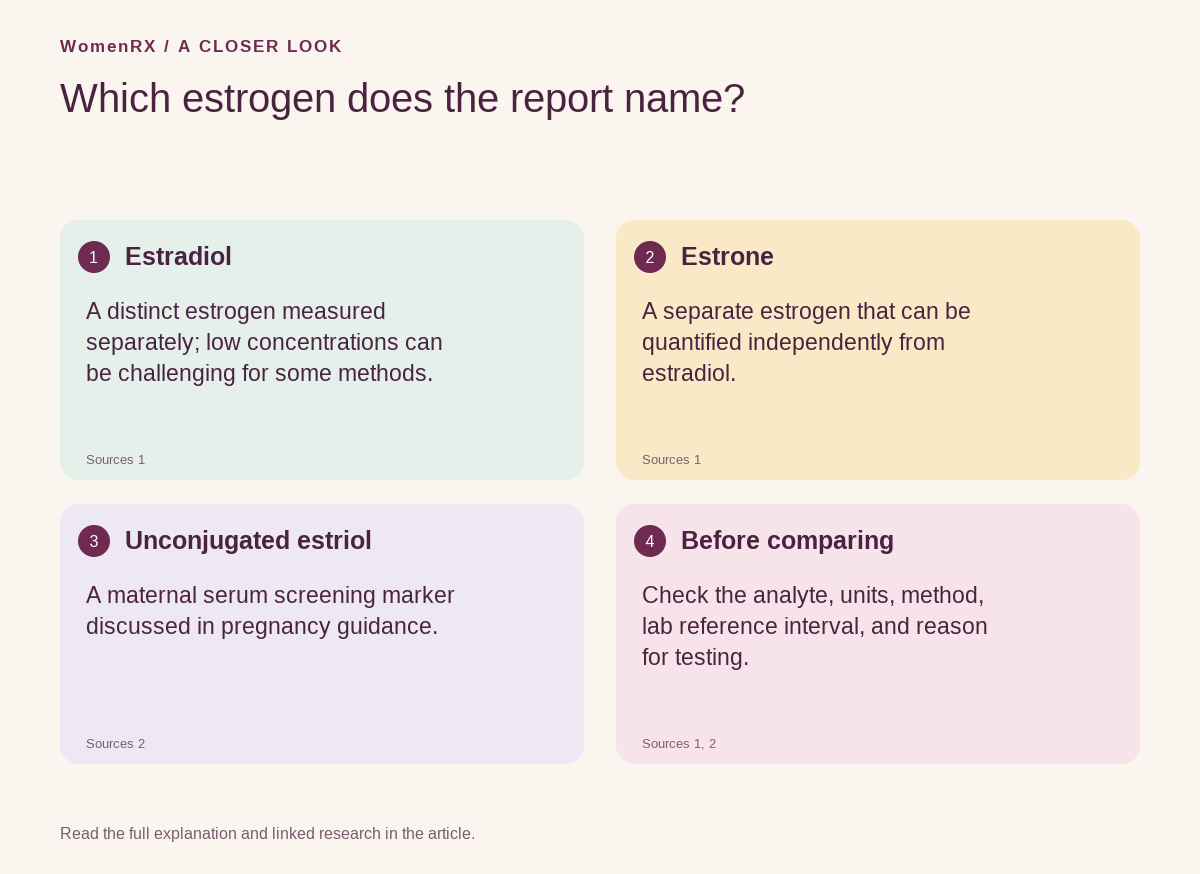
Which estrogen does the report name?
Estradiol: A distinct estrogen measured separately; low concentrations can be challenging for some methods.1
Estrone: A separate estrogen that can be quantified independently from estradiol.1
Unconjugated estriol: A maternal serum screening marker discussed in pregnancy guidance.2
Before comparing: Check the analyte, units, method, lab reference interval, and reason for testing.12
Read the figure as text
These names refer to distinct analytes and testing contexts. The comparison is not a set of reference ranges.- Estradiol: A distinct estrogen measured separately; low concentrations can be challenging for some methods.1
- Estrone: A separate estrogen that can be quantified independently from estradiol.1
- Unconjugated estriol: A maternal serum screening marker discussed in pregnancy guidance.2
- Before comparing: Check the analyte, units, method, lab reference interval, and reason for testing.12
More questions, answered
Is estradiol the same as estrogen?
No. Estradiol is one specific estrogen; estrone is another. Unconjugated estriol is also measured in some pregnancy screening contexts, so results for these analytes aren’t interchangeable. 1 2
Why might the test method matter for a low estradiol result?
At low concentrations, some immunoassays may have difficulty measuring estradiol reliably. A laboratory-method study reports that LC-MS/MS can offer greater specificity and sometimes greater sensitivity, though that finding doesn’t mean everyone needs a particular method. 1
Sources you can check
- Derivatization of estrogens enhances specificity and sensitivity of analysis of human plasma and serum by liquid chromatography tandem mass spectrometry.Faqehi AMM, Cobice DF, Naredo G, Mak TCS, Upreti R, Gibb FW, Beckett GJ, Walker BR, Homer NZM, Andrew R. · Talanta · 2016Return to first citation
- Obstetrical complications associated with abnormal maternal serum markers analytes.Gagnon A, Wilson RD, SOCIETY OF OBSTETRICIANS AND GYNAECOLOGISTS OF CANADA GENETICS COMMITTEE. · Journal of obstetrics and gynaecology Canada : JOGC = Journal d'obstetrique et gynecologie du Canada : JOGC · 2008Return to first citation