When to Take Maca: Morning or Evening?
A human trial used maca twice daily before meals, but it didn’t compare morning with evening.
There’s no supported reason here to prefer morning or evening. One human trial used a maca-containing blend twice daily before meals, but researchers chose that schedule partly to make it easier to follow, not to test which time worked best. 2 Treat that protocol as a study detail, not a universal rule; follow the directions for your specific product.
What the human study schedule actually tells us
A randomized trial in 95 people with knee osteoarthritis compared a maca-containing blend with glucosamine. The blend was taken twice daily before meals for eight weeks. The researchers said they chose twice-daily use partly to help participants follow the schedule, so the schedule describes how that particular product was studied. It doesn’t show that morning or evening is better, or that taking maca before meals is necessary for other products. 2
The trial also can’t isolate maca’s effects: maca was one ingredient in a combination product. Its schedule and results shouldn’t be treated as evidence about maca alone or as directions for every powder, capsule, or extract.
There’s a useful distinction between how often a product was taken, when in relation to meals it was taken, and what time of day it was taken. The trial reports the first two: twice daily and before meals. The reported protocol doesn’t say that the researchers compared morning use with evening use. So it can’t tell you whether changing the clock time would change an outcome. 2
A study protocol isn’t a best-time recommendation
A systematic review of maca studies on physical performance included randomized research in humans and animals. Its stated focus was performance outcomes, not a comparison of morning and evening use. That kind of research may describe a supplement routine, but a routine by itself doesn’t establish that the timing caused a benefit. 1
So the useful distinction is simple: a study schedule tells you what researchers did; a timing comparison would test whether changing the time changes an outcome. The human protocol described here offers the first, not the second. 2
It also helps to keep the product in view. A trial of a blend doesn’t establish a schedule for a different maca preparation. For example, if you have a standalone maca powder or a capsule with its own directions, the trial’s before-meal schedule doesn’t show that you should copy it. That’s true even though both products contain maca: the study tested its particular combination and routine, not every form of maca. 2
Choosing a routine without guessing
If you already take maca, use the directions on your specific product rather than borrowing the twice-daily schedule from the osteoarthritis trial. If the product doesn’t specify a time, this evidence doesn’t establish a best clock time or a benefit from taking it with or without food. There’s no evidence here that timing advice needs to change by sex or life stage.
If your product gives meal-related directions, treat those as directions for that product, not proof that maca generally needs to be taken with or away from food. If it gives no clock time, this evidence doesn’t offer a reason to choose morning over evening. The practical takeaway is to avoid turning a schedule used in one study into a rule for every product.
Pregnancy and breastfeeding call for a separate product-safety question, not a different timing rule. The knee osteoarthritis trial does not establish whether a maca product is safe during either life stage, so its schedule shouldn’t be used to infer safety. 2
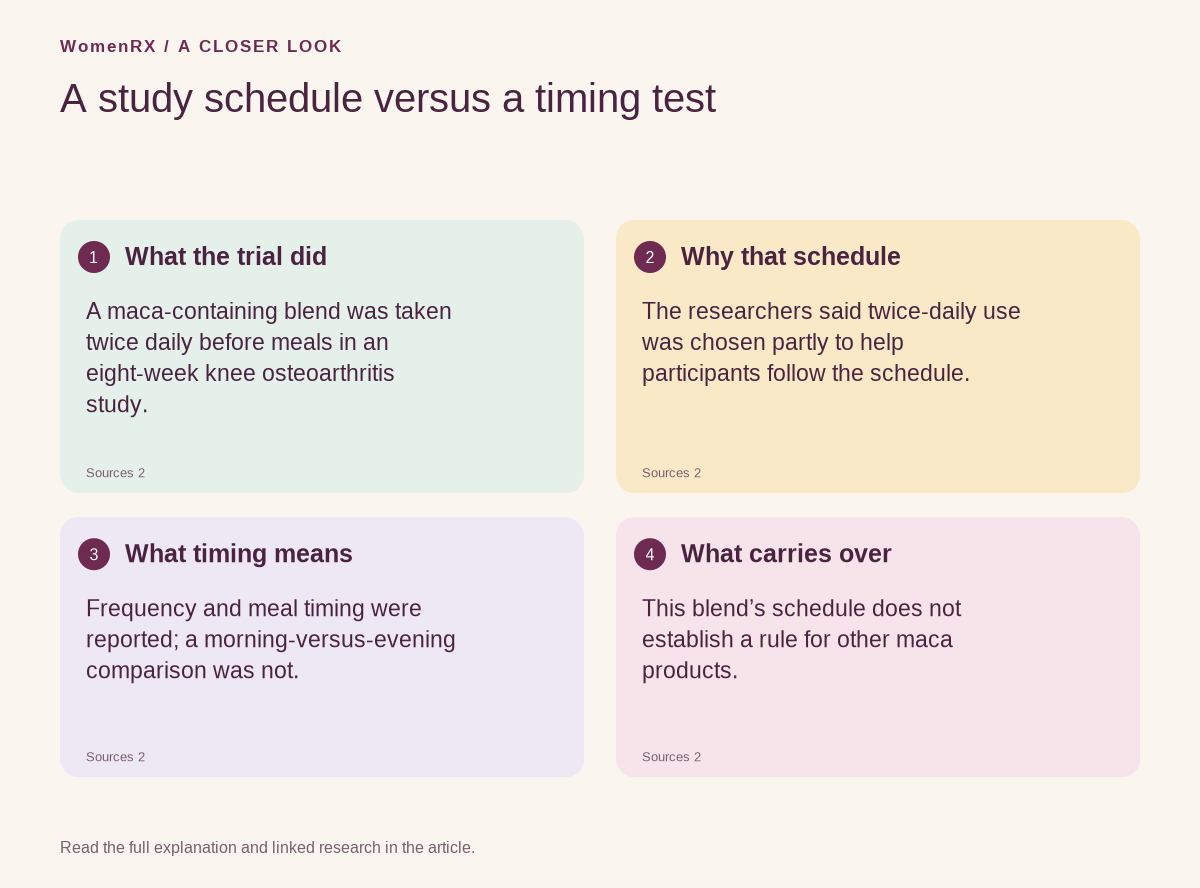
A study schedule versus a timing test
What the trial did: A maca-containing blend was taken twice daily before meals in an eight-week knee osteoarthritis study.2
Why that schedule: The researchers said twice-daily use was chosen partly to help participants follow the schedule.2
What timing means: Frequency and meal timing were reported; a morning-versus-evening comparison was not.2
What carries over: This blend’s schedule does not establish a rule for other maca products.2
Read the figure as text
Compare the routine reported in one maca-containing trial with the separate question of whether morning or evening use changes an outcome.- What the trial did: A maca-containing blend was taken twice daily before meals in an eight-week knee osteoarthritis study.2
- Why that schedule: The researchers said twice-daily use was chosen partly to help participants follow the schedule.2
- What timing means: Frequency and meal timing were reported; a morning-versus-evening comparison was not.2
- What carries over: This blend’s schedule does not establish a rule for other maca products.2
Sources you can check
- Effects of Maca (Lepidium meyenii Walp.) on Physical Performance in Animals and Humans: A Systematic Review and Meta-Analysis.Huerta Ojeda Á, Rodríguez Rojas J, Cancino-López J, Barahona-Fuentes G, Pavez L, Yeomans-Cabrera MM, Jorquera-Aguilera C. · Nutrients · 2024Return to first citation
- Comparison of glucosamine sulfate and a polyherbal supplement for the relief of osteoarthritis of the knee: a randomized controlled trial [ISRCTN25438351].Mehta K, Gala J, Bhasale S, Naik S, Modak M, Thakur H, Deo N, Miller MJ. · BMC complementary and alternative medicine · 2007Return to first citation