When to Discuss Switching From Sequential to Continuous HRT
If you’d rather not have a planned bleed, the key questions are whether you’re still cycling and how your prescribed progestogen schedule would change.
A switch may be worth discussing if scheduled bleeding no longer suits you. Sequential HRT adds a progestogen for part of the regimen; continuous combined HRT uses estrogen and a progestogen together every day, with the aim of avoiding planned bleeding. Spotting can still occur. Your menstrual history, current bleeding pattern, and exact prescription matter more than a single switch date. 1 2 3
What would actually change?
With a sequential regimen, the progestogen is used for part of the hormone schedule. With a continuous combined regimen, estrogen and a progestogen are used together every day. For example, one US sequential product contains estrogen alone in the first half of its schedule and estrogen plus medroxyprogesterone acetate in the second half; its continuous combined counterpart contains both hormones in each daily tablet. That’s an example of the distinction, not a schedule to apply to another prescription. 1
Sequential treatment can bring a predictable bleed linked to the progestogen phase. Continuous combined treatment is intended to avoid that planned bleed, but it isn’t a promise of no bleeding. The difference matters if your goal is fewer scheduled bleeds, rather than relief from new or unpredictable spotting. 3 4
Why your periods matter
If you’re still having natural periods, bleeding may reflect your own cycle as well as the treatment schedule. If your periods have stopped, the time since your last natural period helps frame the discussion. A bleed that occurs while you’re using sequential HRT isn’t necessarily a new natural period, so it’s worth being clear about which kind of bleeding you mean.
A trial comparing particular continuous and sequential regimens included women whose last bleeding had been 6-11 months earlier and women whose last bleeding had been at least 12 months earlier. Those were categories used to study bleeding patterns, not a rule that everyone should switch at a particular month or age. Menopausal hormone therapy decisions are individualized and periodically revisited. 3 2
What a change might do for bleeding
In that randomized trial of 446 late-perimenopausal and postmenopausal women, 12.2% assigned to the continuous combined regimen and 25.8% assigned to the sequential regimen reported irregular bleeding or spotting during the ninth treatment cycle. This measures irregular bleeding, not how many women had an expected, scheduled bleed. It also compares two regimens containing different estrogens and progestogens, so it can’t isolate the effect of changing the schedule or predict your experience with another prescription. 3
Still, the practical tradeoff is clear: continuous combined treatment removes the planned progestogen-free portion of a sequential schedule, while unexpected bleeding remains possible. If the predictable bleed is what bothers you, that may be a reasonable change to explore. If you’re already having bleeding that doesn’t fit your usual pattern, describe that separately rather than assuming a new regimen will solve it. 1 3
Bring your actual schedule into the decision
Before changing regimens, make sure the discussion covers:
- Your bleeding pattern: Are you having natural periods, an expected treatment-related bleed, spotting between bleeds, or a recent change?
- Your current hormones: What estrogen and progestogen are prescribed, and when do you use each one? Findings for one combination don’t automatically transfer to another. 3
- What you want from treatment now: Is avoiding a planned bleed the priority, and is the treatment still helping with the symptoms for which you started it? Hormone therapy’s benefits and risks vary with the formulation and circumstances, so periodic review is part of the decision. 2
If you have a uterus, switching isn’t simply a matter of leaving out the progestogen. Its role is to counter estrogen’s effect on the uterine lining: studies cited in US product information found less endometrial hyperplasia when a progestin was added for part of an estrogen cycle or taken daily with estrogen than with estrogen alone. The new regimen needs its own complete, prescribed hormone schedule. 1
Two hormone schedules, two bleeding expectations
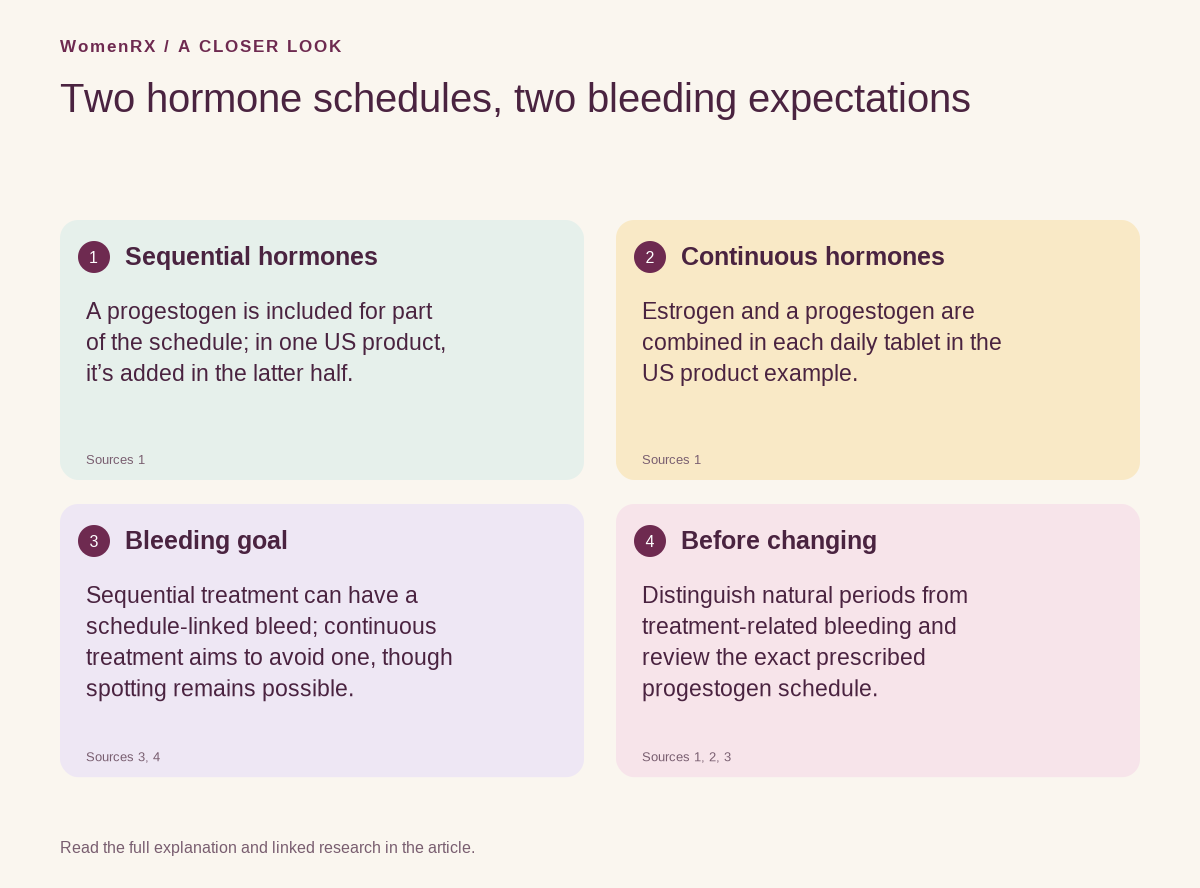
Sequential hormones: A progestogen is included for part of the schedule; in one US product, it’s added in the latter half.1
Continuous hormones: Estrogen and a progestogen are combined in each daily tablet in the US product example.1
Bleeding goal: Sequential treatment can have a schedule-linked bleed; continuous treatment aims to avoid one, though spotting remains possible.34
Before changing: Distinguish natural periods from treatment-related bleeding and review the exact prescribed progestogen schedule.123
Read the figure as text
A side-by-side guide to what changes when the progestogen becomes part of every day’s regimen.- Sequential hormones: A progestogen is included for part of the schedule; in one US product, it’s added in the latter half.1
- Continuous hormones: Estrogen and a progestogen are combined in each daily tablet in the US product example.1
- Bleeding goal: Sequential treatment can have a schedule-linked bleed; continuous treatment aims to avoid one, though spotting remains possible.34
- Before changing: Distinguish natural periods from treatment-related bleeding and review the exact prescribed progestogen schedule.123
Sources you can check
- PREMPHASE (CONJUGATED ESTROGENS AND MEDROXYPROGESTERONE ACETATE) KIT PREMPRO (CONJUGATED ESTROGENS AND MEDROXYPROGESTERONE ACETATE) TABLET, SUGAR COATED [WYETH PHARMACEUTICALS LLC, A SUBSIDIARY OF PFIZER INC.] | US prescribing information and patient instructionsAccessed 2026-09-25Return to first citation
- The 2022 hormone therapy position statement of The North American Menopause Society.“The 2022 Hormone Therapy Position Statement of The North American Menopause Society” Advisory Panel. · Menopause (New York, N.Y.) · 2022Return to first citation
- Bleeding patterns in peri and postmenopausal women taking a continuous combined regimen of estradiol with norethisterone acetate or a conventional sequential regimen of conjugated equine estrogens with medrogestone.von Holst T, Lang E, Winkler U, Keil D. · Maturitas · 2002Return to first citation
- The effect of a change in the dose of trimegestone on the pattern of bleeding in estrogen-treated post-menopausal women: 6 month extension of a dose-ranging study.Wahab M, Thompson J, Whitehead M, Al-Azzawi F. · Human reproduction (Oxford, England) · 2002Return to first citation