When Should Testosterone Therapy Be Reviewed for Effectiveness?
A planned check-in can help you weigh changes in desire against side effects and safety monitoring, without treating a study timeline as a promise.
There’s no guaranteed week when testosterone will improve desire. If you and your prescriber choose a review point, a check-in around 12 weeks is a practical time to discuss whether treatment is helping, not a proven response deadline or required interval. Raise bothersome effects sooner, and if there’s no meaningful benefit at review, reassess whether continuing makes sense. 1 4
Agree on a review point, but don’t wait to raise concerns
For women prescribed systemic testosterone for hypoactive sexual desire disorder (HSDD), a useful review asks two separate questions: has the concern you wanted to address meaningfully changed, and does the benefit still outweigh side effects and monitoring? The guidance focuses on HSDD, low desire associated with distress. It does not promise broader wellness benefits. 1
There isn’t a proven response deadline that applies to every woman. A meta-analysis included randomized trials lasting at least 12 weeks, but that describes how long studies ran, not when an individual should feel a change. As a practical plan, you could agree with your prescriber on a check-in around 12 weeks after starting. That’s a discussion point, not a guideline-mandated interval, a reason to wait through unwanted effects, or a guarantee of improvement. 1 4
If a new or bothersome effect appears before then, bring it up rather than waiting for the planned review. Acne and unwanted hair growth were reported more often in the randomized-trial meta-analysis. Your prescriber can also assess for signs of androgen excess and review testosterone levels as part of safety monitoring. 1 4
Track changes that matter to you
Before treatment, or now if you’ve already started, identify the specific low-desire concern you hoped would improve. At review, compare your experience with that starting point. For example, you might consider whether sexual interest feels more present, whether the distress around low desire has eased, or whether sexual experiences feel more satisfying. These are prompts for a personal conversation, not a validated score or outcomes you’re guaranteed to experience.
It’s also reasonable to discuss changes in relationship circumstances, mental health, or other factors that could be affecting desire. HSDD care guidance describes considering potentially modifiable factors as part of an individualized assessment, rather than treating the hormone as the only part of the picture. 3
A testosterone blood test answers a different question from “Do I feel better?” Guidance recommends using levels to monitor treatment and avoid concentrations above the physiologic premenopausal range. Blood levels do not predict treatment effectiveness, and there is no level that serves as a target for proving the treatment is working. 1 2
At the check-in, make a continuation decision
A review can be simple and specific: What has changed compared with before treatment? Is that change meaningful enough to you? Are side effects affecting the balance? What do the safety checks show? Studies found improvements in several sexual-function measures among postmenopausal women, but group results can’t tell you whether you personally will benefit. 4
If there’s no meaningful improvement at the agreed review, tell your prescriber and revisit the plan together. That may include reconsidering the factors contributing to low desire and whether continuing is worthwhile. A lab result alone isn’t proof of benefit or a reason to continue indefinitely. Long-term safety has not been established, so ongoing treatment calls for continued benefit-and-safety discussion. 1 2 3
The key is to set a review point in advance, bring up unwanted effects when they happen, and decide about continuation based on your experience as well as safety monitoring.
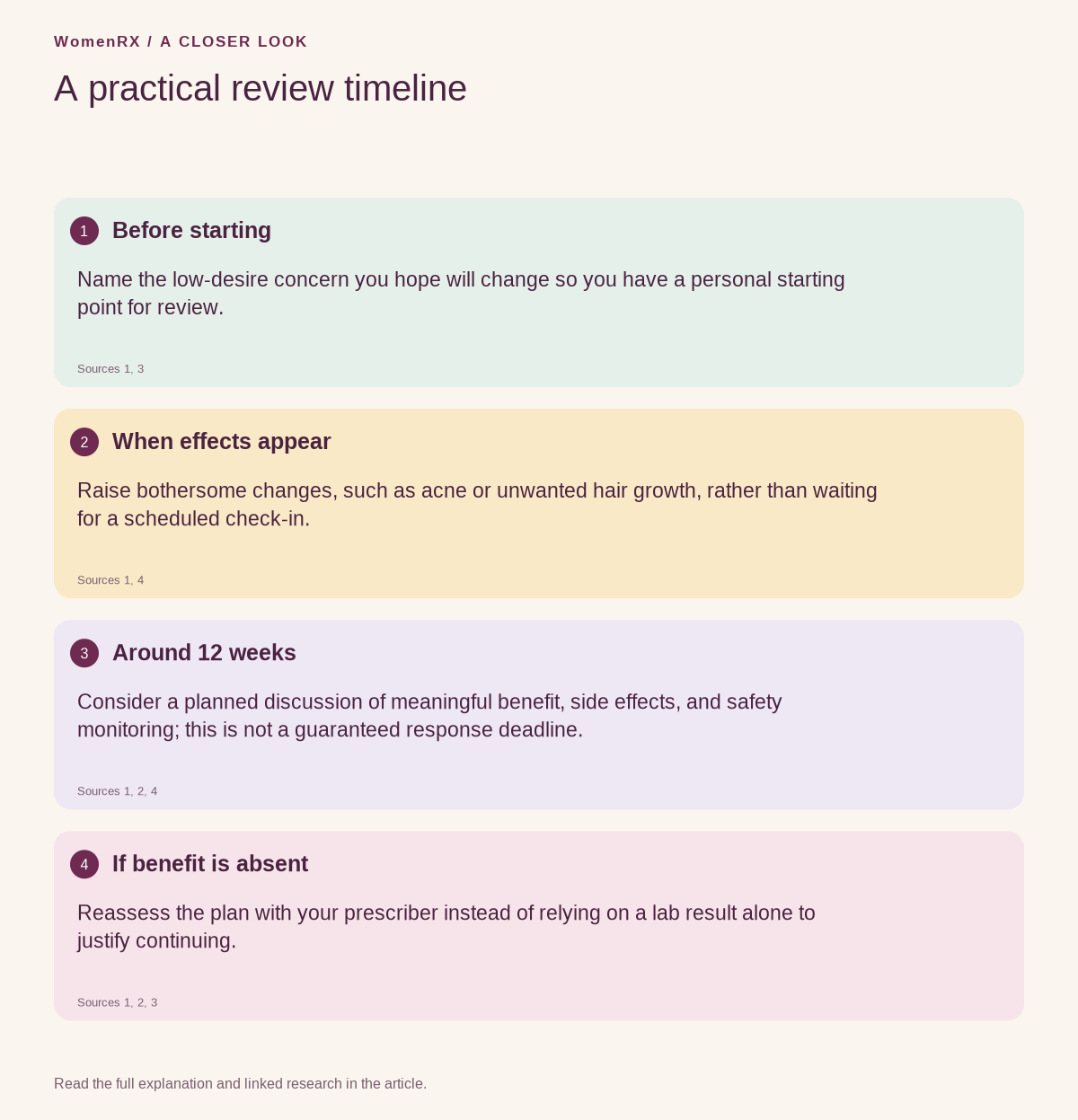
A practical review timeline
Before starting: Name the low-desire concern you hope will change so you have a personal starting point for review.13
When effects appear: Raise bothersome changes, such as acne or unwanted hair growth, rather than waiting for a scheduled check-in.14
Around 12 weeks: Consider a planned discussion of meaningful benefit, side effects, and safety monitoring; this is not a guaranteed response deadline.124
If benefit is absent: Reassess the plan with your prescriber instead of relying on a lab result alone to justify continuing.123
Read the figure as text
Use this sequence to plan conversations about benefit and safety. The 12-week check-in is a practical option, not a proven response deadline or universal follow-up rule.- Before starting: Name the low-desire concern you hope will change so you have a personal starting point for review.13
- When effects appear: Raise bothersome changes, such as acne or unwanted hair growth, rather than waiting for a scheduled check-in.14
- Around 12 weeks: Consider a planned discussion of meaningful benefit, side effects, and safety monitoring; this is not a guaranteed response deadline.124
- If benefit is absent: Reassess the plan with your prescriber instead of relying on a lab result alone to justify continuing.123
More questions, answered
Does a testosterone level show whether the treatment is working?
No. Guidance describes testosterone testing as a way to monitor levels for safety, not to predict effectiveness or measure whether desire has improved. 2
Sources you can check
- International Society for the Study of Women's Sexual Health Clinical Practice Guideline for the Use of Systemic Testosterone for Hypoactive Sexual Desire Disorder in Women.Parish SJ, Simon JA, Davis SR, Giraldi A, Goldstein I, Goldstein SW, Kim NN, Kingsberg SA, Morgentaler A, Nappi RE, Park K, Stuenkel CA, Traish AM, Vignozzi L. · The journal of sexual medicine · 2021Return to first citation
- International Society for the Study of Women's Sexual Health Clinical Practice Guideline for the Use of Systemic Testosterone for Hypoactive Sexual Desire Disorder in Women.Parish SJ, Simon JA, Davis SR, Giraldi A, Goldstein I, Goldstein SW, Kim NN, Kingsberg SA, Morgentaler A, Nappi RE, Park K, Stuenkel CA, Traish AM, Vignozzi L. · Journal of women's health (2002) · 2021Return to first citation
- The International Society for the Study of Women's Sexual Health Process of Care for Management of Hypoactive Sexual Desire Disorder in Women.Clayton AH, Goldstein I, Kim NN, Althof SE, Faubion SS, Faught BM, Parish SJ, Simon JA, Vignozzi L, Christiansen K, Davis SR, Freedman MA, Kingsberg SA, Kirana PS, Larkin L, McCabe... · Mayo Clinic proceedings · 2018Return to first citation
- Safety and efficacy of testosterone for women: a systematic review and meta-analysis of randomised controlled trial data.Islam RM, Bell RJ, Green S, Page MJ, Davis SR. · The lancet. Diabetes & endocrinology · 2019Return to first citation