When Low Desire May Meet HSDD Criteria
A diagnosis is about more than how often you want sex: clinicians look at its impact, persistence, context, and possible causes.
HSDD describes persistent low sexual desire that causes marked distress or interpersonal difficulty, not simply a lower level of desire than a partner has. An assessment considers whether the change is new or longstanding, happens across situations or only in particular circumstances, and may relate to health, medication, pain, stress, or relationship factors. US medication-label criteria focus on the pattern and its impact, not a frequency quota. 2345
The key distinction is impact, not a number
The US medication-label criteria for HSDD describe low desire that causes marked distress or interpersonal difficulty; they don't specify a quota for sexual thoughts, occasions, or initiations. A difference between partners’ levels of interest does not by itself establish a disorder. The question is whether low desire is troubling to you or causing interpersonal difficulty, and whether the broader pattern fits a clinical concern. Descriptions of HSDD often emphasize personal distress, while the cited US labels explicitly say marked distress or interpersonal difficulty. 2345
That distinction can make room for two different truths: you may want more desire for yourself, or you may mainly feel pressure because someone else expects it. A clinician should take your own experience seriously rather than treat sexual frequency or a partner’s dissatisfaction as a diagnosis.
What an assessment usually explores
What changed, and when? A clinician may ask whether desire has decreased from your usual level or has generally been low throughout your life. The “acquired” pattern used in US medication labeling means desire problems began after a time when there had not been a problem. That is one clinical distinction, not a judgment about which history is more valid. 23
Is the change broad or situation-specific? “Generalized” means low desire across types of stimulation, situations, or partners. If desire is present in some settings but not others, that context can help shape the assessment rather than automatically pointing to HSDD. 23
How does it affect you and your relationships? The clinician should ask about your own distress and any interpersonal difficulty, not infer either from how often you have sex or what a partner wants. Medication labeling describes the relevant low desire as causing marked distress or interpersonal difficulty. 23
What else could be contributing? Health or mental-health conditions, medications or other substances, pain, arousal or orgasm concerns, relationship difficulties, stress, and fatigue can all matter. A symptom questionnaire used in research also asks about pregnancy, recent childbirth, and menopausal symptoms as possible contributors. These factors are prompts for discussion, not proof of a cause or automatic reasons to dismiss what you are experiencing. 135
The assessment may therefore involve questions about your health, medicines, sexual experiences, and relationship context. 135
Life stage can change the context
A research questionnaire asked about pregnancy, recent childbirth, and menopausal symptoms as possible contributors to decreased desire; that list does not establish whether any of them caused a change. 5 A study of urban Chinese women of childbearing age found that respondents often attributed decreased desire to stress and fatigue; because it was an online cross-sectional survey in one population, it cannot tell us what causes low desire in an individual woman or how common HSDD is across US life stages. 5
Evidence and treatment eligibility also differ by population. The US prescribing information for bremelanotide describes use for premenopausal women with acquired, generalized HSDD. Flibanserin’s US label describes use for women younger than 65 with acquired, generalized HSDD. Those medication criteria do not define every clinical assessment, and they should not be taken to mean that low desire outside those groups is unreal or unworthy of care. 23
What the label does, and doesn’t, tell you
You may hear two different terms. The DSM-5 groups concerns about sexual interest and arousal under female sexual interest/arousal disorder (FSIAD), rather than retaining HSDD as its separate desire category. HSDD remains a term in clinical discussion and in US medication labels. The terms overlap, but a medication’s HSDD indication is not the full set of DSM-5 criteria. 236
HSDD is a clinical way to describe a pattern involving marked distress or interpersonal difficulty, not a verdict about your sexuality or relationship. Diagnostic categories have limits: research continues to debate whether desire is best captured by a categorical diagnosis, and one study based on nonclinical participants cautioned that its findings could not be generalized as clinician-made diagnoses. 6
A useful next step is to describe the pattern in your own words: what feels different, whether it is troubling to you or causing interpersonal difficulty, where desire does or doesn’t show up, and what else changed around the same time. That gives a clinician something more meaningful to assess than a count of sexual encounters.
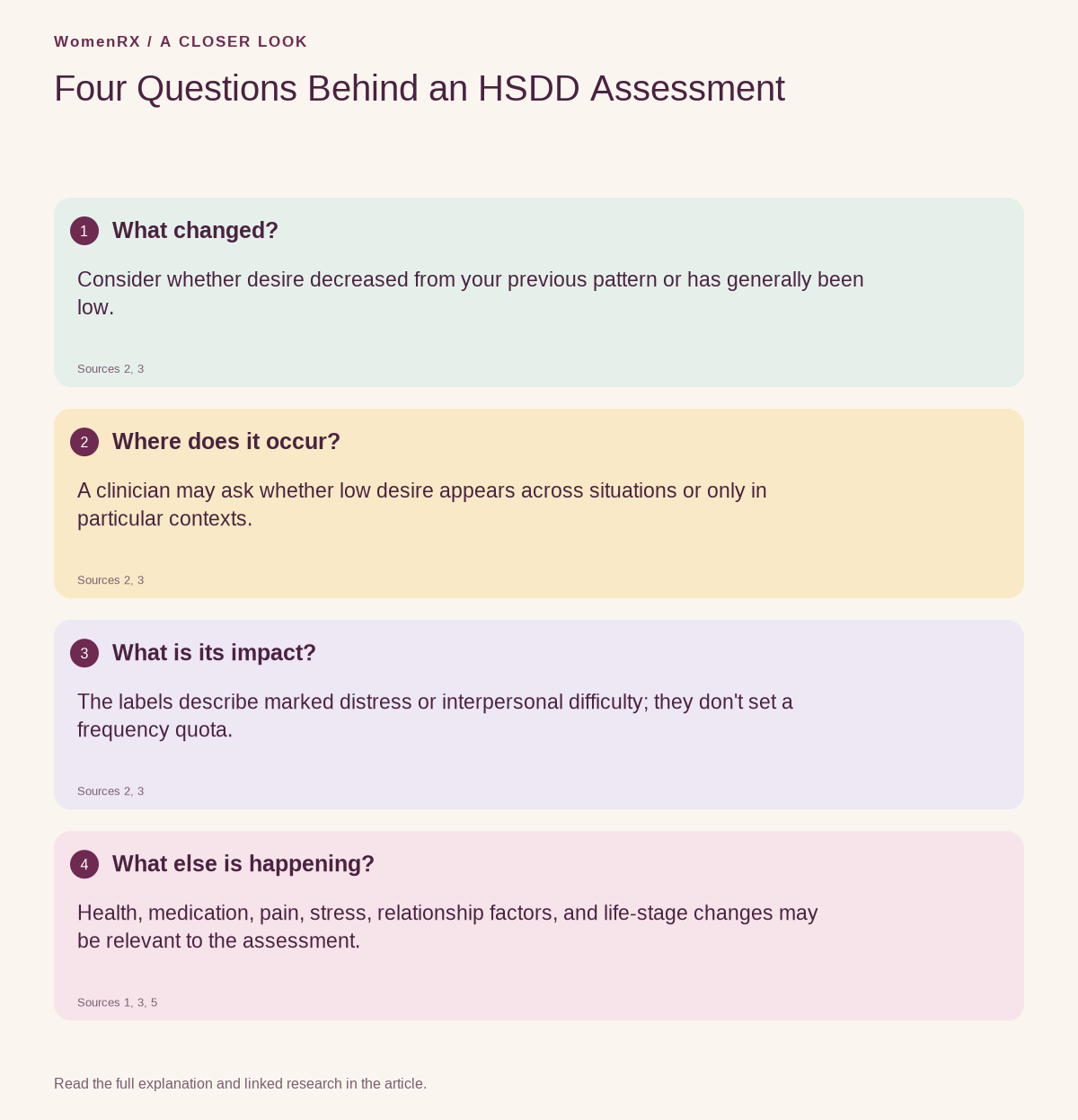
Four Questions Behind an HSDD Assessment
What changed?: Consider whether desire decreased from your previous pattern or has generally been low.23
Where does it occur?: A clinician may ask whether low desire appears across situations or only in particular contexts.23
What is its impact?: The labels describe marked distress or interpersonal difficulty; they don't set a frequency quota.23
What else is happening?: Health, medication, pain, stress, relationship factors, and life-stage changes may be relevant to the assessment.135
Read the figure as text
These domains help explain what a clinician may explore. They are conversation prompts, not a self-diagnosis checklist.- What changed?: Consider whether desire decreased from your previous pattern or has generally been low.23
- Where does it occur?: A clinician may ask whether low desire appears across situations or only in particular contexts.23
- What is its impact?: The labels describe marked distress or interpersonal difficulty; they don't set a frequency quota.23
- What else is happening?: Health, medication, pain, stress, relationship factors, and life-stage changes may be relevant to the assessment.135
More questions, answered
Can a desire mismatch with a partner be HSDD?
A mismatch alone doesn’t establish HSDD. An assessment considers whether low desire causes marked distress or interpersonal difficulty and whether other symptoms or circumstances help explain it. A partner’s preferred frequency isn’t the diagnostic standard. 235
Sources you can check
- Sexual Health | MedlinePlusAccessed 2026-09-25Return to first citation
- VYLEESI (BREMELANOTIDE) INJECTION [COSETTE PHARMACEUTICALS, INC.] | US prescribing information and patient instructionsAccessed 2026-09-25Return to first citation
- ADDYI (FLIBANSERIN) TABLET, FILM COATED [SPROUT PHARMACEUTICALS, INC.] | US prescribing information and patient instructionsAccessed 2026-09-25Return to first citation
- Female Sexual Interest and Arousal DisorderAdebisi OY, Carlson K. · 2026Return to first citation
- Decreased sexual desire and distress symptoms: an analysis among urban Chinese women.Luo L, Fu T, Huang J, Li H. · Sexual medicine · 2026Return to first citation
- Do the DSM-5 criteria actually reflect the clinical reality of female sexual dysfunctions?Pagnini G, Fumarola E, Salvatori G, Déttore D. · The journal of sexual medicine · 2025Return to first citation