What Your Cholesterol Results Say About Heart Risk
A lipid panel shows several kinds of fats in your blood, but your next step depends on your health history as well as the numbers.
Start with LDL cholesterol, then look at HDL, triglycerides, and non-HDL cholesterol together. For adults, LDL below 100 mg/dL is a general guide, not a treatment threshold. 8 Non-HDL is total cholesterol minus HDL. None of these numbers is a stand-alone verdict. Blood pressure, diabetes, smoking, and your history help determine whether lifestyle changes, medication, or both deserve a discussion. 1347
Read the panel as a set, not a scorecard
A cholesterol result can feel surprisingly personal, especially if you’ve been eating well and expected different numbers. But the panel is measuring what’s in your blood, not grading your effort. Your clinician uses those results alongside factors such as age, blood pressure, and health conditions to assess cardiovascular risk. The result that needs attention for one woman may lead to a different conversation for another. 37
Here’s what each measure contributes:
- LDL cholesterol (LDL-C) carries cholesterol in particles that can contribute to plaque buildup in arteries when LDL is high. It’s a central measure in decisions about lowering cholesterol. 13
- HDL cholesterol (HDL-C) carries cholesterol from other parts of the body back to the liver. It provides useful context, but an HDL result doesn’t erase concern about high LDL or other risk factors. 17
- Triglycerides are a different kind of fat in the blood, not another name for cholesterol. They add information about your lipid profile and can also be relevant to heart risk. 13
- Non-HDL cholesterol is total cholesterol minus HDL cholesterol. In plain language, it shows the cholesterol left outside the HDL portion, including cholesterol carried in LDL and other particles. It’s another way to look at the panel, not a separate test you need to guess from a single LDL result. 37
Total cholesterol is the overall amount of cholesterol measured in your blood. On its own, it doesn’t show how much is HDL versus non-HDL. For example, if two women have the same total cholesterol but different HDL results, their non-HDL results will differ too. That arithmetic is one reason to ask for the full panel rather than judge the total alone. 7
For a numerical starting point, MedlinePlus lists these general guides for adults: total cholesterol below 200 mg/dL, LDL below 100 mg/dL, non-HDL below 130 mg/dL, and triglycerides below 150 mg/dL. It lists HDL of 60 mg/dL or higher as best. These figures help you locate a result on the page. They don’t, by themselves, tell you whether you need medication or what your personal target should be. 8
What changes the meaning of a result?
The question isn’t simply, “Is this number high?” It’s, “What does this result mean alongside my other risks?” A history of heart attack or stroke changes the medication conversation. Diabetes, kidney disease, or inherited high cholesterol can matter too. A strong family pattern of very high cholesterol is worth mentioning even if your result is the first one that has drawn attention. 234
Midlife adds another layer. Cholesterol levels tend to rise with age, and the risk of high cholesterol rises after menopause. Reviews also describe changes in lipid metabolism and cardiovascular risk across the menopause transition. That doesn’t mean every change in your panel was caused by menopause, or that menopause alone determines treatment. It does make a comparison with earlier results useful. 356
Your reproductive history can supply context a lipid panel can’t. Early menopause and premature ovarian insufficiency have been associated with higher cardiovascular risk; a review also identifies pregnancy history as relevant to assessing risk in younger women. If either applies to you, bring it into the conversation rather than assuming it’s already reflected in a risk estimate. 6
Timing matters in a more immediate way if you’ve recently had a baby: cholesterol results may be higher or lower in that period. If you’re pregnant, planning pregnancy, or breastfeeding, say so before making a medication plan. MedlinePlus advises against statin use during pregnancy and breastfeeding; if you already take one, discuss what to do with your prescriber rather than stopping it on your own. 17
When does the conversation turn to treatment?
Heart-healthy eating, regular physical activity, and weight management can help lower cholesterol, though none guarantees a particular result. Saturated fat intake is one factor that can raise LDL; genetics, other conditions, and some medicines can affect cholesterol too. A result that hasn’t changed much after lifestyle adjustments isn’t proof you’ve done something wrong. 3
Medication may be discussed when lifestyle changes aren’t enough or when overall cardiovascular risk makes them unlikely to be enough on their own. Statins lower LDL by reducing cholesterol production in the liver and helping the liver clear LDL from the blood. They’ve been shown to reduce heart attack and stroke risk in people with high LDL cholesterol. The reason for recommending a medicine, and the benefit expected from it, should be clear to you before you decide. 124
A useful way to review your results is to ask: Which part of my panel is driving concern? What else in my history changes my risk assessment? What would make us consider medication rather than lifestyle changes alone? If you’re around menopause, have had early menopause, or may become pregnant, add that context to the same discussion. You’re asking for an explanation of the decision, not just a verdict on a number. 1467
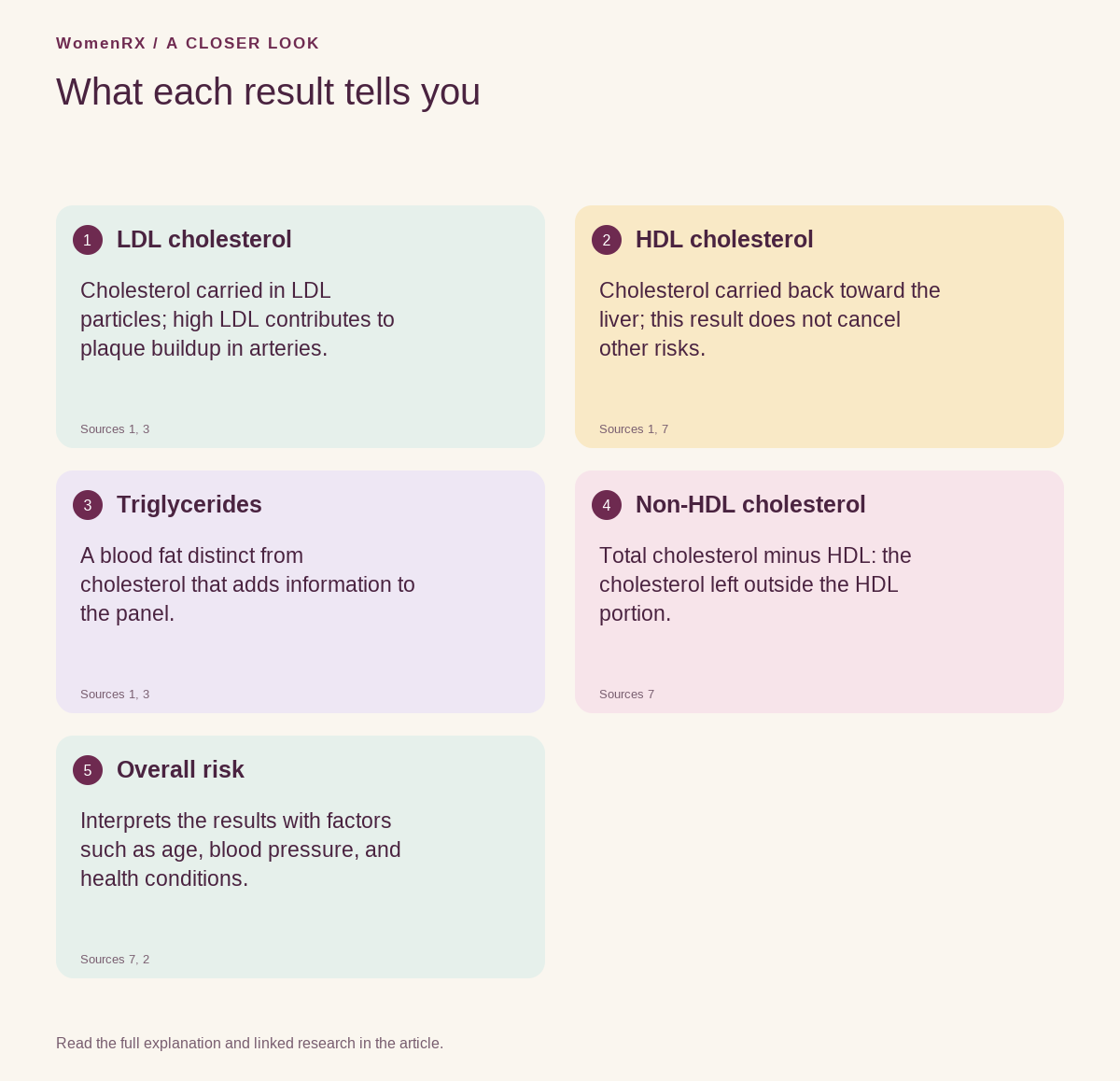
What each result tells you
LDL cholesterol: Cholesterol carried in LDL particles; high LDL contributes to plaque buildup in arteries.13
HDL cholesterol: Cholesterol carried back toward the liver; this result does not cancel other risks.17
Triglycerides: A blood fat distinct from cholesterol that adds information to the panel.13
Non-HDL cholesterol: Total cholesterol minus HDL: the cholesterol left outside the HDL portion.7
Overall risk: Interprets the results with factors such as age, blood pressure, and health conditions.72
Read the figure as text
A lipid panel describes fats in the blood; an overall risk assessment adds your health history.- LDL cholesterol: Cholesterol carried in LDL particles; high LDL contributes to plaque buildup in arteries.13
- HDL cholesterol: Cholesterol carried back toward the liver; this result does not cancel other risks.17
- Triglycerides: A blood fat distinct from cholesterol that adds information to the panel.13
- Non-HDL cholesterol: Total cholesterol minus HDL: the cholesterol left outside the HDL portion.7
- Overall risk: Interprets the results with factors such as age, blood pressure, and health conditions.72
Sources you can check
- Statins: MedlinePlusAccessed 2026-09-25Return to first citation
- Statins - NHSAccessed 2026-09-25Return to first citation
- Cholesterol | MedlinePlusAccessed 2026-09-25Return to first citation
- Cholesterol Medicines: MedlinePlusAccessed 2026-09-25Return to first citation
- Cardiovascular Disease Risk in Women with Menopause.Fasero M, Coronado PJ. · Journal of clinical medicine · 2025Return to first citation
- Role of menopause in the development of cardiovascular disease in women.Das S, Wang W, Kunadian V. · Open heart · 2026Return to first citation
- High cholesterol - Cholesterol levels - NHSAccessed 2026-09-25Return to first citation
- Cholesterol Levels: What You Need to Know: MedlinePlusAccessed 2026-09-25Return to first citation