A Practical Guide to Your Heart and Metabolic Risk
Your blood pressure, cholesterol, blood sugar, smoking history, and family history tell a more useful story together than your weight alone.
For a heart and metabolic risk review, bring recent blood pressure, cholesterol, and blood sugar results, plus your smoking and family history. Mention past gestational diabetes and when your periods stopped, if applicable. Together, these details tell you more than weight alone.139 Sudden chest discomfort that doesn’t go away, spreads, or comes with sweating, nausea, lightheadedness, or shortness of breath needs emergency help, not a routine appointment.10
Start with what you know, not a risk score
You don't need to calculate your own heart risk before a check-up. A useful starting point is a short picture of your health: any recent blood pressure readings; a cholesterol or lipid panel, if you have one; what you know about your blood sugar or diabetes history; whether you smoke; and whether a close relative developed heart disease early. Age and family history matter, but the factors you may be able to change deserve attention too.156
Bring the actual results if they're easy to find. “My cholesterol was high” is worth mentioning, but a lipid panel can show different patterns, including LDL cholesterol and triglycerides. If you don't have recent results, that's a question for the visit, not a reason to put it off.5
Family history is most useful when it's specific. For example, was it your mother or sister who developed heart disease before 65, or your father or brother before 55? Those are the early-family-history examples MedlinePlus identifies. If you don't know the age or diagnosis, say what you do know.19
Ask what the measurements mean together
Blood pressure, blood lipids, and blood sugar are connected to cardiovascular risk, but they aren't interchangeable. High blood pressure is one factor in cardiovascular risk. High LDL cholesterol can contribute to disease in the arteries. Over time, high blood sugar in diabetes can damage blood vessels and the nerves that help control the heart and blood vessels.157
That means the most useful question isn't simply, “Is this number normal?” Try: “Looking at these results together, which factor should we focus on first, and why?” A plan may differ for someone who smokes and has high blood pressure, for example, from one for someone with an unusual lipid result and a strong family history. Risk assessments use several factors, and a lipid review may also consider whether an abnormal result has another cause.56
A single elevated office blood pressure reading may need confirmation rather than an immediate conclusion. Ask whether readings outside the office would help clarify it. A systematic evidence review found that one-visit office screening and follow-up measurement have limitations; it did not establish one best confirmation protocol for everyone.8
Weight can be part of this conversation, but it shouldn't replace it. MedlinePlus notes that excess weight is linked to heart risk in large part through factors such as blood pressure, lipids, and diabetes. Ask about those measurable factors directly, whatever you weigh.1
Add the history a standard set of numbers can miss
If you had gestational diabetes, bring it up even if your blood sugar returned to normal after pregnancy. It raises your chance of developing type 2 diabetes later. A useful question is, “Do I need a blood sugar check now, and how should we follow it over time?” This is a reason to revisit glucose risk, not a claim that gestational diabetes tells you your current heart-risk level by itself.34
Menopause belongs in the history too. Heart-disease risk rises with age, and MedlinePlus describes an increase after menopause; it also identifies periods stopping before age 40 as a higher-risk history compared with other women of the same age. If that applies to you, mention when your periods stopped. Menopause alone doesn't explain an individual result or determine a treatment decision.19
Two other distinctions are worth knowing. Diabetes raises heart-disease risk more in women than in men, according to MedlinePlus. High triglycerides may also be particularly relevant to coronary artery risk in women. Neither point means you should interpret a lab result in isolation. It means diabetes history and the specific results on your lipid panel deserve a place in the discussion.1
Finally, tell the person reviewing your risk whether you smoke and what physical activity looks like in your life. For example, “I walk most workdays but sit through the evening” is more useful context than trying to give yourself a pass-or-fail grade. Smoking appears in cardiovascular risk models, while physical activity can add context that a standard calculation may not capture.6
Separate prevention from symptoms happening now
A check-up is for questions such as whether you need a blood pressure recheck, glucose testing, a closer look at your lipid results, or a discussion of ways to lower risk. Some cardiovascular conditions have no symptoms, so feeling well doesn't make those questions pointless.25
Symptoms happening now are a different task. If you have sudden chest pain or discomfort that doesn't go away, especially if it spreads to an arm, neck, jaw, stomach, or back, or comes with sweating, nausea, lightheadedness, or shortness of breath, seek emergency help immediately. Chest pain that comes and goes still calls for medical advice rather than waiting for a routine risk review.10
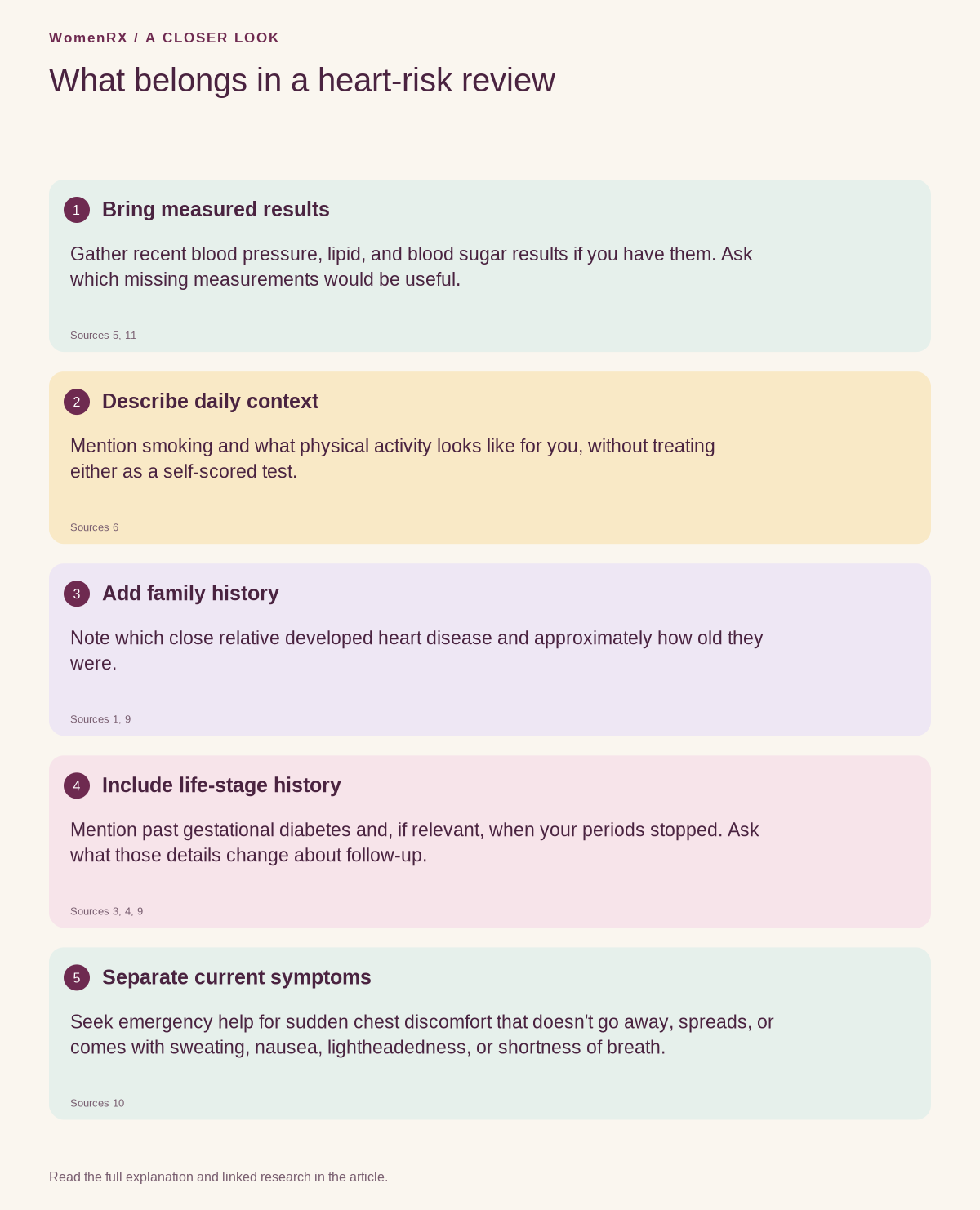
What belongs in a heart-risk review
Bring measured results: Gather recent blood pressure, lipid, and blood sugar results if you have them. Ask which missing measurements would be useful.511
Describe daily context: Mention smoking and what physical activity looks like for you, without treating either as a self-scored test.6
Add family history: Note which close relative developed heart disease and approximately how old they were.19
Include life-stage history: Mention past gestational diabetes and, if relevant, when your periods stopped. Ask what those details change about follow-up.349
Separate current symptoms: Seek emergency help for sudden chest discomfort that doesn't go away, spreads, or comes with sweating, nausea, lightheadedness, or shortness of breath.10
Read the figure as text
Use these prompts to gather useful context and keep symptoms happening now separate from a routine prevention visit.- Bring measured results: Gather recent blood pressure, lipid, and blood sugar results if you have them. Ask which missing measurements would be useful.511
- Describe daily context: Mention smoking and what physical activity looks like for you, without treating either as a self-scored test.6
- Add family history: Note which close relative developed heart disease and approximately how old they were.19
- Include life-stage history: Mention past gestational diabetes and, if relevant, when your periods stopped. Ask what those details change about follow-up.349
- Separate current symptoms: Seek emergency help for sudden chest discomfort that doesn't go away, spreads, or comes with sweating, nausea, lightheadedness, or shortness of breath.10
More questions, answered
Do I need a risk calculator result before my visit?
No. Bring the information you have. Risk assessment considers several factors, and a family history of an early heart attack can add context that a standard calculator may leave out. Ask how any estimate fits your broader history.56
What if my blood pressure is high only at the appointment?
Ask whether it should be confirmed with additional measurements. One office screening reading has limits, and the best follow-up approach depends on the situation.8
Sources you can check
- Heart Disease Prevention | MedlinePlusAccessed 2026-09-25Return to first citation
- Cardiovascular disease - NHSAccessed 2026-09-25Return to first citation
- Gestational diabetes - NHSAccessed 2026-09-25Return to first citation
- Gestational diabetes - Treatment - NHSAccessed 2026-09-25Return to first citation
- Approach to the Patient with DyslipidemiaFeingold KR. · 2000Return to first citation
- Novel Self-Report Tool for Cardiovascular Risk Assessment.Mansoor H, Jo A, Beau De Rochars VM, Pepine CJ, Mainous AG. · Journal of the American Heart Association · 2019Return to first citation
- UKPDS-modelling of cardiovascular risk assessment and lifetime simulation of outcomes.Adler AI. · Diabetic medicine : a journal of the British Diabetic Association · 2008Return to first citation
- Screening for Hypertension in Adults: An Updated Systematic Evidence Review for the U.S. Preventive Services Task ForceGuirguis-Blake JM, Evans CV, Webber EM, Coppola EL, Perdue LA, Weyrich MS. · 2021Return to first citation
- Heart Disease in Women | MedlinePlusAccessed 2026-09-25Return to first citation
- Chest pain - NHSAccessed 2026-09-25Return to first citation
- Metabolic syndrome - NHSAccessed 2026-09-25Return to first citation