Estrogen, Menopause, and Cholesterol: How to Read the Evidence
Hormone therapy can shift some cholesterol numbers, but a better-looking lipid panel is not the same as proof of fewer heart attacks or strokes.
Cholesterol often changes with age, and the chance of high cholesterol rises after menopause, but one test can’t show how much of a change is due to estrogen. Studies find that menopause hormone therapy can improve some lipid markers, with results varying by route and formulation. Those lab changes don’t establish cardiovascular protection, so assess cholesterol and overall risk on their own. 1 4
A cholesterol change isn’t a menopause diagnosis
A lipid panel is a snapshot of cholesterol carried in the blood, not a test of why it changed. LDL can contribute to plaque buildup in arteries; HDL carries cholesterol back to the liver. Cholesterol tends to rise as people get older, and women’s risk of high cholesterol rises after menopause. Because age and menopause overlap, a change in your results can’t automatically be assigned to falling estrogen. 1
That distinction matters when you’re comparing tests over time. A result is most useful alongside your age, other risk factors, and family history, rather than as a stand-alone verdict about menopause or hormone levels. High cholesterol usually has no symptoms, so a blood test, not how you feel, is what identifies it. 1
What hormone therapy studies say about lipid numbers
A systematic review and meta-analysis of 73 randomized trials in postmenopausal women found that menopause hormone therapy lowered total cholesterol and LDL cholesterol overall compared with placebo or no treatment. The review also found that results differed across treatment approaches: oral therapy was associated with higher triglycerides than transdermal therapy in the pooled comparison, and comparisons between estrogen alone and estrogen-plus-progestogen regimens did not show identical lipid results. 4
Those findings are about markers measured in blood. They don’t show that starting hormone therapy to change LDL or total cholesterol prevents heart attacks, strokes, or other cardiovascular events. Nor do pooled averages predict what will happen to one person’s test. The review noted that long-term effects and differences between routes were sparsely reported, which limits how confidently its findings can guide an individual choice. 4
Route and formulation are therefore part of the evidence, not details to gloss over. “Estrogen” isn’t one uniform treatment effect: the studies grouped together different approaches, and the results varied. The Menopause Society also says hormone therapy’s risks differ by type, dose, duration, route, timing of initiation, and whether a progestogen is used. Treatment decisions should be individualized and periodically revisited. 3 4
Keep the treatment question separate from the lipid question
Hormone therapy remains an effective treatment for bothersome hot flashes and other vasomotor symptoms, and it can help prevent bone loss. Those are different goals from treating high cholesterol. A favorable shift in LDL or total cholesterol doesn’t establish that hormone therapy is the right choice for someone whose main concern is cardiovascular risk. 3 4
For a cholesterol result, use the usual risk-assessment path: review the panel with your age, risk factors, and family history. If treatment is needed, cholesterol medicines and heart-healthy lifestyle changes address cholesterol directly; the choice depends on the person’s results and overall health. 1 2
If you’re already taking hormone therapy and your lipid panel changes, don’t assume either that the treatment caused the change or that its lipid effects are protective. Bring the actual results and the therapy’s purpose into the discussion. The useful comparison is between your cardiovascular risk and the reasons you’re using hormone therapy, not simply whether one cholesterol number moved in a favorable direction. 1 3
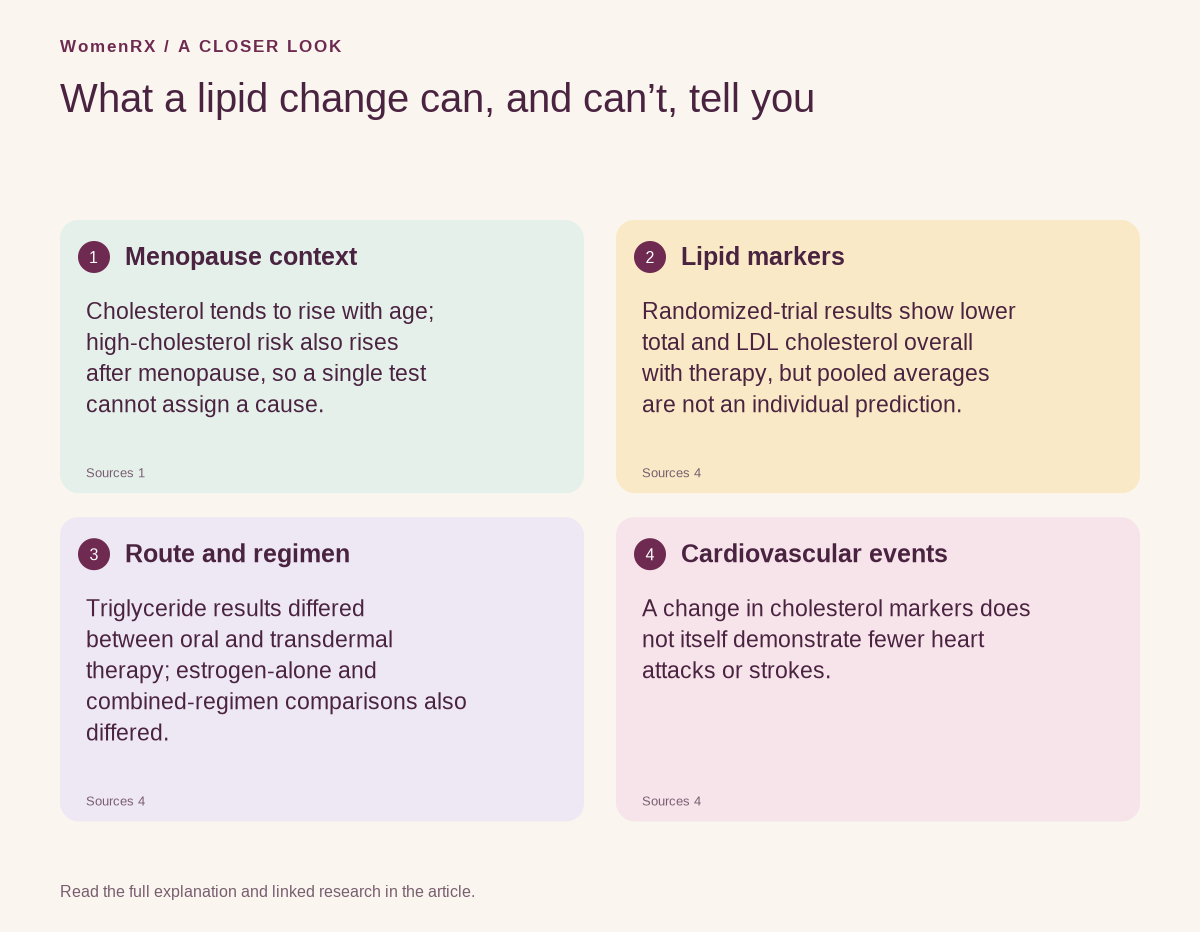
What a lipid change can, and can’t, tell you
Menopause context: Cholesterol tends to rise with age; high-cholesterol risk also rises after menopause, so a single test cannot assign a cause.1
Lipid markers: Randomized-trial results show lower total and LDL cholesterol overall with therapy, but pooled averages are not an individual prediction.4
Route and regimen: Triglyceride results differed between oral and transdermal therapy; estrogen-alone and combined-regimen comparisons also differed.4
Cardiovascular events: A change in cholesterol markers does not itself demonstrate fewer heart attacks or strokes.4
Read the figure as text
Separate the evidence on blood-test markers from cardiovascular outcomes, while keeping route and formulation differences visible.- Menopause context: Cholesterol tends to rise with age; high-cholesterol risk also rises after menopause, so a single test cannot assign a cause.1
- Lipid markers: Randomized-trial results show lower total and LDL cholesterol overall with therapy, but pooled averages are not an individual prediction.4
- Route and regimen: Triglyceride results differed between oral and transdermal therapy; estrogen-alone and combined-regimen comparisons also differed.4
- Cardiovascular events: A change in cholesterol markers does not itself demonstrate fewer heart attacks or strokes.4
More questions, answered
If my LDL improves on hormone therapy, does that mean my heart risk is lower?
Not by itself. The hormone-therapy meta-analysis evaluated lipid markers, and a change in those numbers does not establish a reduction in heart attacks or strokes. Interpret the panel as one part of cardiovascular risk assessment. 1 4
Why might oral and transdermal hormone therapy show different triglyceride results?
In a meta-analysis of randomized trials, oral therapy was associated with higher triglycerides than transdermal therapy in the pooled comparison. That is a group-level finding, not a prediction for an individual, and it doesn’t establish which route is appropriate for a particular person. 4
Sources you can check
- Cholesterol | MedlinePlusAccessed 2026-09-25Return to first citation
- Cholesterol Medicines: MedlinePlusAccessed 2026-09-25Return to first citation
- The 2022 hormone therapy position statement of The North American Menopause Society.“The 2022 Hormone Therapy Position Statement of The North American Menopause Society” Advisory Panel. · Menopause (New York, N.Y.) · 2022Return to first citation
- The Effects of Menopause Hormone Therapy on Lipid Profile in Postmenopausal Women: A Systematic Review and Meta-Analysis.Nie G, Yang X, Wang Y, Liang W, Li X, Luo Q, Yang H, Liu J, Wang J, Guo Q, Yu Q, Liang X. · Frontiers in pharmacology · 2022Return to first citation