How Does Menopause Relate to Heart Disease Risk?
Menopause adds context to your heart-health picture, but your blood pressure, cholesterol, health conditions, and history help make it personal.
Heart disease risk rises during the midlife years, when menopause and aging overlap. Menopause is worth mentioning in a cardiovascular review, especially if it happened early, but it doesn’t predict your outcome on its own. Review your blood pressure, cholesterol, diabetes status, smoking, family history, and pregnancy history together rather than focusing on menopause alone. 1 3 6
What menopause tells you, and what it doesn’t
Menopause is associated with higher heart-disease risk, but it happens during years when age and other risk factors matter too. High blood pressure, diabetes, abnormal cholesterol, smoking, and family history all contribute to the picture. A new concern in midlife shouldn’t automatically be blamed on changing hormones, or dismissed as inevitable aging. 1 6
Menopause timing can add useful information. MedlinePlus identifies menopause before age 40 as a heart-disease risk factor. In a separate meta-analysis of 10 studies involving 273,994 postmenopausal women, menopause before age 45 was associated with slightly higher odds of high blood pressure than menopause after 45. The studies showed considerable variation, and an association can’t establish that early menopause caused high blood pressure in any one woman. 1 3
That distinction matters when you’re deciding what to do next. You can’t change when menopause happened, but you can find out whether a measurable risk factor needs attention.
Start with the numbers that can change a decision
Blood pressure: Ask what your readings show, even if you feel well. High blood pressure usually has no symptoms, yet it raises the risk of heart attack and stroke. If a reading has been high, ask what follow-up makes sense for you. 2
Cholesterol: Look at your results, including LDL cholesterol, rather than assuming you know your level from how you feel. Abnormal cholesterol is an established cardiovascular risk factor. If you have familial hypercholesterolemia, an inherited condition that causes high LDL cholesterol, name it specifically: a review of women with that condition describes a lifelong LDL burden and further increases after menopause. That finding shouldn’t be applied to every woman going through menopause. 5 6
Blood sugar and diabetes: Tell your clinician if you have diabetes or had gestational diabetes. Diabetes is an established cardiovascular risk factor, while pregnancy-related diabetes adds history that may otherwise be missed in a midlife review. 1 6
These measurements belong in a broader discussion, not a menopause-only test. For example, a woman whose periods stopped at 43 and whose blood pressure has been rising has two relevant pieces of information: early menopause is context, and the blood pressure readings are a current risk factor to address. 2 3
Add the history a set of numbers can miss
Mention whether you smoke or have smoked, whether close relatives developed heart disease, and whether you had high blood pressure during pregnancy. Smoking and family history are cardiovascular risk factors; pregnancy complications can add information about a woman’s risk. Physical activity is worth discussing too. A review of prospective studies in middle-aged and older women found an association between greater physical activity and lower cardiovascular risk, although those studies could not cleanly separate the role of menopause from aging. 1 4 6
A focused question is: “Given my readings and my history, what needs attention now?” If menopause happened early, include when your periods stopped. None of these details is a score or a forecast by itself. Together, they make the conversation more useful than asking whether menopause is the cause of your risk.
Don’t write off new chest symptoms as menopause
A risk review is different from evaluating a symptom. Chest pressure or tightness can be a heart-attack symptom, and women may also experience shortness of breath. If you have new chest pressure or tightness that could be a heart attack, seek emergency care rather than waiting for a routine appointment. New shortness of breath with activity also deserves medical attention. 1
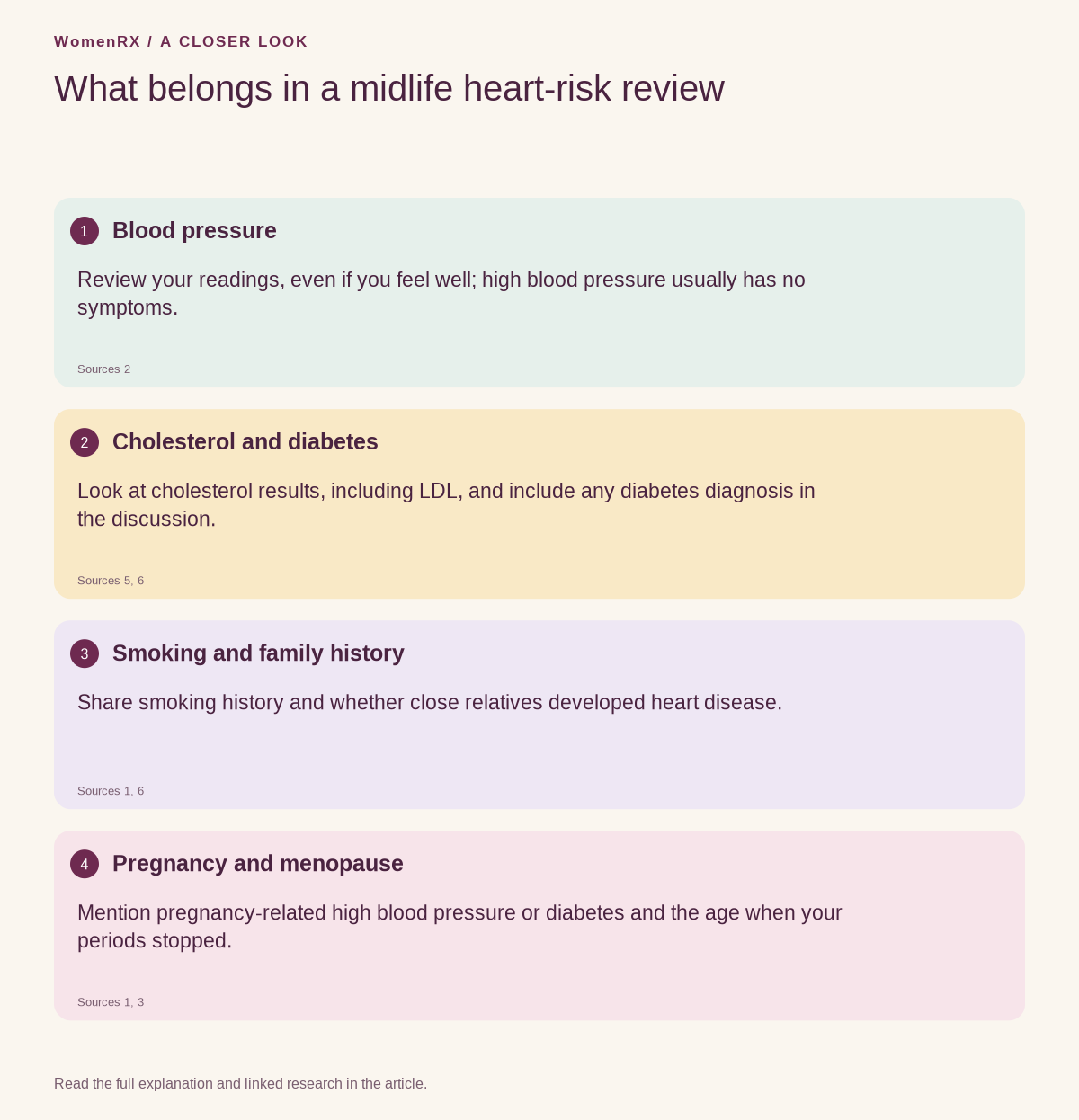
What belongs in a midlife heart-risk review
Blood pressure: Review your readings, even if you feel well; high blood pressure usually has no symptoms.2
Cholesterol and diabetes: Look at cholesterol results, including LDL, and include any diabetes diagnosis in the discussion.56
Smoking and family history: Share smoking history and whether close relatives developed heart disease.16
Pregnancy and menopause: Mention pregnancy-related high blood pressure or diabetes and the age when your periods stopped.13
Read the figure as text
Use this checklist to separate current risk factors from life-history details. It isn’t a risk score.- Blood pressure: Review your readings, even if you feel well; high blood pressure usually has no symptoms.2
- Cholesterol and diabetes: Look at cholesterol results, including LDL, and include any diabetes diagnosis in the discussion.56
- Smoking and family history: Share smoking history and whether close relatives developed heart disease.16
- Pregnancy and menopause: Mention pregnancy-related high blood pressure or diabetes and the age when your periods stopped.13
Sources you can check
- Heart Disease in Women | MedlinePlusAccessed 2026-09-25Return to first citation
- Blood Pressure Medicines | MedlinePlusAccessed 2026-09-25Return to first citation
- Early menopause is associated with increased risk of arterial hypertension: A systematic review and meta-analysis.Anagnostis P, Theocharis P, Lallas K, Konstantis G, Mastrogiannis K, Bosdou JK, Lambrinoudaki I, Stevenson JC, Goulis DG. · Maturitas · 2020Return to first citation
- Lifestyle factors, cardiovascular disease and all-cause mortality in middle-aged and elderly women: a systematic review and meta-analysis.Colpani V, Baena CP, Jaspers L, van Dijk GM, Farajzadegan Z, Dhana K, Tielemans MJ, Voortman T, Freak-Poli R, Veloso GGV, Chowdhury R, Kavousi M, Muka T, Franco OH. · European journal of epidemiology · 2018Return to first citation
- Familial Hypercholesterolemia in Women: Diagnosis, Treatment, and Cardiovascular Outcomes Across the Lifespan.Karungi I, Holven KB, Ray KK, Elshorbagy A. · Current atherosclerosis reports · 2026Return to first citation
- Coronary Artery Disease in Women: Sex-Specific Pathophysiology, Risk Factors, Clinical Presentation and Management.Nastouli KM, Apostolos A, Bozika M, Boliaris G, Iliakis P, Ktenopoulos N, Vlachakis PK, Karakasis P, Theodoropoulou T, Tsiamis N, Milaras N, Pitsillidi A, Konstantinou K, Skalidis ... · Medicina (Kaunas, Lithuania) · 2026Return to first citation