Bone and Heart Health After Menopause: Which Checks Matter?
A midlife health review works best when fracture risk and cardiovascular risk are assessed as separate questions.
Ask for two distinct reviews: one of bone strength and fracture risk, and another of cardiovascular risk, including blood pressure and cholesterol. A DXA scan measures bone density, but density alone doesn’t capture every factor that affects fractures. Blood pressure and LDL results answer different questions about your arteries, so neither set of checks can stand in for the other. 1 3 4
One appointment, two separate questions
Menopause can be a useful time to review prevention, but bone health and heart health aren’t one combined screening question. A DXA scan measures bone mineral density. A cardiovascular review looks at measures such as blood pressure and cholesterol. Each gives information about a different system, and a result in one area doesn’t tell you what’s happening in the other. 1 3 4
That distinction matters because these checks answer different questions. DXA can help predict fracture risk, while blood pressure and cholesterol tests provide information about cardiovascular risk. High blood pressure and high cholesterol can both be present without symptoms, so feeling well doesn’t answer whether it’s time to review your results. 1 3 4
For bones: look beyond the scan
DXA measures bone mineral density, commonly at the hip and spine. But a scan result isn’t the whole fracture assessment. A prior fragility fracture, some medications such as glucocorticoids, and falls can also affect fracture risk. Ask how your history fits alongside any bone-density result, rather than treating the scan as a complete verdict. 4 5
A useful starting question is: “Given my age and history, should we assess my fracture risk or consider a DXA scan?” If a scan is being considered or you already have a result, you might also ask:
- “How do any past fractures or falls affect my risk?”
- “Could any of my medicines affect my bones?”
- “What does the scan tell us, and what does it leave out?”
Calcium is a nutrient your body uses to build and maintain bones. It’s reasonable to ask whether your diet provides enough and whether a supplement is appropriate for you, but calcium intake is a separate discussion from assessing fracture risk. 2
For your heart: interpret the measures in context
Blood pressure is the pressure of blood against artery walls. A cholesterol blood test measures lipids including LDL; high LDL contributes to plaque buildup in arteries. These aren’t interchangeable measures, and neither one alone describes your full cardiovascular picture. 1 3
After menopause, cholesterol risk can rise. Cholesterol testing frequency depends on factors such as age, risk factors, and family history, so ask when your results should be revisited and how they fit with your personal history. 3
Try questions such as:
- “When were my blood pressure and cholesterol last checked, and what do the results mean for me?”
- “Does my family history or another health condition change how you interpret my LDL?”
- “If a result is high, what are the reasonable next steps?”
Keep the next steps specific
Before you leave, make sure you know which concern each next step addresses: bone density or fracture risk, blood pressure, cholesterol, or another part of your health history. A DXA result doesn’t measure artery health, and blood pressure or LDL results don’t measure bone strength. 1 3 4
Menopausal hormone therapy has been shown to prevent bone loss and fracture, but its risks vary with factors such as treatment type, duration, and timing. That makes it an individualized treatment discussion, not a substitute for separate bone and cardiovascular reviews. 6
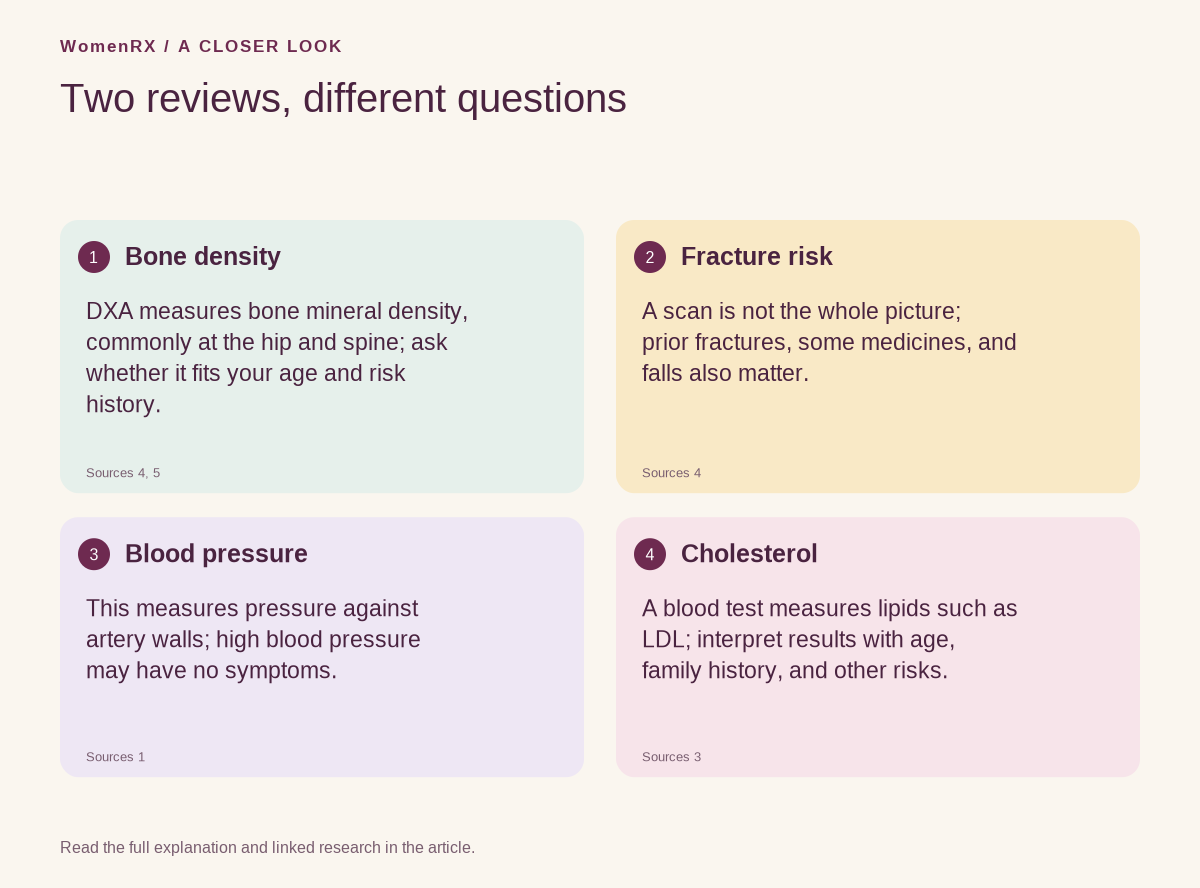
Two reviews, different questions
Bone density: DXA measures bone mineral density, commonly at the hip and spine; ask whether it fits your age and risk history.45
Fracture risk: A scan is not the whole picture; prior fractures, some medicines, and falls also matter.4
Blood pressure: This measures pressure against artery walls; high blood pressure may have no symptoms.1
Cholesterol: A blood test measures lipids such as LDL; interpret results with age, family history, and other risks.3
Read the figure as text
Compare what bone and cardiovascular checks measure, what they leave out, and a useful question to bring to a midlife review.- Bone density: DXA measures bone mineral density, commonly at the hip and spine; ask whether it fits your age and risk history.45
- Fracture risk: A scan is not the whole picture; prior fractures, some medicines, and falls also matter.4
- Blood pressure: This measures pressure against artery walls; high blood pressure may have no symptoms.1
- Cholesterol: A blood test measures lipids such as LDL; interpret results with age, family history, and other risks.3
More questions, answered
Does a calcium blood test show how strong my bones are?
No. Calcium is a nutrient involved in building and maintaining bones, while DXA measures bone mineral density. If a blood test is suggested, ask what question it is meant to answer rather than treating it as a measure of bone strength. 2 4
Does hormone therapy mean I can skip a separate heart-risk review?
No. Hormone therapy’s potential role in preventing bone loss and fractures is separate from reviewing blood pressure, cholesterol, and cardiovascular risk. Its benefits and risks vary, so the treatment decision is individualized. 1 3 6
Sources you can check
- Blood Pressure Medicines | MedlinePlusAccessed 2026-09-25Return to first citation
- Calcium | MedlinePlusAccessed 2026-09-25Return to first citation
- Cholesterol | MedlinePlusAccessed 2026-09-25Return to first citation
- Dual-Energy X-Ray Absorptiometry for Osteoporosis Screening: AJR Expert Panel Narrative Review.Aparisi Gómez MP, Wáng YJ, Yu JS, Johnson R, Chang CY. · AJR. American journal of roentgenology · 2025Return to first citation
- Bone Health and Osteoporosis Management in the Elderly: A Review of Guidelines and Orthopedic Implications.Das S, Kotwal V, Thakur A, T L, Kumar N. · Cureus · 2025Return to first citation
- The 2022 hormone therapy position statement of The North American Menopause Society.“The 2022 Hormone Therapy Position Statement of The North American Menopause Society” Advisory Panel. · Menopause (New York, N.Y.) · 2022Return to first citation