What Can You Do to Assess and Reduce Bone-Fracture Risk After Menopause?
A bone-density scan is one part of the picture: age, fracture history, health conditions, medicines, and falls can all shape what to do next.
After menopause, ask whether your age and personal risk factors make a bone-density scan appropriate. MedlinePlus summarizes screening for women 65 and older, and for postmenopausal women under 65 with factors that raise osteoporosis risk. A DXA result helps assess bone density, but fracture history, falls, medicines, and health conditions matter too. Prevention and treatment should fit that fuller picture. 3 5
Begin with your history, not just your age
Osteoporosis often has no symptoms until a bone breaks, so feeling well doesn’t tell you whether your bones are strong. Risk increases with age, and women can lose bone more rapidly in the first years after menopause. A previous fragility fracture is also relevant when estimating the chance of another fracture. 3 4 5
MedlinePlus summarizes screening for women age 65 and older, and for postmenopausal women under 65 who have factors that increase the chance of osteoporosis. This is a useful starting point for asking about testing, not a complete personal risk calculation. Early menopause, some medical conditions, and long-term use of certain medicines may also be relevant. Examples of medicines listed by MedlinePlus include corticosteroids and some medicines used for reflux or epilepsy. Don’t stop a prescribed medicine on your own; ask whether it may affect bone health and whether your overall plan should account for it. 3 4
Other helpful details to bring into the conversation include a prior fracture, a parent’s hip fracture, or a condition that affects hormones, inflammation, or nutrient absorption. Risk tools and clinical assessment can help organize these factors, but they don’t replace the full picture. 3 4 5
What a DXA scan can tell you
A DXA scan measures bone mineral density and can help identify osteoporosis and estimate fracture risk. But bone density isn’t the only influence on whether a fracture happens. Prior fractures, falls, and certain medicines can affect risk beyond the scan result. 4 5
A useful question is, “Would a DXA scan change what we do next?” If you’re under 65, ask which risk factors matter in your situation. If you’ve already had a scan, ask how its findings fit with your fracture history, health conditions, medicines, and likelihood of falling. A number from a scan isn’t a guarantee that you will or won’t have a fracture. 3 5
A DXA result may show osteopenia, meaning bone density is lower than average but not low enough to be classified as osteoporosis. Osteopenia doesn’t always progress to osteoporosis. Whether any action is appropriate depends on more than that label, including the overall risk of a fracture. 4
Support bones and reduce falls
Build meals around bone-supporting foods. Calcium helps maintain bone health, and vitamin D helps your body absorb calcium. Dairy foods and leafy greens are examples of calcium-rich foods; oily fish is one food source of vitamin D. If your diet is limited or a health condition affects what you absorb, ask whether you may have a nutritional gap before adding a supplement. 1 3
Include strength and weight-bearing movement where it fits. Walking, dancing, and resistance exercise are examples of activities that load bones or work muscles. For people with osteoporosis, strength and balance activity may also be part of care. If you’ve had a fracture or been diagnosed with osteoporosis, ask what kinds of movement are appropriate before starting a new exercise program. 1 2 3
Consider the chance of falling as well as bone strength. Fall prevention is part of osteoporosis care. It may help to consider home hazards and whether changes in balance, vision, or hearing could increase your chance of a fall. These are separate concerns from bone density, but both can affect fracture risk. 3 4
Not smoking and limiting alcohol are also included among lifestyle steps that support bone health. These habits may help, but they don’t cancel out the effects of age, a past fracture, or a condition that affects bones. 1 3
When medication may be part of the conversation
Medication isn’t automatically needed because you’re postmenopausal or because a scan shows bone density below average. Treatment decisions depend on the chance of a future fracture and the overall assessment. Osteoporosis care may include medicines that slow bone loss or medicines that help rebuild bone, alongside lifestyle measures and fall prevention. 3 4
You can ask: “Given my age and history, should I have a DXA scan?” “Could a past fracture, health condition, or medicine change my risk?” and “How do falls and my scan results fit together?” If treatment is being discussed, ask what factors are driving the recommendation and what options fit your health history. The goal is to connect the assessment to a plan that addresses your particular risks.
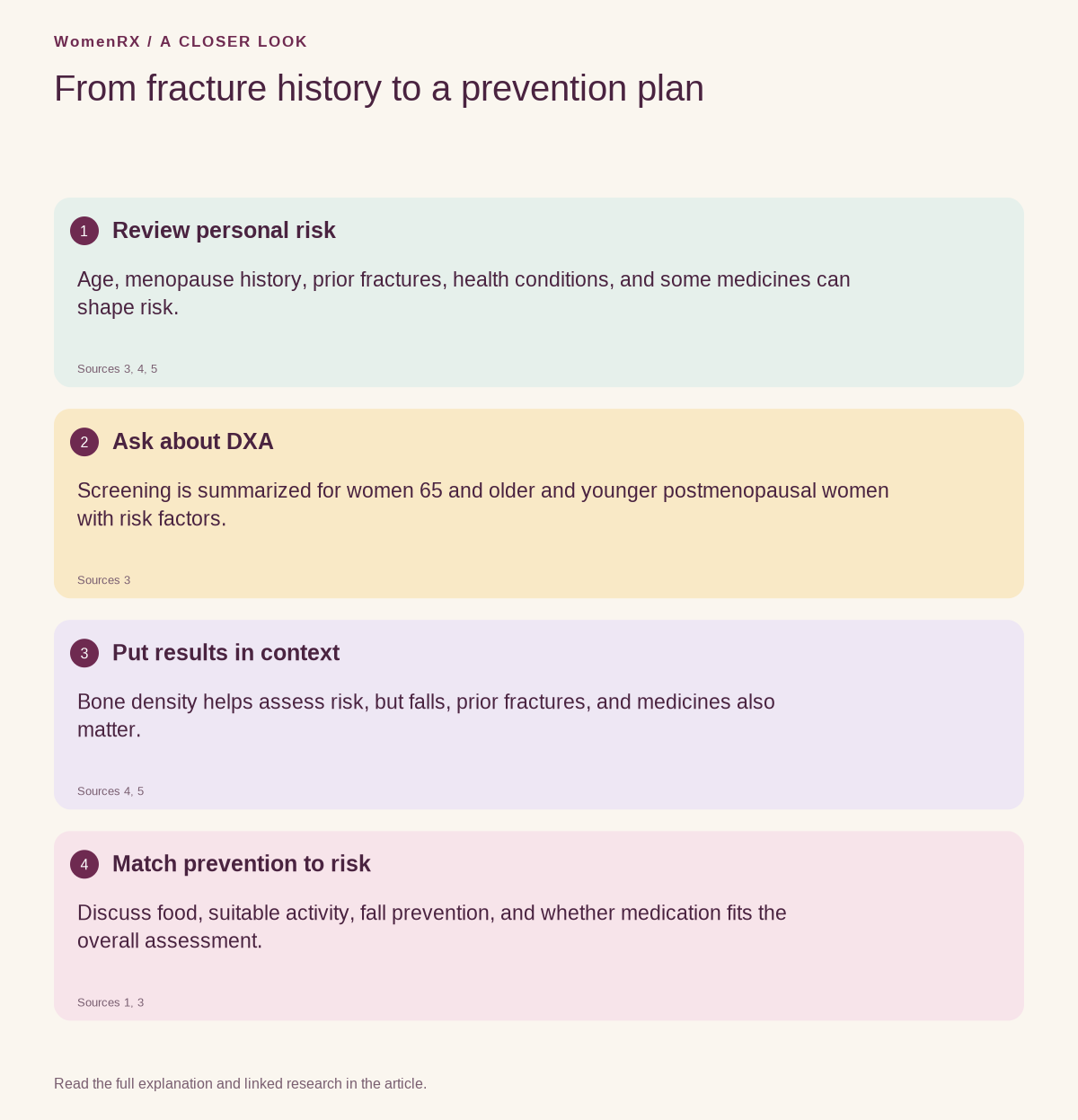
From fracture history to a prevention plan
Review personal risk: Age, menopause history, prior fractures, health conditions, and some medicines can shape risk.345
Ask about DXA: Screening is summarized for women 65 and older and younger postmenopausal women with risk factors.3
Put results in context: Bone density helps assess risk, but falls, prior fractures, and medicines also matter.45
Match prevention to risk: Discuss food, suitable activity, fall prevention, and whether medication fits the overall assessment.13
Read the figure as text
See how personal risk factors, possible testing, and prevention choices connect without treating a scan as the whole answer.- Review personal risk: Age, menopause history, prior fractures, health conditions, and some medicines can shape risk.345
- Ask about DXA: Screening is summarized for women 65 and older and younger postmenopausal women with risk factors.3
- Put results in context: Bone density helps assess risk, but falls, prior fractures, and medicines also matter.45
- Match prevention to risk: Discuss food, suitable activity, fall prevention, and whether medication fits the overall assessment.13
More questions, answered
Does osteopenia mean I will develop osteoporosis?
No. Osteopenia means bone density is lower than average but not low enough to be classified as osteoporosis. It doesn’t always progress. The next step, if any, depends on the broader picture, including fracture risk. 4
Can I rule out osteoporosis if I have no symptoms?
No. Osteoporosis usually doesn’t cause symptoms, and a person may not know they have it until a bone breaks. Feeling well isn’t a substitute for assessment when screening or personal risk factors make it relevant. 3
Sources you can check
- Osteoporosis - Prevention - NHSAccessed 2026-09-25Return to first citation
- Fracture | MedlinePlusAccessed 2026-09-25Return to first citation
- Osteoporosis | MedlinePlusAccessed 2026-09-25Return to first citation
- Osteoporosis - NHSAccessed 2026-09-25Return to first citation
- Dual-Energy X-Ray Absorptiometry for Osteoporosis Screening: AJR Expert Panel Narrative Review.Aparisi Gómez MP, Wáng YJ, Yu JS, Johnson R, Chang CY. · AJR. American journal of roentgenology · 2025Return to first citation