Osteoporosis and Hormones: How Estrogen Relates to Bone Loss
Falling estrogen can speed bone loss around menopause, but it’s one part of a larger picture that includes age, family history, and other hormone conditions.
Estrogen helps balance the ongoing process of breaking down old bone and building new bone. After menopause, estrogen levels fall, and bone loss can speed up. That raises osteoporosis risk, but it isn’t the only influence: aging, family history, early menopause, periods absent for more than six months because of excessive exercise or dieting, and disorders affecting other hormones can matter too. Hormone therapy can prevent bone loss for some women, but its benefits and risks depend on personal circumstances. 2 3 4
Estrogen’s role in the bone-renewal cycle
Bone is living tissue. Throughout life, the body removes old bone and replaces it with new bone. Bone density falls when breakdown outpaces replacement. 1
Estrogen helps keep that process in balance. It supports bone-forming cells and helps limit the activity of cells that break bone down. When estrogen falls around and after menopause, that restraint is reduced, so bone breakdown can outpace rebuilding and bone density may decline more quickly. 2 4
This is why menopause is a meaningful turning point for bone health, especially for women who reach it early. It is a risk factor, not a complete explanation for why one person develops osteoporosis and another doesn’t.
What else can shape your risk?
Age matters: bone density tends to decline over time. A family history of osteoporosis or a parent’s hip fracture can also raise concern. Earlier menopause and periods that stop for an extended time because of excessive exercise or dieting are additional risk factors described in clinical guidance. 1 2
Sex hormones aren’t the only hormones involved. Conditions affecting the thyroid, parathyroid glands, or pituitary gland can also contribute to osteoporosis risk. In women and men, lower sex-hormone levels can be relevant; testosterone, for example, helps maintain healthy bones in men. 2
The useful takeaway is that a menopause-related drop in estrogen may be part of the explanation, but it shouldn’t automatically be assumed to be the only cause. A bone-density scan can show whether density is low, whether osteoporosis is present, and help assess fracture risk. 1
Where hormone therapy fits
Menopause hormone therapy has been shown to prevent bone loss and fractures, but it isn’t a universal choice for bone health. The North American Menopause Society says its benefit-risk balance is generally favorable for women younger than 60 or within 10 years of menopause onset who have no contraindications, when used for bothersome menopause symptoms or prevention of bone loss. For women who start later, the balance appears less favorable because some health risks are higher. Decisions should account for the person’s situation and be revisited over time. 3
That guidance describes prevention of bone loss as one possible benefit; it does not mean estrogen therapy is automatically the right treatment for someone who already has osteoporosis. The question is not simply whether estrogen is low, but how that fits with your age, menopause timing, bone-density findings, other risk factors, and treatment goals.
A practical way to connect the dots
If you’re trying to understand a low bone-density result, consider the explanation in layers: menopause and age can affect the rate of bone loss; family history and other hormone conditions can add risk; and the scan helps show what has happened to bone density. These factors can coexist, so identifying one does not rule out the others. 1 2
Exercise research offers another piece of the picture, though it doesn’t replace an individual assessment. A 2026 systematic review and meta-analysis of eight randomized trials reported small improvements in bone mineral density at the femoral neck and lumbar spine in postmenopausal women assigned to pooled high-intensity, impact, or strength training. The authors also noted small effects and methodological limitations, so the findings don’t establish one ideal routine for every woman. 5
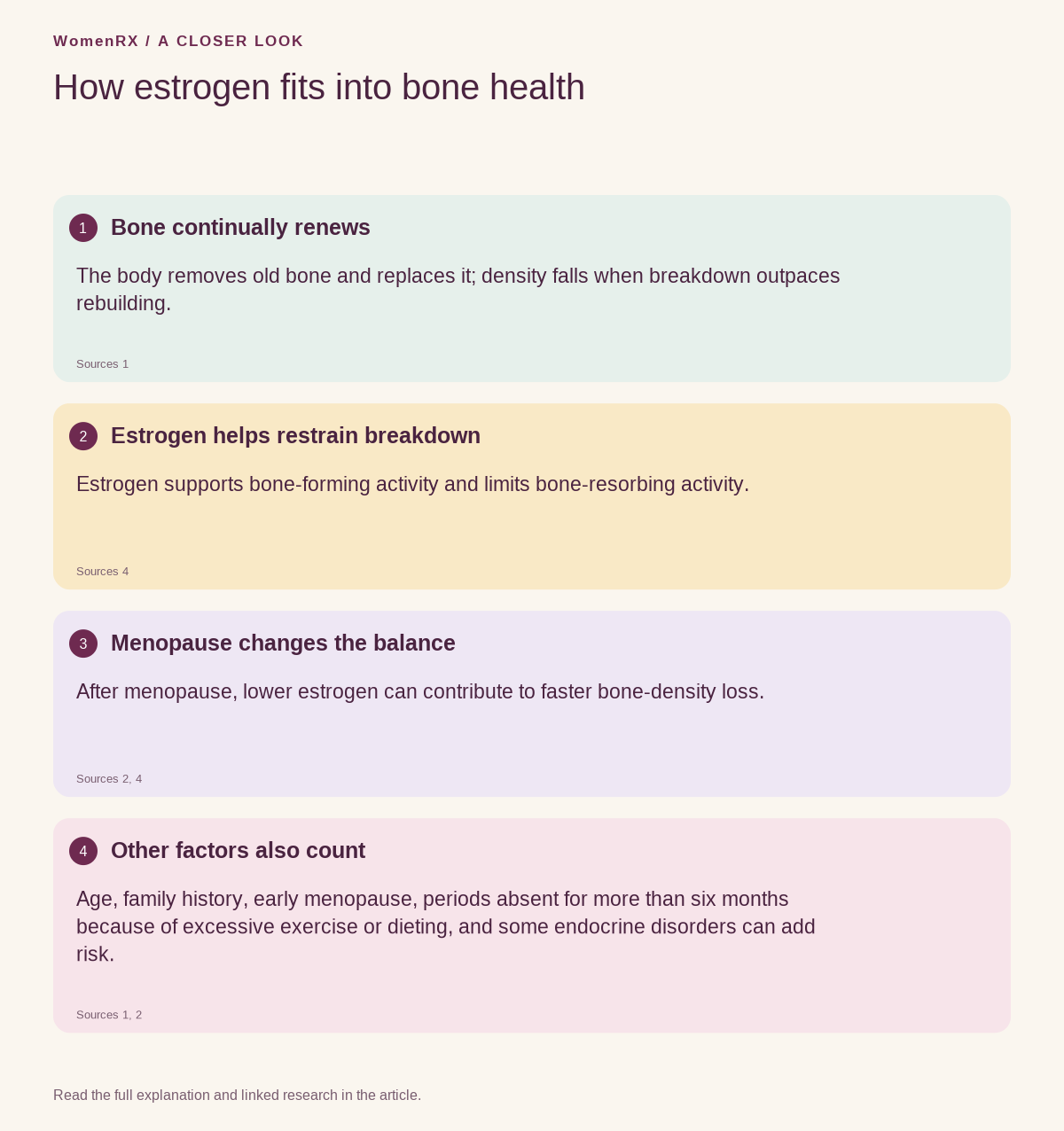
How estrogen fits into bone health
Bone continually renews: The body removes old bone and replaces it; density falls when breakdown outpaces rebuilding.1
Estrogen helps restrain breakdown: Estrogen supports bone-forming activity and limits bone-resorbing activity.4
Menopause changes the balance: After menopause, lower estrogen can contribute to faster bone-density loss.24
Other factors also count: Age, family history, early menopause, periods absent for more than six months because of excessive exercise or dieting, and some endocrine disorders can add risk.12
Read the figure as text
Bone health reflects both the remodeling process and influences beyond estrogen, including aging, family history, and other hormone conditions.- Bone continually renews: The body removes old bone and replaces it; density falls when breakdown outpaces rebuilding.1
- Estrogen helps restrain breakdown: Estrogen supports bone-forming activity and limits bone-resorbing activity.4
- Menopause changes the balance: After menopause, lower estrogen can contribute to faster bone-density loss.24
- Other factors also count: Age, family history, early menopause, periods absent for more than six months because of excessive exercise or dieting, and some endocrine disorders can add risk.12
More questions, answered
Does low estrogen always mean you’ll develop osteoporosis?
No. Falling estrogen after menopause can increase bone loss, but osteoporosis risk also reflects factors such as age, family history, and conditions affecting other hormones. A bone-density scan measures bone health rather than relying on estrogen alone. 1 2
Is hormone therapy a bone treatment for everyone after menopause?
No. Hormone therapy can prevent bone loss and fractures, but its overall balance of benefits and risks varies with age, timing since menopause, and individual circumstances. It isn’t automatically the right choice for every woman with osteoporosis. 3
Sources you can check
- Bone Density | Bone Mineral Density | BMD | MedlinePlusAccessed 2026-09-25Return to first citation
- Osteoporosis - Causes - NHSAccessed 2026-09-25Return to first citation
- The 2022 hormone therapy position statement of The North American Menopause Society.“The 2022 Hormone Therapy Position Statement of The North American Menopause Society” Advisory Panel. · Menopause (New York, N.Y.) · 2022Return to first citation
- Impact of menopause hormone therapy, exercise, and their combination on bone mineral density and mental wellbeing in menopausal women: a scoping review.Platt O, Bateman J, Bakour S. · Frontiers in reproductive health · 2025Return to first citation
- A systematic review and meta-analysis of the effects of high-intensity, impact, and strength training on bone mineral density in premenopausal and postmenopausal women.Jones E, Jones E, Starrs P, Hunter B. · Menopause (New York, N.Y.) · 2026Return to first citation