What to Check Before Getting Low-Dose Naltrexone Online
Low-dose naltrexone is an off-label approach, and the evidence depends on the condition being treated.
Before accepting an online offer, ask what condition the prescription is meant to treat, what human studies show for that condition, and how you’ll review whether it helps. Low-dose naltrexone is not interchangeable with standard-dose naltrexone used for alcohol or opioid use disorders. Ask who will prescribe and follow up, what exact product and strength you’ll receive, and whether it’s compounded. 23

Start with the condition, not the promise
Low-dose naltrexone (LDN) is naltrexone used in a much smaller dose than standard-dose treatment. For conditions such as fibromyalgia, its use is off-label: a clinician may prescribe it, but that does not mean benefit has been established for that condition. Evidence for one diagnosis also can’t be assumed to apply to another. 123
That distinction matters when an online service offers LDN for a broad list of concerns, or describes it as a general treatment for women’s health. Ask: What specific diagnosis is this intended to treat, and what evidence supports it for people with that diagnosis?
The women-specific fibromyalgia evidence now includes a 12-month randomized, placebo-controlled trial of 98 women. At three months, pain scores had changed by −0.33 points with LDN and −0.64 with placebo; the difference between groups was not statistically significant. The study found no clinically meaningful benefit over placebo for pain-related outcomes over follow-up. It was a single-center study, so it answers an important question without settling every question about LDN or every possible subgroup. 1
Evidence differs in other conditions, too. A systematic review of long COVID found no randomized trials and included four observational studies with 155 people; its authors rated the evidence as low certainty. A small Crohn’s disease review found too little evidence to draw firm conclusions. These examples are a reason to ask for evidence tied to the condition being treated, rather than relying on testimonials or results from a different illness. 24
Ask for a clear prescribing and follow-up plan
A useful online evaluation should make it possible to understand who is prescribing, what condition they believe LDN is meant to address, and how follow-up will work. Before agreeing, ask:
- Who is making the prescribing decision, and what information about my health and medicines will they review?
- What change are we hoping to see, and when will we review whether it’s happening?
- What side effects should I report, and who do I contact if they occur?
- What would make us stop or reconsider the treatment?
These questions don’t guarantee that LDN will work. They make the proposed treatment more specific and give you a way to judge whether continuing makes sense. Safety findings from small trials are not proof that a treatment is safe for everyone. In the women’s fibromyalgia trial, adverse events were mostly mild and transient, but they were reported by 68.8% of the LDN group and 72% of the placebo group; no treatment-related serious events occurred. 1
Tell the prescriber about current or possible future opioid treatment, including pain treatment. Naltrexone blocks opioid receptors, and opioid therapy is a relevant interaction to review before starting a plan involving it. 13
Make the product details specific
“LDN” alone doesn’t tell you what you’ll receive. Ask for the exact prescribed strength and form, whether the preparation will be compounded, and the name of the pharmacy filling it. If it is compounded, ask why that form is being used and how to reach the pharmacist with questions about the preparation. These are practical verification questions, not proof that a particular product or pharmacy is better.
Don’t treat low-dose naltrexone as simply a smaller version of standard-dose treatment. The standard-dose uses of naltrexone and the off-label LDN approaches are different treatment contexts; evidence for one does not establish benefit for the other. 23
A quick way to assess an offer
A more credible offer should be able to answer three separate questions plainly: What condition is being treated? What evidence applies to that condition? What product and follow-up plan are being offered? If the answers stay vague, rely mainly on broad claims, or promise results that the condition-specific studies have not shown, pause before agreeing to treatment.
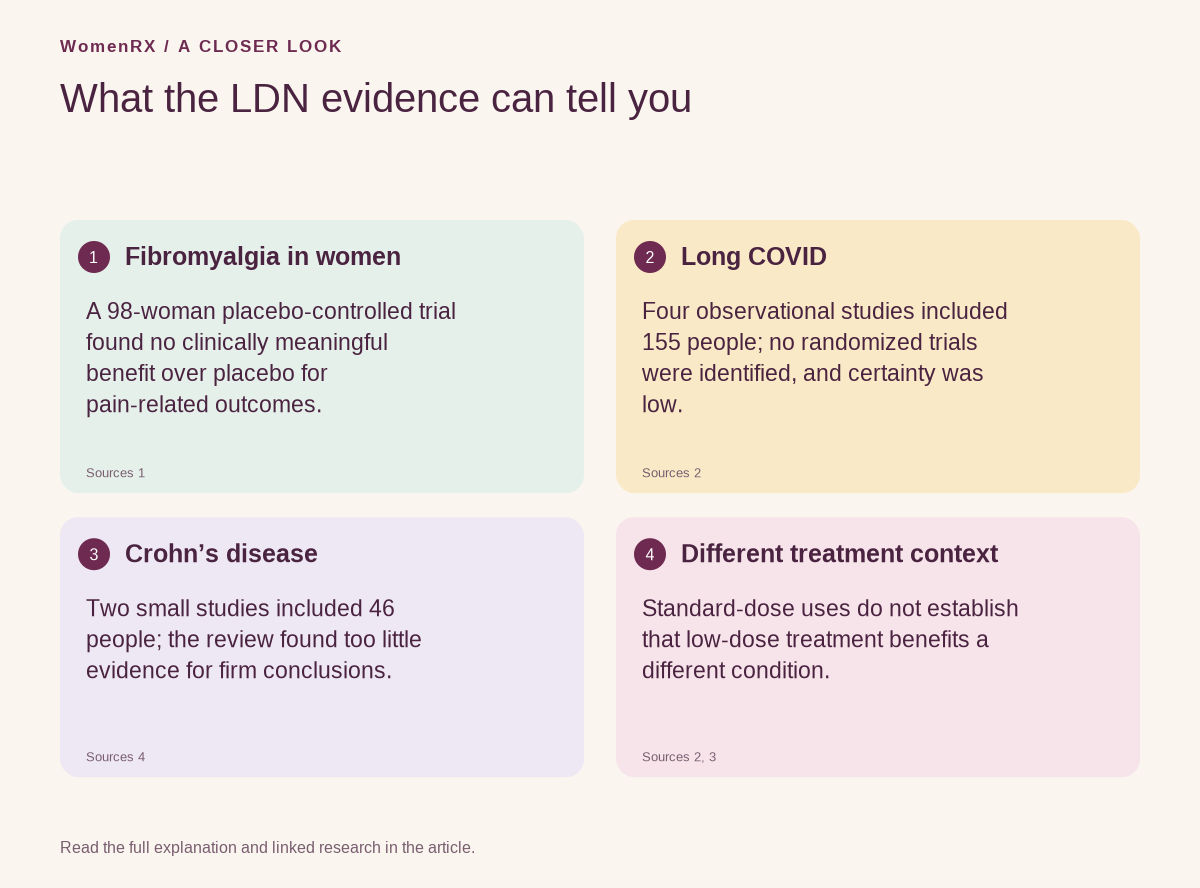
What the LDN evidence can tell you
Fibromyalgia in women: A 98-woman placebo-controlled trial found no clinically meaningful benefit over placebo for pain-related outcomes.1
Long COVID: Four observational studies included 155 people; no randomized trials were identified, and certainty was low.2
Crohn’s disease: Two small studies included 46 people; the review found too little evidence for firm conclusions.4
Different treatment context: Standard-dose uses do not establish that low-dose treatment benefits a different condition.23
Read the figure as text
These examples show why the condition being treated matters: study design and results differ across conditions.- Fibromyalgia in women: A 98-woman placebo-controlled trial found no clinically meaningful benefit over placebo for pain-related outcomes.1
- Long COVID: Four observational studies included 155 people; no randomized trials were identified, and certainty was low.2
- Crohn’s disease: Two small studies included 46 people; the review found too little evidence for firm conclusions.4
- Different treatment context: Standard-dose uses do not establish that low-dose treatment benefits a different condition.23
More questions, answered
Is low-dose naltrexone the same treatment as standard-dose naltrexone?
No. LDN refers to much smaller doses used off-label for some conditions. Standard-dose naltrexone has established uses in treatment of alcohol and opioid use disorders. Evidence from those uses does not establish that LDN treats a different condition. 23
Does an online prescription mean LDN is proven for my condition?
No. A prescription does not establish that a treatment has demonstrated benefit for a particular condition. For example, a review of long COVID studies found no randomized trials, while the randomized trial in women with fibromyalgia found no clinically meaningful benefit over placebo. Ask for evidence specific to the condition being treated. 12
Sources you can check
- Efficacy of Low-Dose Naltrexone in Women With Fibromyalgia Syndrome: A 12-Month Randomised, Double-Blind, Placebo-Controlled Single-Centre Clinical Trial (INNOVA Study).Rodríguez-Freire C, Navarrete J, Rozadilla-Sacanell A, Sanabria-Mazo JP, Del Pino-Gaya B, Borràs X, Feliu-Soler A, Luciano JV. · European journal of pain (London, England) · 2026Return to first citation
- Effect of low-dose naltrexone for long COVID: a systematic review and meta-analysis.Byambasuren O, Atkins T, Baptista S, Glasziou P, Chakraborty S. · BMJ open · 2026Return to first citation
- Low-Dose Naltrexone in Chronic Pain Management: Mechanisms, Evidence, and Clinical Implications.McKenzie A, Bittar T, Dombrower R, Raman D, Hussain H, Theeraphapphong N, McKenzie SM, Abd-Elsayed A. · Journal of personalized medicine · 2026Return to first citation
- Low dose naltrexone for induction of remission in Crohn's disease.Parker CE, Nguyen TM, Segal D, MacDonald JK, Chande N. · The Cochrane database of systematic reviews · 2018Return to first citation