What Mindfulness Can Help With, and What to Expect
Structured mindfulness programs may ease anxiety, but a short solo practice isn’t the same thing as the programs studied in clinical trials.
Mindfulness-based programs can help some adults with anxiety symptoms in the short term, including people already receiving usual care. That’s evidence for structured programs, not a promise that a meditation app or a few quiet minutes will treat an anxiety disorder. If you’re curious, you can try a brief, flexible practice and notice how you feel afterward. If it brings up distress, you can stop; you don’t have to push through it.3
What the research means by “mindfulness”
Mindfulness is often described as paying attention to what’s happening now without immediately trying to change it. In practice, that might mean noticing your breath, the feeling of your feet as you walk, or a thought that keeps returning. Your mind wandering isn’t a failed session; noticing that it wandered is part of the exercise.
The strongest evidence here is for programs, not meditation in any form or amount. Mindfulness-Based Stress Reduction (MBSR) typically combines group sessions, home practice, sitting and walking meditation, gentle movement, and relaxation. Mindfulness-Based Cognitive Therapy (MBCT) adds cognitive-behavioral methods. Acceptance and Commitment Therapy (ACT) uses mindfulness and acceptance alongside work on values and actions. These approaches overlap, but they aren’t interchangeable.3
In a review of 23 randomized studies involving 1,815 adults with diagnosed anxiety disorders, ACT, MBCT, and MBSR showed short-term improvements in anxiety when added to usual care, compared with usual care alone. ACT and MBCT had similar short-term anxiety outcomes to cognitive behavioral therapy (CBT) in the studies that compared them; MBSR had smaller effects than CBT. At follow-up points of up to six and twelve months, the review did not find significant differences against usual care or CBT. Many studies had unclear risk of bias, so this is a reason to consider these approaches, not to assume a lasting result for everyone.3
Anxiety, depression, and everyday stress aren’t one outcome
If anxiety is your main concern, the distinction between a structured program and a solo practice matters most. The anxiety-disorder review studied named interventions, sometimes alongside existing treatment. It cannot tell you that a short recording at home works as well as a course or as well as CBT.3
There’s also evidence from people dealing with particular health conditions. A review of trials in adults with cancer found reductions in depression, anxiety, and stress with mindfulness-based interventions compared with control conditions, but results varied substantially across studies and much of the evidence came from breast cancer populations. That finding may be relevant if cancer-related distress is part of your life; it isn’t a general estimate of how meditation treats depression.5 In a separate review of trials involving women with polycystic ovary syndrome (PCOS), disease-specific quality of life improved, while general depression and anxiety scores did not differ significantly. Those interventions included approaches such as yoga as well as mindfulness meditation.4
So a realistic goal for a first try is modest: find out whether this way of paying attention feels useful to you. You don’t need to expect a quiet mind, immediate calm, or a measurable change in symptoms after one session.
A starting practice that can fit a real day
You could begin with one brief pause while seated or walking. Notice something concrete, such as your feet meeting the floor or air moving as you breathe. When your attention moves to a worry, acknowledge that you’ve noticed it and return to what you chose to observe. Seated and walking meditation are components of studied programs, but this brief example is a way to try the idea, not a tested treatment schedule.3
If uninterrupted time is scarce because you’re caring for someone, choose a moment that doesn’t depend on the house being silent. A short pause may tell you whether you like the practice, even though it doesn’t reproduce the time, teaching, or support of a structured course. If you want help with persistent anxiety, a guided program or an established therapy such as CBT offers more structure than trying to build a practice alone.3
When paying attention feels uncomfortable
Turning inward can feel different from relaxing. If focusing on your breath or body brings up frightening memories, makes you feel more distressed, or simply feels wrong today, stop or shift your attention to something around you. You don’t have to stay with an exercise to make it “count.” Adverse experiences were reported too inconsistently in the anxiety trials to establish how often mindfulness practices feel uncomfortable.3
A trauma history is a good reason to be especially free to choose the kind of support you want. If fear, unwanted memories, or avoidance are persisting and disrupting your life, mindfulness on its own shouldn’t be your only plan. Talk therapy and medication are among the main treatments for post-traumatic stress disorder (PTSD), and treatment can be matched to your symptoms.1
The same distinction matters after childbirth. Exhaustion, limited support, and hormonal changes can all be part of the picture, so feeling unable to meditate is not a personal failing. If symptoms are more severe and last longer than two weeks after birth, it may be postpartum depression, which can begin anytime in the first year and has treatment options. A mindfulness pause can sit alongside support, but it shouldn’t delay that conversation.2
The useful question is less “Am I doing meditation correctly?” and more “Does this practice help me meet the rest of my day, and am I getting enough support for what I’m experiencing?”
Choose the amount of support you want
| Your starting point | A reasonable next step | What not to assume |
|---|---|---|
| You are curious about the practice | Try noticing your feet on the floor during one ordinary pause. | One pause does not reproduce a studied course. |
| You want a regular practice with guidance | Compare the teaching, group sessions and home practice of a named program. | All meditation apps offer the same support. |
| Persistent anxiety is affecting daily life | Compare structured treatment options, including CBT and mindfulness-based programs. 3 | Practicing alone is equivalent to those treatments. |
| Focusing inward increases distress | Stop or shift attention outward; choose support that feels manageable. | Discomfort is something you must push through. |
Before paying for a course, ask who teaches it, what a typical session includes, what practice is expected between sessions, and how you can adapt or stop an exercise. Those details help you compare the actual experience.
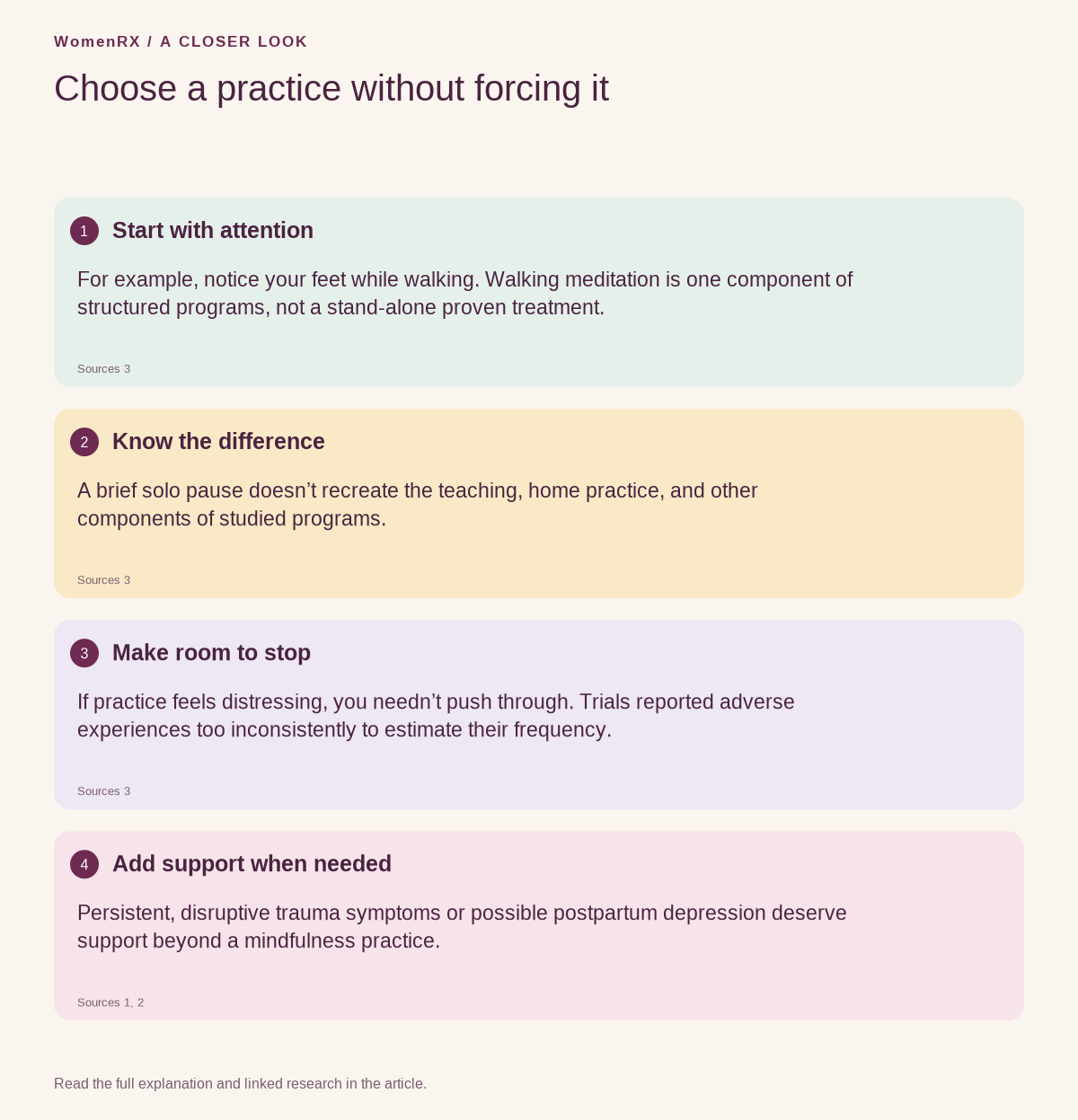
Choose a practice without forcing it
Start with attention: For example, notice your feet while walking. Walking meditation is one component of structured programs, not a stand-alone proven treatment.3
Know the difference: A brief solo pause doesn’t recreate the teaching, home practice, and other components of studied programs.3
Make room to stop: If practice feels distressing, you needn’t push through. Trials reported adverse experiences too inconsistently to estimate their frequency.3
Add support when needed: Persistent, disruptive trauma symptoms or possible postpartum depression deserve support beyond a mindfulness practice.12
Read the figure as text
Four distinctions to help you choose a first try, understand what the research studied, and decide when another kind of support makes more sense.- Start with attention: For example, notice your feet while walking. Walking meditation is one component of structured programs, not a stand-alone proven treatment.3
- Know the difference: A brief solo pause doesn’t recreate the teaching, home practice, and other components of studied programs.3
- Make room to stop: If practice feels distressing, you needn’t push through. Trials reported adverse experiences too inconsistently to estimate their frequency.3
- Add support when needed: Persistent, disruptive trauma symptoms or possible postpartum depression deserve support beyond a mindfulness practice.12
More questions, answered
Do I need to sit still with my eyes closed?
No. Studied programs have included walking meditation as well as sitting practice. You can choose a form of attention that feels more comfortable; a self-directed variation shouldn’t be assumed to have the same effects as a structured program.3
Should I keep practicing if I feel worse?
No. You can stop or change what you’re paying attention to. Because anxiety trials reported adverse experiences inconsistently, they don’t establish how common difficult reactions are. If distress persists or trauma symptoms disrupt daily life, seek support rather than treating the discomfort as something to overcome alone.31
Sources you can check
- Post-Traumatic Stress Disorder: MedlinePlusAccessed 2026-09-25Return to first citation
- Postpartum Depression: MedlinePlusAccessed 2026-09-25Return to first citation
- A systematic review and meta-analysis of acceptance- and mindfulness-based interventions for DSM-5 anxiety disorders.Haller H, Breilmann P, Schröter M, Dobos G, Cramer H. · Scientific reports · 2021Return to first citation
- Efficacy of mindfulness-based interventions on psychological distress, hyperandrogenism, and metabolic profile in women with polycystic ovary syndrome: A systematic review and meta-analysis of randomized controlled trials.Li D, Zheng J, Wang G. · Applied psychology. Health and well-being · 2026Return to first citation
- Mindfulness-Based Interventions for Depression, Anxiety, and Stress in Adults With Cancer: A Stratified Subgroup Meta-Analysis.Ajele KW, Idemudia ES. · Psycho-oncology · 2026Return to first citation