What Inositol May Do for PCOS, Outcome by Outcome
Inositol has promising but uneven evidence for ovulation and fertility care, while changes in lab markers don’t yet establish broad metabolic benefits.
Inositol may help some reproductive outcomes in PCOS, but the evidence depends on what is measured and the setting. A placebo-controlled trial found more frequent ovulation, while other studies tested inositol alongside fertility treatment or another medicine. Those results don’t show that every formulation improves cycles, fertility, or metabolic health for everyone with PCOS. 2 1 3
Inositol isn’t one proven PCOS treatment with the same effect on every symptom. Small clinical trials suggest possible benefits for ovulation and some fertility-treatment outcomes. Evidence for cycle regularity is more limited, and changes in hormones or metabolic lab results are not the same as showing a meaningful long-term health benefit.
Ovulation: a promising, specific finding
One placebo-controlled trial followed women with infrequent periods and polycystic ovaries, measuring ovarian activity regularly. The study found a higher estimated ovulation frequency with inositol than with placebo: 23% versus 13% of observed weeks. The first ovulation also occurred sooner on average in the inositol group. More participants stopped early in the inositol group, which makes the result harder to interpret. 2
That’s a signal of possible benefit, not a guarantee that inositol will restore ovulation for an individual. The study’s participants had a specific pattern of infrequent periods, and the result doesn’t establish how well it applies across the varied symptoms and circumstances of PCOS.
Periods and cycle regularity: some evidence, not a settled answer
A randomized trial in women with PCOS and infertility compared metformin plus myo-inositol with metformin alone. It reported greater improvement in cycle length and bleeding days with the combination. Because both groups received metformin, this suggests a possible added benefit from myo-inositol in that setting; it doesn’t tell us what myo-inositol alone would do. 1
Regular-looking periods also don’t, by themselves, prove that ovulation is happening. The ovulation study measured ovarian activity directly, while the combination trial reported menstrual changes. These are related but distinct outcomes. 1 2
Fertility treatment: encouraging results, but tied to treatment settings
Some trials studied inositol as an addition to fertility care, rather than as a stand-alone approach. In one randomized trial, women with PCOS undergoing ovulation induction and intrauterine insemination had a reported clinical pregnancy rate of 18.6% with myo-inositol and folic acid, compared with 12.2% in the comparison group. The abstract reports the difference but doesn’t establish from the information presented whether it was statistically significant. These results apply to that specific treatment context, not to the chance of pregnancy for everyone with PCOS. 3
Another trial compared metformin plus myo-inositol with metformin alone in infertile women with PCOS. Live birth was reported for 33 of 60 women in the combination group and 16 of 60 in the metformin-only group. This is a notable result, but it evaluates an add-on during a fertility-care protocol, not myo-inositol by itself or routine PCOS care. 1
A small randomized trial in women undergoing ICSI found differences in some egg and embryo measures between myo-inositol and D-chiro-inositol. These are intermediate outcomes in assisted reproduction, not proof that one form improves pregnancy or live birth for women generally. 5
Metabolic results: lab changes aren’t the same as health outcomes
A small placebo-controlled trial found no change in fasting glucose, fasting insulin, or insulin response after 14 weeks, though it reported changes in some other measures. Its findings also varied by body mass. This is a useful reminder that an improvement in one measure doesn’t mean all metabolic markers improve. 2
A separate trial reported changes in measures such as HOMA-IR and blood fats among groups taking combinations of medicines with either myo-inositol or metformin. Since the study tested combination regimens, it can’t isolate myo-inositol’s effect. And shifts in lab values don’t establish fewer cases of diabetes or heart disease. 4
Myo-inositol, D-chiro-inositol, and product ratios
Myo-inositol and D-chiro-inositol are both studied in PCOS, but there isn’t enough in these trials to identify a best form or a preferred ratio for general use. The comparison between the two forms involved 84 women with normal insulin responses who were having ICSI, so it can’t answer which formulation suits people with other PCOS features or goals. 5
The practical takeaway is to match the claim to the outcome: evidence about ovulation is not automatically evidence about pregnancy, cycle regularity, or long-term metabolic health. Inositol may be worth discussing when your main goal is reproductive, but the studies don’t establish a universally effective formulation or a reliable benefit across all PCOS symptoms.
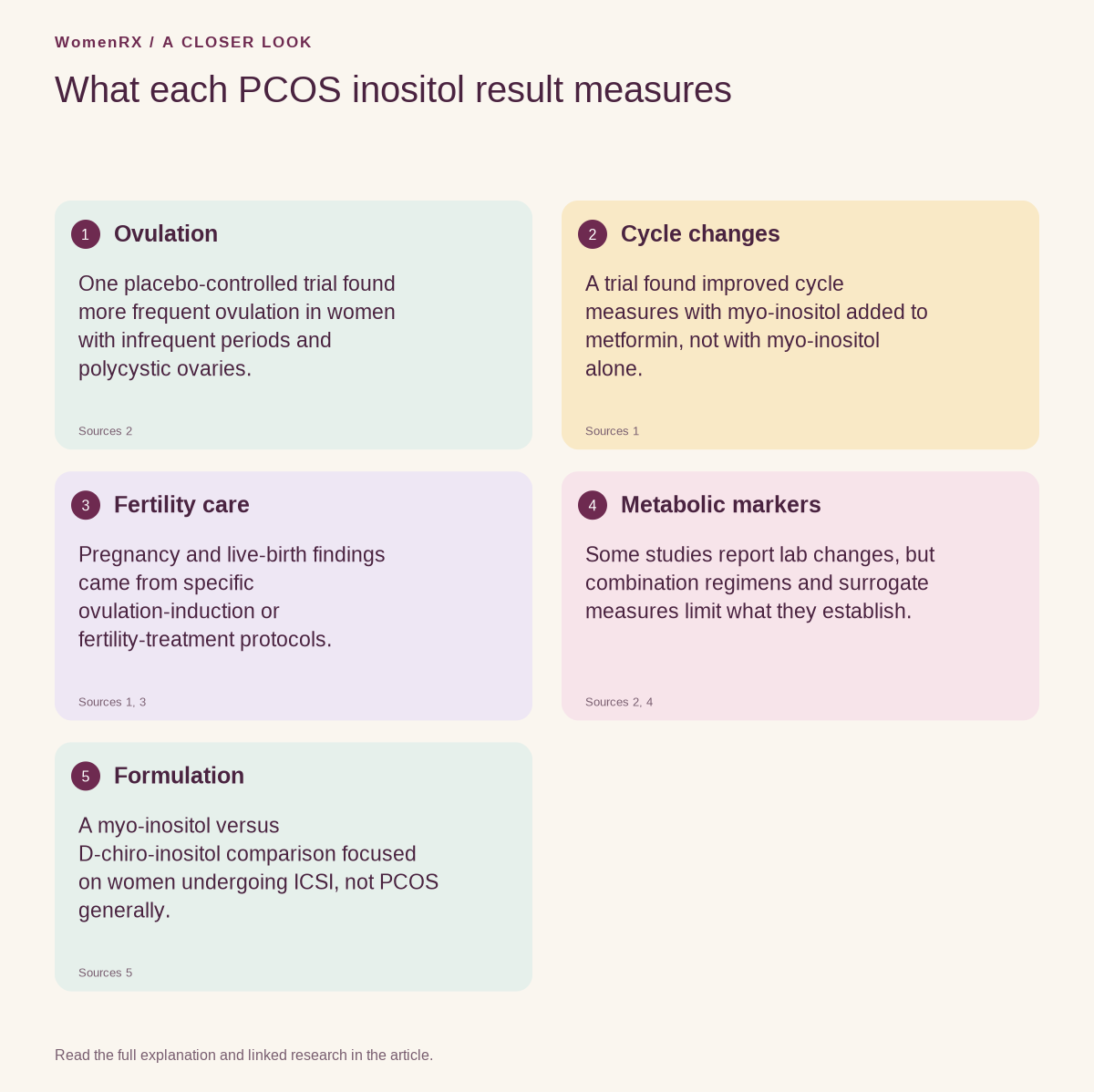
What each PCOS inositol result measures
Ovulation: One placebo-controlled trial found more frequent ovulation in women with infrequent periods and polycystic ovaries.2
Cycle changes: A trial found improved cycle measures with myo-inositol added to metformin, not with myo-inositol alone.1
Fertility care: Pregnancy and live-birth findings came from specific ovulation-induction or fertility-treatment protocols.13
Metabolic markers: Some studies report lab changes, but combination regimens and surrogate measures limit what they establish.24
Formulation: A myo-inositol versus D-chiro-inositol comparison focused on women undergoing ICSI, not PCOS generally.5
Read the figure as text
The outcome matters: a change in ovulation, a fertility-treatment result, and a lab marker answer different questions.- Ovulation: One placebo-controlled trial found more frequent ovulation in women with infrequent periods and polycystic ovaries.2
- Cycle changes: A trial found improved cycle measures with myo-inositol added to metformin, not with myo-inositol alone.1
- Fertility care: Pregnancy and live-birth findings came from specific ovulation-induction or fertility-treatment protocols.13
- Metabolic markers: Some studies report lab changes, but combination regimens and surrogate measures limit what they establish.24
- Formulation: A myo-inositol versus D-chiro-inositol comparison focused on women undergoing ICSI, not PCOS generally.5
More questions, answered
Does inositol guarantee ovulation or pregnancy?
No. One placebo-controlled study found more frequent ovulation in a specific group of women with infrequent periods and polycystic ovaries, and fertility-treatment trials studied particular treatment settings. Neither establishes a guaranteed outcome for an individual. 2 3
Is myo-inositol better than D-chiro-inositol?
A small trial in women with normal insulin responses undergoing ICSI found differences in some egg and embryo measures, but that doesn’t establish which form is best for PCOS overall or for people outside that setting. 5
Sources you can check
- Comparison of metformin plus myoinositol vs metformin alone in PCOS women undergoing ovulation induction cycles: randomized controlled trial.Agrawal A, Mahey R, Kachhawa G, Khadgawat R, Vanamail P, Kriplani A. · Gynecological endocrinology : the official journal of the International Society of Gynecological Endocrinology · 2019Return to first citation
- Effects of inositol on ovarian function and metabolic factors in women with PCOS: a randomized double blind placebo-controlled trial.Gerli S, Mignosa M, Di Renzo GC. · European review for medical and pharmacological sciences · 2003Return to first citation
- Myo-inositol administration positively effects ovulation induction and intrauterine insemination in patients with polycystic ovary syndrome: a prospective, controlled, randomized trial.Emekçi Özay Ö, Özay AC, Çağlıyan E, Okyay RE, Gülekli B. · Gynecological endocrinology : the official journal of the International Society of Gynecological Endocrinology · 2017Return to first citation
- Effectiveness of dual combination therapy of acarbose plus metformin and acarbose plus myo-inositol in ameliorating the metabolic and endocrinologic complications of polycystic ovary syndrome - A randomized controlled trial.Andavar M, Kamaraj R, Mahalingam Vijayakumar T, Murugesan A. · European journal of obstetrics, gynecology, and reproductive biology · 2024Return to first citation
- Myo-inositol rather than D-chiro-inositol is able to improve oocyte quality in intracytoplasmic sperm injection cycles. A prospective, controlled, randomized trial.Unfer V, Carlomagno G, Rizzo P, Raffone E, Roseff S. · European review for medical and pharmacological sciences · 2011Return to first citation