What Helps You Recover During Prolonged Stress?
Resilience isn’t a demand to endure more; it can mean finding support while addressing what’s causing the strain.
When stress keeps going, choose a step that fits the problem: a coping practice, help from someone you trust, or a change to an ongoing demand. Coping isn’t an obligation to tolerate harmful conditions. If severe symptoms disrupt daily life for two weeks or more, seek help. Thoughts of suicide or feeling unable to cope call for help right away. 1
Resilience isn’t the same as enduring more
Stress can come from demands that don’t let up, including work, family needs, and money problems, or from a difficult life change. Resilience means adapting to stress and adversity; it doesn’t mean being unaffected or handling everything alone. 1 3
If the stressor is still there, a calming practice may help with the strain, but it won’t by itself change an unsafe situation, an unmanageable workload, or a recurring financial pressure. Instead of asking, “How do I become tougher?” try asking, “What could ease this pressure, help me feel less alone, or make the next step manageable?”
Match the next step to the kind of strain
If you want a personal coping practice: Mindfulness or another mind-body activity may be worth exploring if it feels accessible to you. In a randomized trial, 44 undergraduate nursing students in Somalia were assigned to a culturally adapted online mindfulness program or routine academic activities. After three weeks, students in the program had lower perceived stress and higher resilience scores. That’s a promising finding in a small, specific student sample, not proof the same program works for every adult or kind of stress. 2
Tai chi is another possible structured activity. In a randomized trial of 68 adults ages 30 to 55, those assigned to supervised tai chi had greater improvements in perceived stress and resilience measures than those who continued their usual activities. The trial was small and assessed outcomes after eight weeks, so it doesn’t establish that tai chi will help everyone or address the source of their stress. 3
If you’re carrying it alone: Ask someone you trust for a specific kind of help. You might want to talk something through, get practical help with a responsibility, or ask for a check-in. MedlinePlus includes asking family or friends for support among ways to manage stress. 1
If the pressure keeps recurring: Consider what change could reduce the demand itself, as well as what might help you cope with it. For example, if caregiving is colliding with work, you could ask a family member to take on a defined task or ask a manager which deadline should come first. If money is the strain, a practical step might be getting help reviewing bills or looking for available financial support. These are examples of problem-solving, not changes tested in the mindfulness or tai chi trials. 2 3 Personal coping shouldn’t be treated as a replacement for addressing harmful circumstances.
Make the step fit your actual life
You don’t need to add a demanding new routine when you’re already stretched. Choose one step that matches your main obstacle and fits the time, energy, privacy, and support you have. If a class or quiet practice isn’t realistic, a specific request for help may be more useful. If an individual coping step doesn’t ease pressure created by work or caregiving demands, that doesn’t mean you failed at resilience. The problem may need a change beyond you.
Caregiving, financial pressure, discrimination, pregnancy, postpartum changes, and menopause transitions can be part of someone’s stress context, but they aren’t universal experiences. The trials described here don’t establish different resilience strategies for each. Start with the pressure you’re actually facing, rather than assuming what women as a group need.
When it’s time to seek more support
Get help if severe symptoms last two weeks or more, especially if you can’t do your usual daily activities. Seek help right away if stress brings thoughts of suicide, leaves you feeling unable to cope, or leads you to use drugs or alcohol more than usual. Those are reasons to get support, not signs that you haven’t tried hard enough. 1
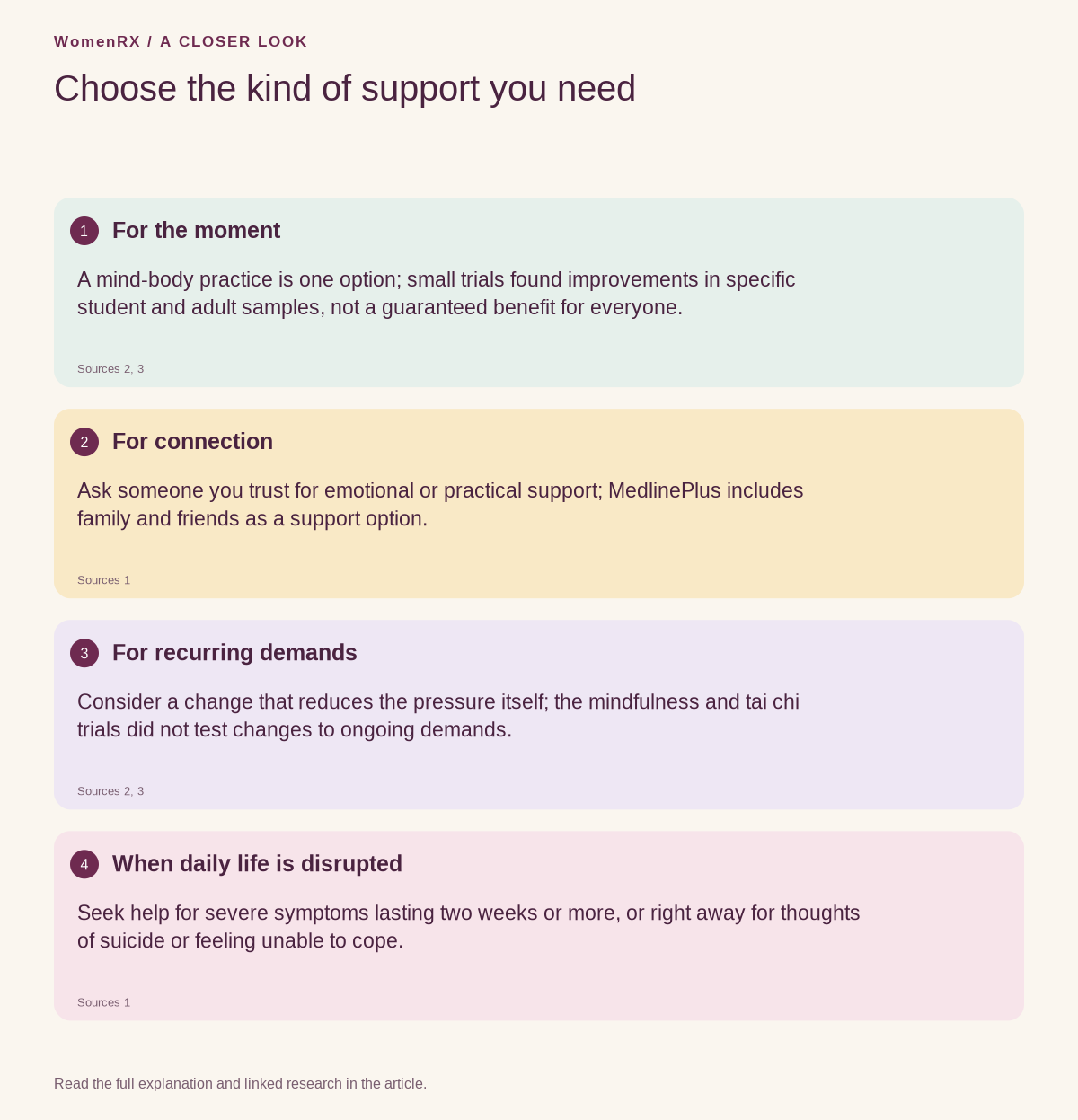
Choose the kind of support you need
For the moment: A mind-body practice is one option; small trials found improvements in specific student and adult samples, not a guaranteed benefit for everyone.23
For connection: Ask someone you trust for emotional or practical support; MedlinePlus includes family and friends as a support option.1
For recurring demands: Consider a change that reduces the pressure itself; the mindfulness and tai chi trials did not test changes to ongoing demands.23
When daily life is disrupted: Seek help for severe symptoms lasting two weeks or more, or right away for thoughts of suicide or feeling unable to cope.1
Read the figure as text
Use this unscored checklist to distinguish a personal coping step, support from another person, a change to recurring demands, and reasons to seek more help.- For the moment: A mind-body practice is one option; small trials found improvements in specific student and adult samples, not a guaranteed benefit for everyone.23
- For connection: Ask someone you trust for emotional or practical support; MedlinePlus includes family and friends as a support option.1
- For recurring demands: Consider a change that reduces the pressure itself; the mindfulness and tai chi trials did not test changes to ongoing demands.23
- When daily life is disrupted: Seek help for severe symptoms lasting two weeks or more, or right away for thoughts of suicide or feeling unable to cope.1
Sources you can check
- Stress: MedlinePlusAccessed 2026-09-25Return to first citation
- Effects of a culturally adapted mindfulness-based intervention on stress, psychological resilience and academic self-efficacy among nursing students in Somalia: A randomized controlled trial.Koyuncu F, Yuceer B. · Nurse education in practice · 2026Return to first citation
- Tai Chi as a public health intervention: effects on stress regulation, attention, and psychological resilience in adults.Wang N, Yang Z. · Frontiers in public health · 2026Return to first citation