What Can Help With Changes in Jawline Definition?
A softer jawline can reflect skin laxity, changing facial volume, deeper tissue changes, or a mix, so the best next step depends on what you want to change.
Start by separating the concern, not choosing a procedure: is it looser skin, less fullness in the cheeks, a change under the chin, or several things at once? Appearance alone may not reliably identify the cause. One uncontrolled study of a specific radiofrequency treatment found modest measured contour and elasticity changes through week 20, not proof of a lasting jawline lift. Weight-loss survey data describe sagging and volume loss as distinct reported changes. 14
What changed: skin, volume, or both?
A less-defined jawline isn’t one diagnosis. Skin can lose some of its ability to spring back, while changes in deeper supporting tissue can affect the outline of the cheeks and jowls. Loss of facial volume can change that outline too. More than one of these changes may be happening at once. 1
Your recent history can offer context, though it can’t settle the question by itself. For example, if your face looks different after substantial weight loss, lost facial volume may be worth discussing alongside skin laxity. In a voluntary survey of people receiving medical weight management, reports of both skin sagging and decreased facial volume became more common across higher weight-loss categories. The survey can’t tell whether a particular medication caused either change or identify the cause for an individual person. 4
Looking closely in the mirror can help you describe where you notice a change: along the jowls, beneath the chin, or in the fullness of the cheeks. It cannot reliably tell you which tissue layer is responsible. A hollow-looking cheek, for instance, may lead to a different treatment conversation than skin that seems less firm, but neither observation proves what’s happening underneath. That distinction matters because a treatment intended to improve skin firmness isn’t the same as one intended to add volume. 17
Match the option to the change you actually want
No procedure. If the difference doesn’t bother you enough to justify treatment, you don’t need a treatment plan. This is also a useful point of comparison when someone proposes a series of sessions: is the possible change worth the appointments, expense, discomfort, and uncertainty to you?
Noninvasive energy treatments. Radiofrequency and microfocused ultrasound are used with the aim of changing skin or underlying tissue without an incision. Evidence for one device and treatment plan should not be treated as proof for the whole category. In a study of one radiofrequency device, 26 adults with mild-to-moderate facial laxity completed follow-up after three sessions. Researchers measured modest facial-contour and skin-elasticity changes through week 20. Because everyone received treatment and there was no comparison group, the study cannot show how much change the device caused or how long a result would last beyond that follow-up. 1
Combination treatment isn’t automatically a better route to a sharper jawline. In a randomized split-face study of 22 Asian participants with Fitzpatrick skin types III-IV, both sides received microfocused ultrasound and one side also received a fractional laser. At 24 weeks, adding the laser did not significantly improve the study’s facial-laxity score or its EI measure compared with ultrasound alone, although the combination did better on some other reported measures. This was a facial-rejuvenation study, not a head-to-head test of jawline definition. 3
Injectables. Here, the product’s purpose matters more than the category name. An approach intended to add facial volume addresses a different concern from hyperdilute calcium hydroxylapatite, which a review discusses primarily in terms of skin quality and contour rather than substantial immediate volumizing. A proposed approach to facial changes after weight loss includes volume-restoring treatments, but that proposal does not establish which injectable works best for a less-defined jawline. Ask what feature the suggested product is meant to change and what it is unlikely to fix. 67
Treatment beneath the skin. An endolaser places a fiber under the skin and is different from a noninvasive surface treatment. A retrospective report followed eight people treated for facial contour loss and related concerns. Participants reported moderate-to-severe pain during treatment; clinicians judged photographs qualitatively, without blinded scoring. The report is too small to establish how reliably this treatment improves jawline definition or how its recovery compares with other procedures. 2
These categories aren’t a ranking. A measured improvement in skin elasticity, a change in facial volume, and a visibly different jawline are not interchangeable results. 1367
Make recovery and cost part of the comparison
The studies above don’t support a dependable price or recovery-time comparison across these options. Nor does “nonsurgical” tell you how treatment will feel: the small endolaser report, for example, recorded moderate-to-severe pain during the procedure. 2 Before booking, ask for the total proposed cost, including the number of sessions and any planned follow-up, and ask what discomfort and recovery are expected for the exact procedure being offered.
A focused conversation with a qualified clinician could start with four questions:
- Which part of my concern are you proposing to change: skin firmness, facial volume, or something else?
- What makes you think that is the main contributor, and what can’t you determine from appearance alone?
- What result is realistic for this specific treatment, and how will we judge whether it worked?
- What are the likely discomfort, recovery, total cost, and limits of the evidence for someone with my anatomy and goals?
Does age or menopause change the expected result?
Age and life stage may be relevant to your history, but these treatment findings don’t provide a dependable way to predict a jawline result by menopausal stage. One infrared-device study enrolled 25 women and 5 men ages 25 to 68; its reported findings did not break down treatment outcomes by menopause, sex, or age. It also did not directly compare jawline treatments. 5 Rather than assuming menopause explains the change or predicts your response, ask for a recommendation tied to the specific feature you want to address.
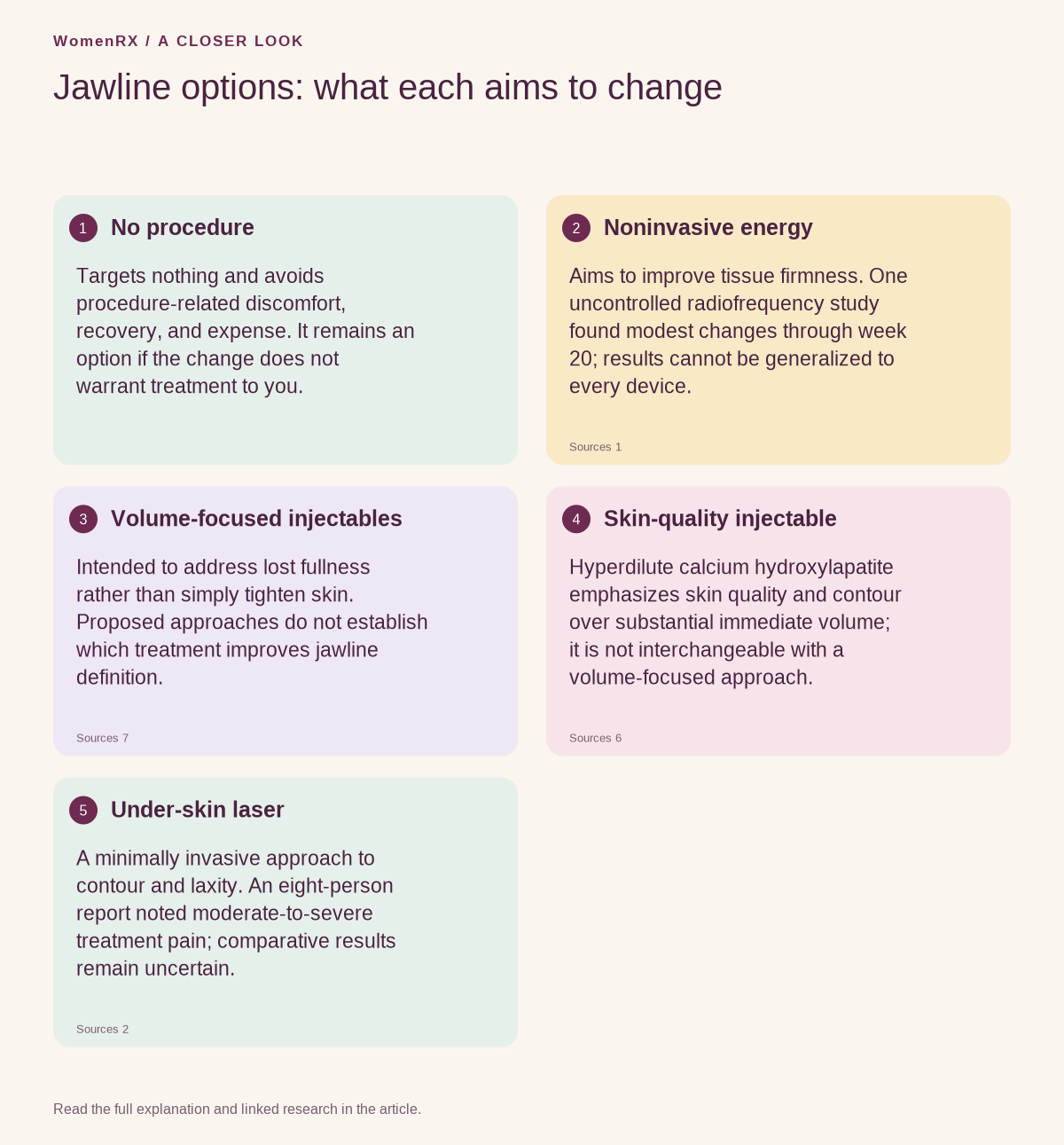
Jawline options: what each aims to change
No procedure: Targets nothing and avoids procedure-related discomfort, recovery, and expense. It remains an option if the change does not warrant treatment to you.
Noninvasive energy: Aims to improve tissue firmness. One uncontrolled radiofrequency study found modest changes through week 20; results cannot be generalized to every device.1
Volume-focused injectables: Intended to address lost fullness rather than simply tighten skin. Proposed approaches do not establish which treatment improves jawline definition.7
Skin-quality injectable: Hyperdilute calcium hydroxylapatite emphasizes skin quality and contour over substantial immediate volume; it is not interchangeable with a volume-focused approach.6
Under-skin laser: A minimally invasive approach to contour and laxity. An eight-person report noted moderate-to-severe treatment pain; comparative results remain uncertain.2
Read the figure as text
Use the intended target and the strength of the evidence to compare options. These are not ranked treatments.- No procedure: Targets nothing and avoids procedure-related discomfort, recovery, and expense. It remains an option if the change does not warrant treatment to you.
- Noninvasive energy: Aims to improve tissue firmness. One uncontrolled radiofrequency study found modest changes through week 20; results cannot be generalized to every device.1
- Volume-focused injectables: Intended to address lost fullness rather than simply tighten skin. Proposed approaches do not establish which treatment improves jawline definition.7
- Skin-quality injectable: Hyperdilute calcium hydroxylapatite emphasizes skin quality and contour over substantial immediate volume; it is not interchangeable with a volume-focused approach.6
- Under-skin laser: A minimally invasive approach to contour and laxity. An eight-person report noted moderate-to-severe treatment pain; comparative results remain uncertain.2
More questions, answered
Does a weight-loss medication itself cause facial sagging?
The voluntary survey found more reports of skin sagging and decreased facial volume among respondents with greater weight loss. It cannot separate an effect of medication from an effect of weight loss or establish the cause of an individual’s facial change. 4
Sources you can check
- Facial contour modulation and skin tightening using 40.68-MHz unipolar radiofrequency.Kim J, Sung K, Park Y, Yi KH. · Lasers in medical science · 2026Return to first citation
- Facial endolaser treatment using a optical fiber connected to a 1444 nm Nd:YAG laser: Preliminary outcomes.Silva SN, Hohl ZT, Biba J, Fusco I, Zingoni T. · JPRAS open · 2026Return to first citation
- Evaluation of the Efficacy and Safety of Microfocused Ultrasound Combined with 1550-nm Non-Ablative Fractional Laser for Facial Rejuvenation in Asian Patients with Fitzpatrick Skin Types III-IV: A Prospective, Randomized Split-Face, Controlled Trial.Zhang L, Liu H, Li X, Chen Y, Yang M, Guo J, Liu J, Chen B, Zeng W. · Aesthetic plastic surgery · 2026Return to first citation
- Skin Impacts and Tradeoffs of GLP-1 Therapy: Improved Patient-Reported Outcomes of Inflammatory Skin Disease in the Era of "Ozempic Face".Rao S, Midura I, Mangual KPS, Igel LI, Saunders KH, Carter J, Murase JE, Kourosh AS. · Dermatology and therapy · 2026Return to first citation
- An Infrared Energy Device for the Treatment of Facial Skin Aging.Kubik P, Gruszczyński W, Pawłowska A, Malinowski M, Baran B, Pawłowska-Kubik A, Kodłubański Ł, Łukasik B. · Biomedicines · 2025Return to first citation
- Hyperdilute Calcium Hydroxylapatite for Skin Quality and Contour: Clinical Applications, Technique, and Practical Considerations.Soza GM. · Dermatologic clinics · 2026Return to first citation
- Aesthetic Considerations for Preventing and Managing GLP-1 Receptor Agonist-Related Facial Aging.Bommareddy K, Fabi S, Muniz M. · The Journal of clinical and aesthetic dermatology · 2026Return to first citation