Weight Loss Plateau: What to Check Before Changing Course
A few weeks without a lower number may reflect scale noise, a changed routine, or a real slowdown, so check the pattern before tightening your plan.
A flat scale for a few weeks does not, by itself, show that you’ve reached a lasting plateau. Weight includes water as well as fat, muscle, and bone, and everyday factors can affect the number. First check whether your weigh-ins form a consistent trend, then review routine, medication, and health changes before considering an adjustment. Weight loss can slow as energy needs change, so a plateau isn’t proof you need a drastic cut. 1 5
Start with the pattern, not the latest number
A weigh-in is a snapshot, not a full account of what’s changing in your body. Weight includes water, muscle, fat, and bone, and everyday factors can affect the scale. That makes a short flat stretch hard to interpret on its own. 1
Before changing your eating or exercise, ask whether you’re comparing similar measurements over time. If weigh-ins happen at different times or under different circumstances, the readings may be harder to compare. A practical first step is to use one consistent approach and look at the pattern across several weeks, rather than reacting to one reading. This is a way to make the comparison more useful, not a test that diagnoses a plateau.
A few weeks of flat readings alone don’t establish a lasting plateau. If your weight has been steady over a longer, consistently measured period, it may be more useful to call it a slowdown worth reviewing than to treat it as proof that something is wrong.
If you have menstrual cycles, you can also note where each weigh-in falls in your cycle when comparing readings. That context alone cannot tell you why the number changed. If you’re pregnant or recently postpartum, this weight-loss troubleshooting sequence is not a substitute for a conversation about weight goals in the context of pregnancy or recovery. And if you’re in perimenopause or postmenopause, a flat trend is not, by itself, evidence that menopause caused it.
Then check what changed in daily life
Walk through the weeks when the scale leveled off. Have your schedule, meals, movement, sleep, or other routines shifted? Could travel, a new work pattern, or less time for activity have changed what a typical week looks like? These are prompts for a calm review, not reasons to blame yourself.
A mathematical modeling study found that intermittent differences between a prescribed eating plan and what people could follow in daily life could help explain early plateaus. That finding does not prove that a plateau means you haven’t been adhering, or that tracking every bite is the answer. It does suggest that a plan’s real-world fit is worth considering alongside physiology. 2
Include medication and health changes in the review
Think about whether a medication was started, stopped, or changed around the time your weight trend shifted, and whether anything else about your health changed. These details don’t establish that a medication or health issue caused a stall; they’re useful context to bring to the prescriber or clinician who knows your situation. Don’t treat a medication change as a reason to alter treatment on your own.
A sudden, unexpected gain or loss is different from a gradual slowdown. MedlinePlus advises discussing an unexpected sudden weight change with a provider because it can be a sign of a medical problem. 1
Remember that energy needs change with weight loss
A weight-loss plan creates a gap between energy intake and energy use. But those two sides don’t stay fixed as your body changes. A review of underfeeding research explains that energy expenditure can fall as body mass and metabolically active tissue decrease; it also discusses adaptive changes beyond those expected from tissue loss. The size of these changes is difficult to estimate for one person living freely. 5
That helps explain why early progress may slow without meaning that your body has stopped responding or that you’ve done anything wrong. A review of weight-loss interventions describes a plateau after an initial period of weight loss as common across many approaches. That is a broad pattern, not a timetable or prediction for any individual. 3
Choose a measured next step
If the trend is genuinely steady and your current routine still feels workable, you can first review whether the plan remains realistic and consistent with your health needs. If part of it has become hard to sustain, consider what small, manageable adjustment would make it fit better. If a medication or health change may be relevant, raise it with the appropriate clinician before making a change to your treatment. The goal is not to compensate for a flat weigh-in with harsher restriction or punishing exercise.
If you’re using a GLP-1 medication as part of weight management, a plateau does not, by itself, show that treatment has stopped working. A modeling analysis illustrates that a plateau can occur while treatment continues, as energy intake and expenditure change. Because it was a model anchored to one representative profile, it cannot predict your personal course. 4
If the scale changes suddenly without an obvious reason, or you’re losing or gaining weight without trying, seek medical advice rather than treating it as a routine plateau. MedlinePlus notes that an unexpected sudden change can be a sign of a medical problem. 1
Keep the conclusion proportional
A useful check ends with one of three conclusions: the readings are too inconsistent or brief to interpret; your routine or circumstances have changed and deserve a practical review; or a longer, clearer trend suggests it’s time to revisit the plan, including any medication or health changes, with appropriate support. None of these conclusions calls for an aggressive calorie cut. The scale is one measure of change, not the whole picture of health. 1
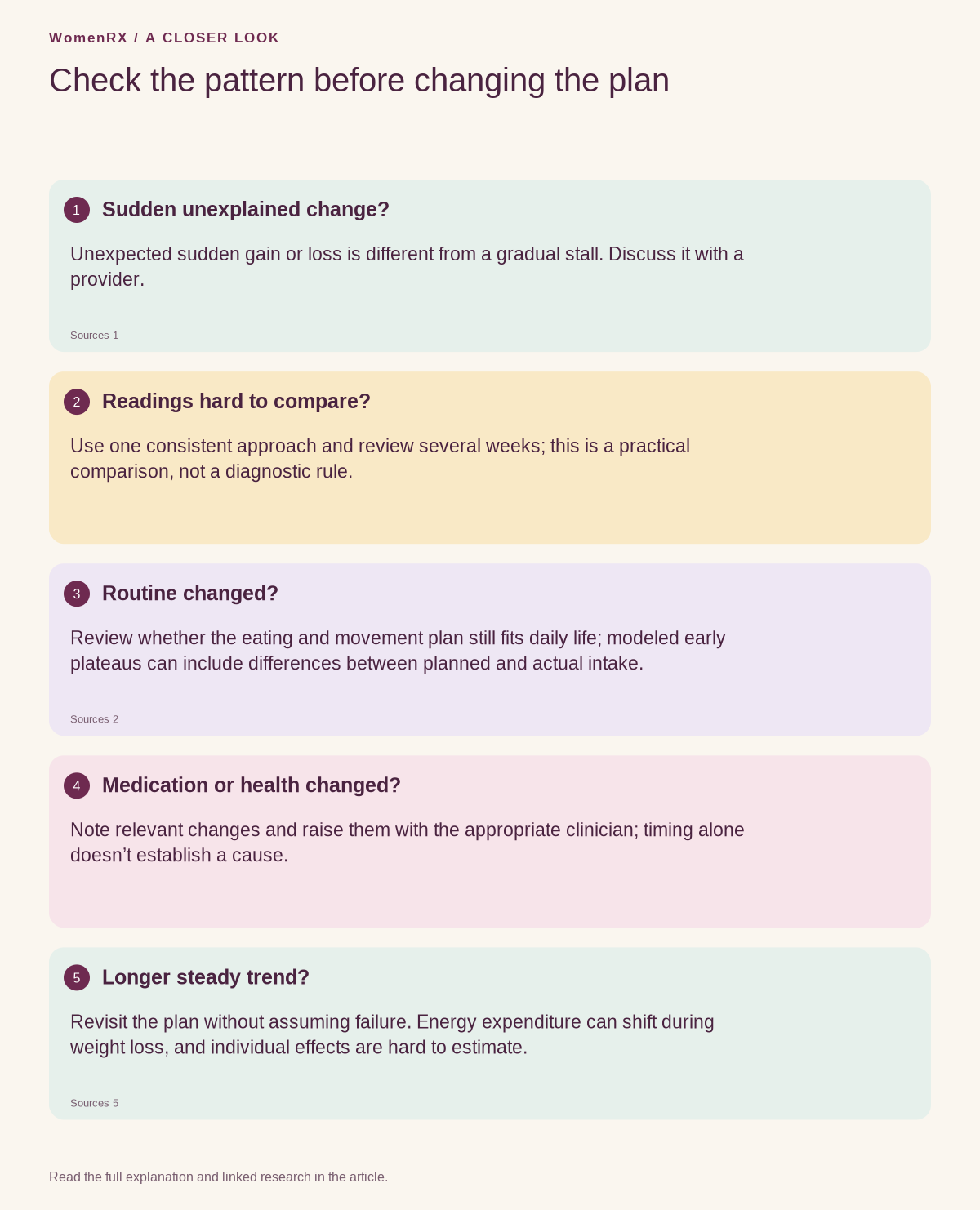
Check the pattern before changing the plan
Sudden unexplained change?: Unexpected sudden gain or loss is different from a gradual stall. Discuss it with a provider.1
Readings hard to compare?: Use one consistent approach and review several weeks; this is a practical comparison, not a diagnostic rule.
Routine changed?: Review whether the eating and movement plan still fits daily life; modeled early plateaus can include differences between planned and actual intake.2
Medication or health changed?: Note relevant changes and raise them with the appropriate clinician; timing alone doesn’t establish a cause.
Longer steady trend?: Revisit the plan without assuming failure. Energy expenditure can shift during weight loss, and individual effects are hard to estimate.5
Read the figure as text
Move through the checks in order: first clarify the trend, then review what changed, and only then consider whether the plan needs support or adjustment.- Sudden unexplained change?: Unexpected sudden gain or loss is different from a gradual stall. Discuss it with a provider.1
- Readings hard to compare?: Use one consistent approach and review several weeks; this is a practical comparison, not a diagnostic rule.
- Routine changed?: Review whether the eating and movement plan still fits daily life; modeled early plateaus can include differences between planned and actual intake.2
- Medication or health changed?: Note relevant changes and raise them with the appropriate clinician; timing alone doesn’t establish a cause.
- Longer steady trend?: Revisit the plan without assuming failure. Energy expenditure can shift during weight loss, and individual effects are hard to estimate.5
More questions, answered
Does a plateau mean my metabolism is broken?
No. Energy expenditure can change during weight loss, and that can contribute to slower progress. But a flat scale alone can’t tell you how much of the change comes from energy needs, measurement variation, or day-to-day circumstances. 1 5
Should I cut calories more when the scale stops moving?
Not automatically. First check whether the measurements form a consistent trend and whether your routine or health circumstances have changed. Research on changing energy needs does not provide a one-size-fits-all adjustment for an individual plateau. 5
Sources you can check
- Body Weight: MedlinePlusAccessed 2026-09-25Return to first citation
- Effect of dietary adherence on the body weight plateau: a mathematical model incorporating intermittent compliance with energy intake prescription.Thomas DM, Martin CK, Redman LM, Heymsfield SB, Lettieri S, Levine JA, Bouchard C, Schoeller DA. · The American journal of clinical nutrition · 2014Return to first citation
- Differential mechanisms affecting weight loss and weight loss maintenance.Rosenbaum M, Foster G. · Nature metabolism · 2023Return to first citation
- Mind the Plateau: A Mathematical Modeling Analysis of Long-Term GLP-1 Receptor Agonist Treatment.Hubert PA, Coleman C, Grosicki GJ, Kiel J, Shepherd M, Lofton HF, Heymsfield SB, Thomas JG, Dhurandhar NV, Jonnalagadda SS. · Journal of the Academy of Nutrition and Dietetics · 2026Return to first citation
- Dynamic changes in energy expenditure in response to underfeeding: a review.Egan AM, Collins AL. · The Proceedings of the Nutrition Society · 2022Return to first citation