How to Check a “Polypeptide Weight Loss” Ad
Before you judge a weight-loss claim, find the exact ingredient and the kind of product being sold.
“Polypeptide weight loss” doesn’t identify a specific medicine. An ad might be referring to a named prescription ingredient, a compounded product, or something else entirely. Ask for the exact active ingredient, formulation, and product name before looking at weight-loss studies. Evidence for an approved medicine doesn’t automatically establish that a different formulation works the same way.5

Start with the name behind the claim
If an ad says only “polypeptide weight loss,” you still don’t know what you’d be taking. The phrase doesn’t tell you the active ingredient or identify the exact product. Prescription ingredients you might encounter include semaglutide, tirzepatide, and liraglutide. They aren’t interchangeable names for the same product: Wegovy contains semaglutide, Zepbound contains tirzepatide, and Saxenda contains liraglutide.367
The exact name matters because the research belongs to a particular ingredient and studied product. For example, the Saxenda prescribing information reports weight-loss results from trials of liraglutide compared with placebo. Those results don’t tell you whether an unnamed “peptide” product works.3
Four questions that make an ad specific
- What is the active ingredient? Look for its name on the proposed product information, not just a phrase such as “peptide therapy.” If the seller won’t name it, you can’t match the claim to a clinical trial or product label.
- What exactly is being offered? Get the product name, formulation, and full ingredient list. A product containing semaglutide plus another ingredient isn’t necessarily the same formulation studied in a trial of a named semaglutide medicine. Researchers examining compounded semaglutide and tirzepatide listings found products with added ingredients and alternative formulations whose benefits and risks were not established by the approved products’ evidence.5
- What is it being sold as? An FDA-approved medicine, a compounded prescription, and a dietary supplement are different categories. A Supplement Facts panel identifies a supplement, which does not receive FDA premarket approval as a drug. Compounded medications are not FDA-approved or reviewed by FDA for safety, effectiveness, and quality before marketing.2
- Does the evidence match this product and use? Check the study’s ingredient, formulation, participants, comparison group, and outcome. An ad’s reference to “FDA approval” isn’t enough to establish that the product in the ad is approved. In a 2025 study of 93 Colorado websites surveyed in spring 2024 that advertised compounded GLP-1 products, 41 referred to FDA approval in their descriptions. That finding concerns those websites, not every seller, but it shows why the product’s status is worth checking rather than assuming.4
You can use the named medicine’s US prescribing information to check its active ingredient and what was studied. Then compare that description with the product actually offered. Even when the ingredient name matches, don’t assume a compounded version has the same formulation or the same body of product-specific evidence.3567
What if you’re pregnant or planning pregnancy?
First identify the medicine. Pregnancy guidance is product-specific, not something you can read from the word polypeptide. Wegovy’s US label says to discontinue it at least two months before a planned pregnancy. That timing belongs to Wegovy, not every product advertised as a peptide.6
If pregnancy is recognized while you’re using Wegovy for weight reduction or Zepbound, both US product labels say to discontinue the medicine. The Zepbound label also says human pregnancy data are insufficient to evaluate its drug-related risks. That’s a reason to discuss the exact medication and pregnancy with your prescriber, not a basis for predicting what will happen in an individual pregnancy.67
It’s also worth asking what evidence was reported for women, rather than assuming a study gives a women-specific answer. In one Wegovy injection study described in its label, 79% of the randomized participants were female, but that participant breakdown is not itself a separate estimate of the treatment’s effect in women.6
If the ad still won’t give you an exact ingredient and product description, you’ve reached a useful stopping point. There’s no sound way to evaluate a product-specific weight-loss promise while the product remains unnamed.
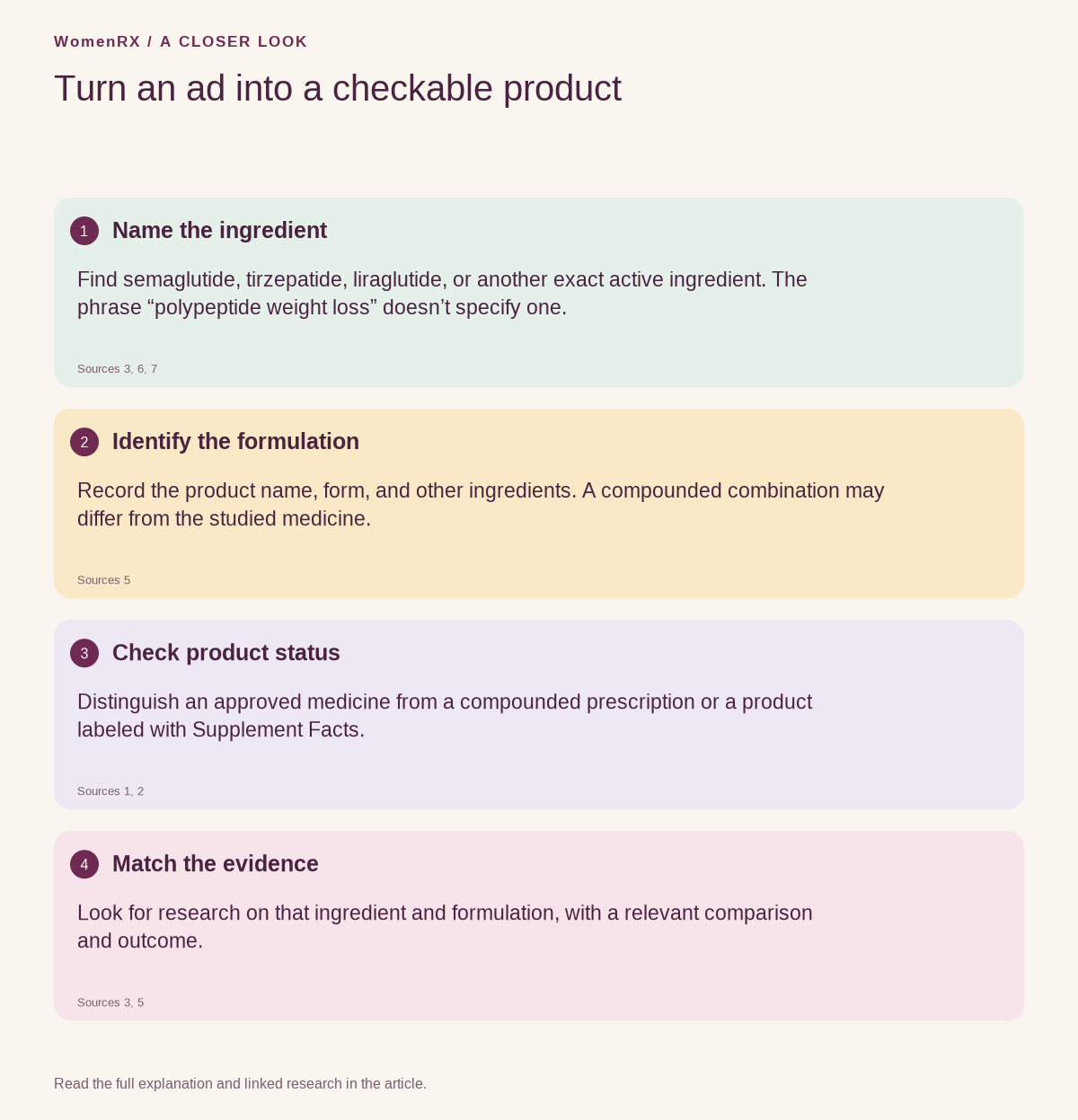
Turn an ad into a checkable product
Name the ingredient: Find semaglutide, tirzepatide, liraglutide, or another exact active ingredient. The phrase “polypeptide weight loss” doesn’t specify one.367
Identify the formulation: Record the product name, form, and other ingredients. A compounded combination may differ from the studied medicine.5
Check product status: Distinguish an approved medicine from a compounded prescription or a product labeled with Supplement Facts.2
Match the evidence: Look for research on that ingredient and formulation, with a relevant comparison and outcome.35
Read the figure as text
Use these distinctions before applying a study or an approval claim to an advertised product.- Name the ingredient: Find semaglutide, tirzepatide, liraglutide, or another exact active ingredient. The phrase “polypeptide weight loss” doesn’t specify one.367
- Identify the formulation: Record the product name, form, and other ingredients. A compounded combination may differ from the studied medicine.5
- Check product status: Distinguish an approved medicine from a compounded prescription or a product labeled with Supplement Facts.2
- Match the evidence: Look for research on that ingredient and formulation, with a relevant comparison and outcome.35
Sources you can check
- Dietary Supplements for Weight Loss - Health Professional Fact SheetAccessed 2026-09-25Return to first citation
- SAXENDA (LIRAGLUTIDE) INJECTION, SOLUTION [NOVO NORDISK PHARMACEUTICAL INDUSTRIES, LP] | US prescribing information and patient instructionsAccessed 2026-09-25Return to first citation
- Compounded glucagon-like peptide-1 receptor agonists for weight loss: the direct-to-consumer market in Colorado.DiStefano MJ, Dardouri M, Moore GD, Saseen JJ, Nair KV. · Journal of pharmaceutical policy and practice · 2025Return to first citation
- Compounded Semaglutide and Tirzepatide Products Use Unique Formulations but Efficacy and Safety Largely Unknown.Belcourt J, Sapowadia A, White CM. · The Annals of pharmacotherapy · 2026Return to first citation
- WEGOVY (SEMAGLUTIDE) INJECTION, SOLUTION WEGOVY (SEMAGLUTIDE) TABLET [NOVO NORDISK PHARMACEUTICAL INDUSTRIES, LP] | US prescribing information and patient instructionsAccessed 2026-09-25Return to first citation
- ZEPBOUND (TIRZEPATIDE) INJECTION, SOLUTION ZEPBOUND (TIRZEPATIDE) INJECTION, SOLUTION ZEPBOUND KWIKPEN (TIRZEPATIDE) INJECTION, SOLUTION [ELI LILLY AND COMPANY] | US prescribing information and patient instructionsAccessed 2026-09-25Return to first citation