Vitamin B6: When It Helps and When the Dose Adds Up
B6 has a role in pregnancy-related nausea, but benefits for other concerns are less certain and long-term high intake can harm nerves.
Vitamin B6 is used under clinical guidance for nausea and vomiting in pregnancy, and it may ease premenstrual symptoms, though that evidence has limits. Before taking it, add up B6 from every supplement, check the daily amount and how long you plan to use it, and remember that the U.S. adult upper limit is a ceiling, not a target. 1
Start with the reason you want B6
Vitamin B6 is an essential nutrient, and foods such as chickpeas, potatoes, poultry, fish, and fortified cereals supply it. For most adults, the recommended daily intake is 1.3 mg for women ages 19-50 and 1.5 mg for women 51 and older. During pregnancy, it’s 1.9 mg. These are total-intake targets, not supplement doses. 1
A supplement may make sense for a specific reason, but “more” isn’t automatically better. The evidence depends on the intended use, and a high-dose product can push your total intake far beyond what you meant to take.
What B6 may help with, and what remains uncertain
Nausea and vomiting in pregnancy: B6 is one option in clinical guidance for pregnancy-related nausea. The NIH Office of Dietary Supplements summarizes American College of Obstetricians and Gynecologists guidance as pyridoxine 10-25 mg three or four times a day; doxylamine may be added if symptoms don’t improve. Because the full daily amount can approach the adult upper limit, check the regimen with your pregnancy-care clinician, especially if you already take a prenatal vitamin. This is a pregnancy-specific use, not evidence that B6 reliably improves everyday mood. 1
Premenstrual symptoms: Research suggests B6 might ease some PMS symptoms, but the studies have limitations. A review of nine trials involving nearly 1,000 women found possible benefit over placebo, while noting that many trials were small or methodologically weak. One trial in 94 women reported improvement with 80 mg daily over three menstrual cycles. That study result is not a reason to copy its dose: 80 mg is much more than the daily requirement, and a single trial doesn’t settle whether the benefit outweighs the risks for you. 1
Mood and memory: Don’t assume a B6 supplement will help. A Cochrane review summarized by NIH found no mood or cognitive benefit in the two short-term studies it assessed, which lasted 5-12 weeks. In a separate randomized trial of 43 people with acute bipolar I mania, adding B6 to folate and valproate did not provide an advantage over folate and valproate alone. That trial addresses acute mania, not everyday mood. Taken together, these findings don’t support taking extra B6 as a general-purpose mood or focus aid. 1 2
Audit the label, not just the bottle
B6 can appear in a multivitamin, a B-complex product, a stand-alone B6 tablet, or other supplements. To estimate your daily supplemental total:
- Find the amount of vitamin B6 in each product’s Supplement Facts panel, in milligrams (mg).
- Check the serving size. If a serving is more than one tablet or gummy, use the amount you actually take.
- Add the B6 amounts from all the products you take in a day. Include a prenatal vitamin if you’re pregnant.
- Write down the intended reason and planned duration too. The amount alone doesn’t tell the whole safety story.
For example, a multivitamin plus a separate B-complex product can contribute B6 from both, even if neither is labeled as a high-dose B6 supplement. Fortified foods can add B6 to your diet as well; some food labels won’t list it unless it’s been added. 1
The upper limit is a ceiling, not a goal
The U.S. adult tolerable upper intake level (UL) for B6 is 100 mg a day from food and supplements combined. The UL is the maximum daily intake considered unlikely to cause harm for most people, not an amount to aim for or a guarantee that long-term use at that level is right for you. 1
Safety authorities don’t all set the same UL: the NIH fact sheet also reports that the European Food Safety Authority set an adult limit of 12 mg a day in 2023. These limits come from different assessments. Their difference is a reminder not to treat the U.S. limit as a supplement target or a personal safety cutoff. 1
The clearest concern with excessive B6 is sensory nerve damage, or neuropathy. NIH reports severe, progressive sensory neuropathy after chronic oral pyridoxine intakes of 1-6 g daily for 12-40 months, with severity appearing related to dose. Reports of neuropathy at lower doses also exist, so the available evidence doesn’t establish one dependable threshold below which every person is safe during long-term use. 1
If you develop new sensory changes or trouble with coordination while taking B6, stop taking non-prescribed B6. NIH notes that symptoms may stop when pyridoxine is discontinued as soon as neurological symptoms appear. 1
When to get the dose checked
Bring the product labels to a pharmacist or prescribing clinician if you’re combining B6 products, planning to take B6 for months, or using a dose well above the daily requirement. This is especially useful if you take phenytoin or phenobarbital: NIH reports that pyridoxine at 200 mg a day for 12-120 days may lower blood levels of those medicines, while effects at lower doses are unknown. Don’t change a prescribed medicine to make room for a supplement. 1
A useful decision is simple: name the reason for taking B6, total the amounts on your labels, and check the planned duration before starting or continuing. If the reason is pregnancy-related nausea or PMS, use guidance for that specific situation rather than borrowing a dose from a different purpose.
Check Your B6 Total
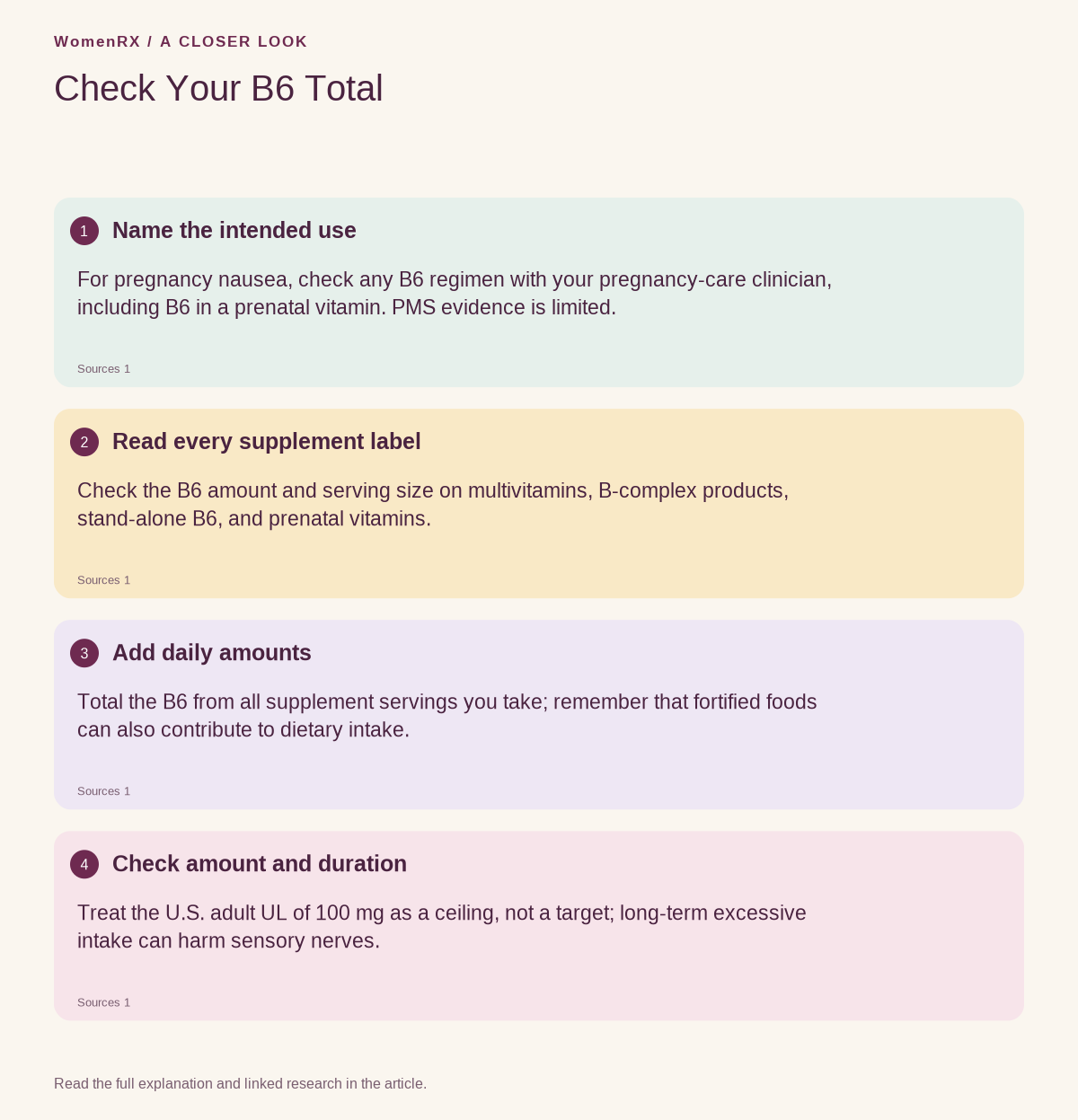
Name the intended use: For pregnancy nausea, check any B6 regimen with your pregnancy-care clinician, including B6 in a prenatal vitamin. PMS evidence is limited.1
Read every supplement label: Check the B6 amount and serving size on multivitamins, B-complex products, stand-alone B6, and prenatal vitamins.1
Add daily amounts: Total the B6 from all supplement servings you take; remember that fortified foods can also contribute to dietary intake.1
Check amount and duration: Treat the U.S. adult UL of 100 mg as a ceiling, not a target; long-term excessive intake can harm sensory nerves.1
Read the figure as text
Use this label audit to connect the reason for taking B6 with the amount and duration across products.- Name the intended use: For pregnancy nausea, check any B6 regimen with your pregnancy-care clinician, including B6 in a prenatal vitamin. PMS evidence is limited.1
- Read every supplement label: Check the B6 amount and serving size on multivitamins, B-complex products, stand-alone B6, and prenatal vitamins.1
- Add daily amounts: Total the B6 from all supplement servings you take; remember that fortified foods can also contribute to dietary intake.1
- Check amount and duration: Treat the U.S. adult UL of 100 mg as a ceiling, not a target; long-term excessive intake can harm sensory nerves.1
More questions, answered
Should I count B6 in my prenatal vitamin?
Yes. Include the B6 amount listed on your prenatal vitamin when you total your daily intake. The NIH fact sheet summarizes pregnancy-nausea guidance as pyridoxine 10-25 mg three or four times a day, but check the full regimen with your pregnancy-care clinician before adding a separate product. 1
Does the 100 mg upper limit mean that amount is safe for long-term use?
No. The U.S. adult UL is a population-level ceiling, not a target or a guarantee of safety for every person over time. The NIH fact sheet also reports a lower adult limit set by EFSA, reflecting a different assessment. 1
Sources you can check
- Vitamin B6 - Health Professional Fact SheetAccessed 2026-09-25Return to first citation
- Short-Term Effects of Folate Supplementation in Combination With Vitamin B6 for Treating Acute Manic Episodes in Bipolar I Disorder: A Randomized Controlled Trial.Akbarzadeh F, Talaei A, Nematy M, Ganji D, Ebrahimi A, Talaei A. · Brain and behavior · 2025Return to first citation