How to Check Your Vitamin B6 Dose Before Long-Term Use
Add up the B6 in every supplement you use, and review new nerve or balance symptoms without assuming B6 is the cause.
Check the serving size and B6 amount on every supplement, including multivitamins, B-complex products, and combination formulas, then add the amounts for the servings you take. New tingling, numbness, or balance changes are reasons to review your B6 exposure and seek advice, but they don’t establish that B6 caused the symptoms. Pregnancy-related use calls for a separate, clinician-guided plan. 1
Start with the amount you actually take
Vitamin B6 may be listed as pyridoxine, pyridoxine hydrochloride, or pyridoxal 5′-phosphate (PLP). It’s sold on its own and in multivitamins, B-complex products, and other supplement blends. Check the serving size as well as the amount of B6, then count the number of servings you actually take. 1
For example, if you use a multivitamin and a combination supplement that also contains B6, include both. Add the amounts from all supplements to get a useful supplement total. Food contributes to total intake too, but high B6 intake from food sources hasn’t been reported to cause adverse effects. 1
Treat upper limits as reference points, not targets
The U.S. Food and Nutrition Board’s tolerable upper intake level (UL) for adults is 100 mg a day from food and supplements combined. A UL is a population-level reference for an intake unlikely to cause adverse effects. It isn’t a recommended amount to take, and it doesn’t guarantee that a particular person can use an amount near it long term without harm. 1
The European Food Safety Authority set a lower adult UL of 12 mg a day, including for pregnant and lactating women, based on its review of evidence related to peripheral neuropathy. Different limits reflect differences in how authorities assessed the evidence. Neither figure establishes one universally safe long-term amount for every person. 1
For context, the U.S. recommended daily allowance is 1.3 mg for women ages 19-50 and 1.9 mg during pregnancy. These are recommended intake levels, not supplement prescriptions. 1
Put new symptoms in context
Long-term use of excessive oral pyridoxine can cause sensory neuropathy; the NIH fact sheet also describes loss of coordination, or ataxia, with severe toxicity. The evidence doesn’t establish a single dose or duration that predicts what will happen to each individual. 1
If you develop new tingling, numbness, or balance changes while taking B6, review the labels and discuss your exposure and symptoms with a clinician. These symptoms are a reason to check what you’re taking, not proof that B6 is the cause. A study of 261 people with chronic idiopathic axonal polyneuropathy found that moderately elevated blood B6 levels weren’t associated with more severe neuropathy. That finding doesn’t determine whether stopping a supplement would help an individual. 2
Don’t add another B6 product to try to treat unexplained nerve symptoms. The first practical step is to identify what’s already in your supplements and get the symptoms assessed in context.
Include medicines in the review
A supplement tally is only part of the picture if you take regular medicine. The NIH fact sheet reports that valproic acid, carbamazepine, and phenytoin can affect B6 metabolism. It also reports that high-dose pyridoxine reduced blood concentrations of phenytoin and phenobarbital in research; whether lower doses have the same effect is unknown. Share your product labels and medicine list with a pharmacist or prescriber rather than changing a prescription on your own. 1
Pregnancy nausea is a separate use
Vitamin B6 is used for nausea and vomiting in pregnancy. The NIH fact sheet summarizes American College of Obstetricians and Gynecologists guidance on B6, with doxylamine as an option if symptoms don’t improve. That pregnancy-specific use is different from taking a self-selected supplement indefinitely. Check the B6 in your prenatal and any other products, and have your pregnancy-care clinician guide the plan and review the combined amount. 1
A product-by-product tally gives you a clearer starting point than relying on the amount printed on one bottle. It can also make a conversation about ongoing use, symptoms, pregnancy, or medicine interactions more specific.
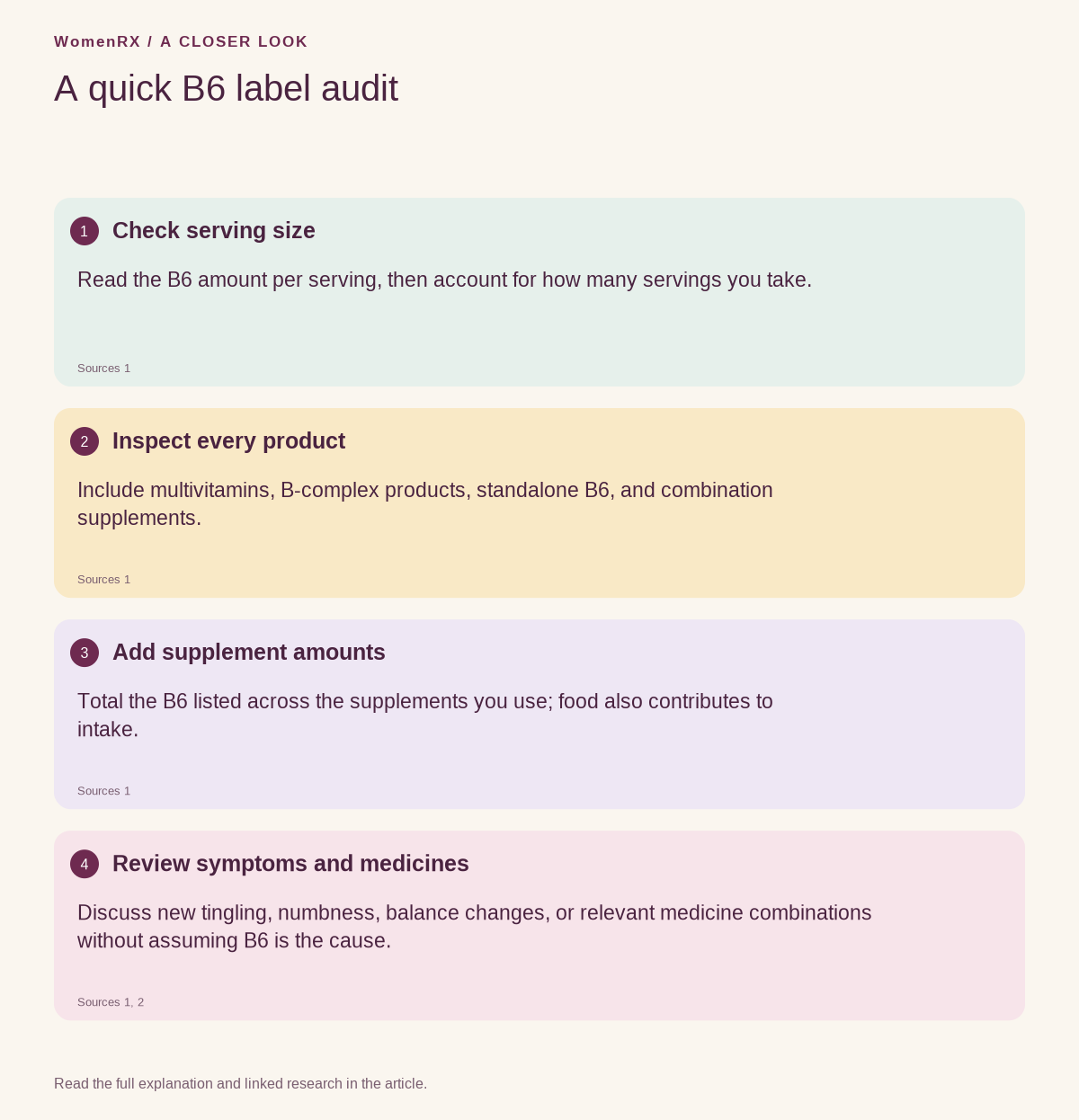
A quick B6 label audit
Check serving size: Read the B6 amount per serving, then account for how many servings you take.1
Inspect every product: Include multivitamins, B-complex products, standalone B6, and combination supplements.1
Add supplement amounts: Total the B6 listed across the supplements you use; food also contributes to intake.1
Review symptoms and medicines: Discuss new tingling, numbness, balance changes, or relevant medicine combinations without assuming B6 is the cause.12
Read the figure as text
Check each label and serving you use to build a practical supplement total and identify when a wider review may help.- Check serving size: Read the B6 amount per serving, then account for how many servings you take.1
- Inspect every product: Include multivitamins, B-complex products, standalone B6, and combination supplements.1
- Add supplement amounts: Total the B6 listed across the supplements you use; food also contributes to intake.1
- Review symptoms and medicines: Discuss new tingling, numbness, balance changes, or relevant medicine combinations without assuming B6 is the cause.12
More questions, answered
Should I stop B6 if I’m pregnant and taking it for nausea?
B6 is used for pregnancy-related nausea, but the amount in a prenatal and any other products should be considered together. Ask your pregnancy-care clinician to guide its use for your situation rather than treating pregnancy guidance as a reason for unsupervised long-term supplementation. 1
Sources you can check
- Vitamin B6 - Health Professional Fact SheetAccessed 2026-09-25Return to first citation
- Vitamin B6 levels do not correlate with severity of neuropathy in chronic idiopathic axonal polyneuropathy.Stewart SL, Thomas S, Höke E, Simpson D, Singleton JR, Höke A. · Journal of the peripheral nervous system : JPNS · 2022Return to first citation