Vitamin B6 Supplements: Check the Dose Before Adding More
Vitamin B6 can appear in several supplements at once, and high intake has been linked to nerve problems.
Check the vitamin B6 amount on every supplement you take, then add up the amounts for the servings you actually use. A multivitamin and a separate B-complex both count. High supplemental B6 has been linked to sensory nerve problems, and there isn’t a reliable dose or duration that predicts who will develop them. New numbness or tingling deserves a review of your products and symptoms. 12
Add up what you take, not what each bottle promises
Start with the Supplement Facts panel on every product you use. Look for “vitamin B6” in your multivitamin, B-complex, and any combination supplement you take for another reason. Pyridoxine is one form of B6. 1
For each product, note the B6 amount per serving and how many servings you actually take in a day. Add those amounts together. For example, if both your multivitamin and a separate supplement list B6, include both in your total. Keep the product names or photos of the labels, too. The total tells you whether products overlap; it doesn’t, by itself, prove that a dose is safe or unsafe.
The amount your body needs isn’t a toxicity cutoff
B6 has a normal role in metabolism and nerve function. One systematic review describes a general dietary intake recommendation of about 1.6-2 mg a day to maintain nutritional status. That range isn’t a target for treating symptoms, a pregnancy-specific recommendation, or a line below which every supplement routine is guaranteed safe. 1
The concern with excess B6 is peripheral neuropathy, a nerve problem that can affect sensation. A systematic review of 20 articles found that higher B6 levels, usually associated with supplements, may lead to predominantly sensory neuropathy. It also found that B6 hasn’t been confirmed as a treatment for neuropathy: studies reporting improvement generally used B6 with other vitamins, not B6 alone. 1
There’s no dependable number you can use to predict whether or when nerve symptoms will occur. In a study of 261 people who already had chronic idiopathic axonal polyneuropathy, moderately elevated blood B6 levels weren’t associated with more severe symptoms. That finding doesn’t establish a safe supplement dose for someone starting B6, and a blood level isn’t the same thing as the amount listed on a bottle. 2
Check the reason and the length of use
A short course and a high-dose product taken repeatedly for months aren’t the same exposure. Note when you started each product, particularly if you added one to a multivitamin you were already taking. Dose and duration both matter when considering B6-associated neuropathy, but neither gives you a personal risk prediction. 13
If you’re taking B6 for fatigue, premenstrual symptoms, or tingling, pause before assuming more will help. B6’s essential role in the body isn’t evidence that an extra supplement will relieve your particular symptom. And tingling shouldn’t be treated as a reason to add B6 on your own: high B6 intake is one possible concern, while nerve symptoms can have other causes. 1
Pregnancy or breastfeeding is another reason to check the whole supplement routine rather than adding a stand-alone B6 product without a specific reason. Include any prenatal or multivitamin in your total, and ask the clinician caring for you to review a proposed extra product. The neuropathy research doesn’t provide a pregnancy-, breastfeeding-, or women-specific dose threshold. 12
If you develop new numbness, tingling, or sensory pain, tell a clinician what you’re taking and how long you’ve taken it. Bring the labels or your written list. That gives them a way to assess B6 exposure alongside other possible explanations, instead of guessing from one bottle. 12
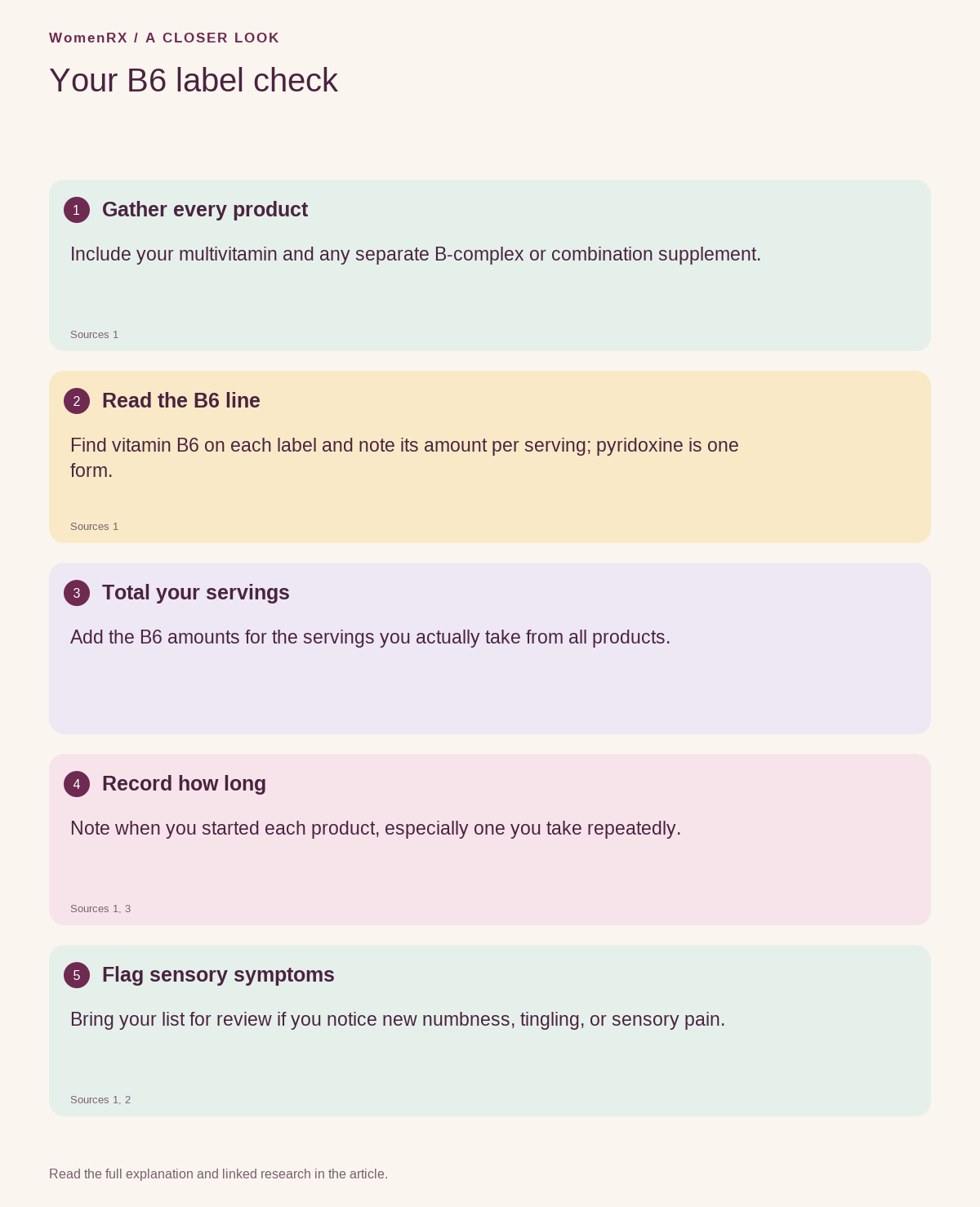
Your B6 label check
Gather every product: Include your multivitamin and any separate B-complex or combination supplement.1
Read the B6 line: Find vitamin B6 on each label and note its amount per serving; pyridoxine is one form.1
Total your servings: Add the B6 amounts for the servings you actually take from all products.
Record how long: Note when you started each product, especially one you take repeatedly.13
Flag sensory symptoms: Bring your list for review if you notice new numbness, tingling, or sensory pain.12
Read the figure as text
Use these steps to find overlapping B6 and bring a useful record to a dose review.- Gather every product: Include your multivitamin and any separate B-complex or combination supplement.1
- Read the B6 line: Find vitamin B6 on each label and note its amount per serving; pyridoxine is one form.1
- Total your servings: Add the B6 amounts for the servings you actually take from all products.
- Record how long: Note when you started each product, especially one you take repeatedly.13
- Flag sensory symptoms: Bring your list for review if you notice new numbness, tingling, or sensory pain.12
Sources you can check
- The Role of Vitamin B6 in Peripheral Neuropathy: A Systematic Review.Muhamad R, Akrivaki A, Papagiannopoulou G, Zavridis P, Zis P. · Nutrients · 2023Return to first citation
- Vitamin B6 levels do not correlate with severity of neuropathy in chronic idiopathic axonal polyneuropathy.Stewart SL, Thomas S, Höke E, Simpson D, Singleton JR, Höke A. · Journal of the peripheral nervous system : JPNS · 2022Return to first citation
- Vitamin B6: too much, too little, too late? An analysis of sales trends in Australia from 2023 to 2025.Chan WJ, Hunter J, Lee VY, Cairns R, Mathews S, Harnett JE. · Internal medicine journal · 2026Return to first citation