Vitamin A From Food or Supplements: What’s Different?
Both animal foods and colorful plants can contribute vitamin A, but your body handles their forms differently, especially when you’re choosing a supplement before pregnancy.
Yes, food can provide vitamin A through two routes: preformed vitamin A in animal foods and provitamin A carotenoids in plants. Your body converts some carotenoids into vitamin A, and intake accounting reflects that conversion. In pregnancy, the distinction matters because excess preformed vitamin A, including from supplements, can harm fetal development; the upper limit does not apply to carotenoids. 1 2
Two routes to the same vitamin
Vitamin A isn’t just one ingredient in food. Preformed vitamin A (retinol and retinyl esters) occurs in animal foods such as dairy products, eggs, fish, and organ meats. Provitamin A carotenoids are plant pigments; beta-carotene, alpha-carotene, and beta-cryptoxanthin are examples your body can convert into vitamin A. Other familiar carotenoids, including lycopene, lutein, and zeaxanthin, don’t convert into vitamin A. 1
So a plate with vegetables and a meal containing animal foods contribute in different ways. The plant foods provide building blocks; the animal foods provide vitamin A in a preformed form. Neither route is automatically a sign that you’re getting too little or too much. A food list alone can’t establish your personal intake or status.
Why intake labels use RAE
Retinol activity equivalents, or RAE, account for the different amounts of food and supplement forms needed to express vitamin A activity on a common scale. For example, 1 microgram RAE equals 1 microgram of retinol, 12 micrograms of beta-carotene from food, or 2 micrograms of beta-carotene from supplements. Dietary alpha-carotene and beta-cryptoxanthin have different conversion factors again. These are accounting equivalents, not a promise that every person absorbs or converts the same amount. 1
That difference helps explain why a food’s listed amount of a carotenoid shouldn’t be read as the same amount of preformed vitamin A. Conversion varies, and the body’s conversion of provitamin A carotenoids can also vary genetically. 1
Pregnancy makes the form worth checking
If you’re planning a pregnancy, pay particular attention to the form of vitamin A in supplements. Excess preformed vitamin A can be teratogenic, meaning it can harm fetal development. The upper intake limit for vitamin A applies to preformed vitamin A, not beta-carotene or other provitamin A carotenoids. This is why preformed vitamin A and plant carotenoids shouldn’t be treated as interchangeable risks. 2
That distinction isn’t a reason to avoid vegetables that contain carotenoids. It is a reason to check what a supplement actually contains rather than assuming all vitamin A on a label behaves the same way. A prenatal supplement may contribute to total intake, and some products differ in the nutrients and amounts they contain. 2
A practical way to compare food and supplements
When you’re reviewing your usual meals and a supplement label, separate the sources into two groups:
- Animal foods and supplements with preformed vitamin A: These contribute retinol or retinyl esters. For pregnancy planning, look for whether a supplement lists a preformed form, and consider it as part of your overall intake.
- Plant foods and supplements with beta-carotene: These provide provitamin A carotenoids, which the body converts. Their intake is not subject to the preformed-vitamin-A upper limit. 1 2
Then look at the product’s total vitamin A amount and form. If the label lists only a combined amount without making the form clear, don’t guess how much is preformed versus carotenoid. A prenatal supplement is generally recommended during pregnancy, but that doesn’t mean every product has the same composition. 2
For most people in the United States, frank vitamin A deficiency is rare. That population-level fact is reassuring, but it can’t tell you whether your own diet or supplement combination is adequate. A careful comparison of food sources and product labels is more useful than adding a separate vitamin A supplement based on a general impression that your diet might be low. 1
Two forms, different pregnancy considerations
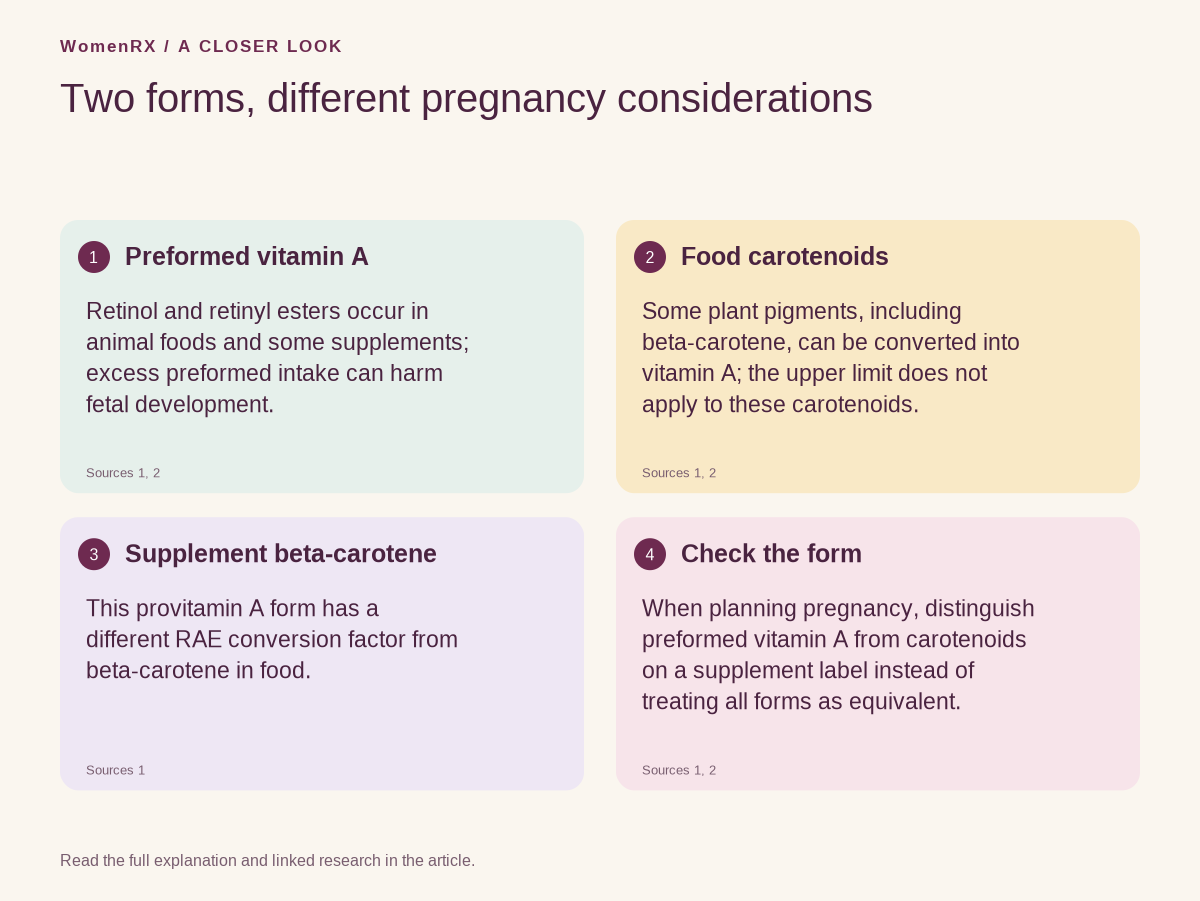
Preformed vitamin A: Retinol and retinyl esters occur in animal foods and some supplements; excess preformed intake can harm fetal development.12
Food carotenoids: Some plant pigments, including beta-carotene, can be converted into vitamin A; the upper limit does not apply to these carotenoids.12
Supplement beta-carotene: This provitamin A form has a different RAE conversion factor from beta-carotene in food.1
Check the form: When planning pregnancy, distinguish preformed vitamin A from carotenoids on a supplement label instead of treating all forms as equivalent.12
Read the figure as text
Compare where vitamin A forms come from, how the body uses them, and which distinction matters when reviewing a supplement for pregnancy planning.- Preformed vitamin A: Retinol and retinyl esters occur in animal foods and some supplements; excess preformed intake can harm fetal development.12
- Food carotenoids: Some plant pigments, including beta-carotene, can be converted into vitamin A; the upper limit does not apply to these carotenoids.12
- Supplement beta-carotene: This provitamin A form has a different RAE conversion factor from beta-carotene in food.1
- Check the form: When planning pregnancy, distinguish preformed vitamin A from carotenoids on a supplement label instead of treating all forms as equivalent.12
More questions, answered
Are plant carotenoids the same as vitamin A?
Not exactly. Some carotenoids, including beta-carotene, can be converted into vitamin A; others, such as lycopene, lutein, and zeaxanthin, cannot. Intake calculations account for the conversion, but it varies between people. 1
Does the vitamin A upper limit include beta-carotene from food?
No. The upper limit applies to preformed vitamin A, not beta-carotene or other provitamin A carotenoids. 2