Vaginal and Urinary Changes Around Menopause: What Helps?
Dryness, painful sex, and urinary discomfort can have different causes, so the most useful treatment depends on which symptom you’re trying to relieve.
Falling estrogen around menopause can contribute to vaginal dryness, irritation, painful sex, and some urinary symptoms. These changes are often called genitourinary syndrome of menopause, or GSM. Lubricants and moisturizers may help dryness; persistent symptoms may respond to local vaginal estrogen or another prescription treatment. Burning, urgency, or leakage deserves a closer look because menopause isn’t the only possible cause.2347
Why these symptoms can show up together
As estrogen levels fall around menopause, vaginal dryness and irritation can develop. Some women also have pain with sex, urinary urgency, or discomfort when they urinate. Clinicians may group these symptoms under genitourinary syndrome of menopause (GSM). It describes a possible connection, not a way to diagnose every new symptom on your own.24
That distinction matters most with urinary symptoms. For example, burning when you pee might occur alongside vaginal irritation, but a urinary tract infection (UTI) is another possibility. Leaking when you cough or laugh calls for a different assessment than a sudden urge to pee. A clinician may check for infection or examine other causes of leakage rather than assume it’s all due to menopause.78
Match the option to what bothers you
For vaginal dryness: If dryness causes friction during sex, a lubricant may help. A vaginal moisturizer is another option for dryness. If you use condoms, avoid oil-based lubricant because it can damage them; water-based lubricants are available.26
For dryness or irritation that keeps returning: Low-dose vaginal estrogen treats menopausal vaginal dryness and irritation. It comes in forms including vaginal tablets, creams, gels, and rings. Unlike hormone therapy used throughout the body, it acts mainly in the vagina and isn’t a treatment for hot flashes, mood changes, or sleep problems. It can take up to three months to work fully, so it isn’t an instant substitute for a lubricant when sex is uncomfortable today.12
If painful sex comes with dryness, treating the vaginal symptoms may help. But pain that persists deserves its own discussion rather than an assumption that dryness is the whole explanation. A small, nonrandomized study in postmenopausal women reported better outcomes for painful sex with local estriol or vaginal prasterone than with radiofrequency treatment; its design cannot establish which treatment would work best for an individual woman.45
If over-the-counter options aren’t enough: The North American Menopause Society’s (NAMS) 2022 position statement recommends considering low-dose vaginal estrogen, vaginal dehydroepiandrosterone (DHEA, also called prasterone), or oral ospemifene for bothersome GSM when over-the-counter treatments haven’t relieved symptoms and systemic hormone therapy isn’t otherwise indicated. These aren’t interchangeable choices: one question is whether you’d prefer a vaginal treatment or an oral medicine; another is how your medical history affects the choice.3
For urinary discomfort or leakage: Ask what the urinary symptom might represent before choosing a vaginal treatment to address it. An infection may need evaluation and treatment. Urgency and leakage may also need assessment to identify the type of bladder problem. Repeated or new UTI symptoms need assessment rather than an assumption that a vaginal treatment will address them.78
What to bring into the treatment conversation
It helps to be specific: Is the main problem dryness throughout the day, friction during sex, pain even without friction, burning when you pee, a sudden urge to go, or leakage with a cough? Those differences point toward different questions and, for urinary symptoms, sometimes different examinations or tests.47
You can also ask, “What is this treatment meant to improve, and what should we do if that symptom doesn’t improve?” With vaginal estrogen, a different form may be worth discussing if the one you try doesn’t suit you. Treatment should be individualized and revisited, especially when you have a medical history that could affect hormone-treatment decisions.23
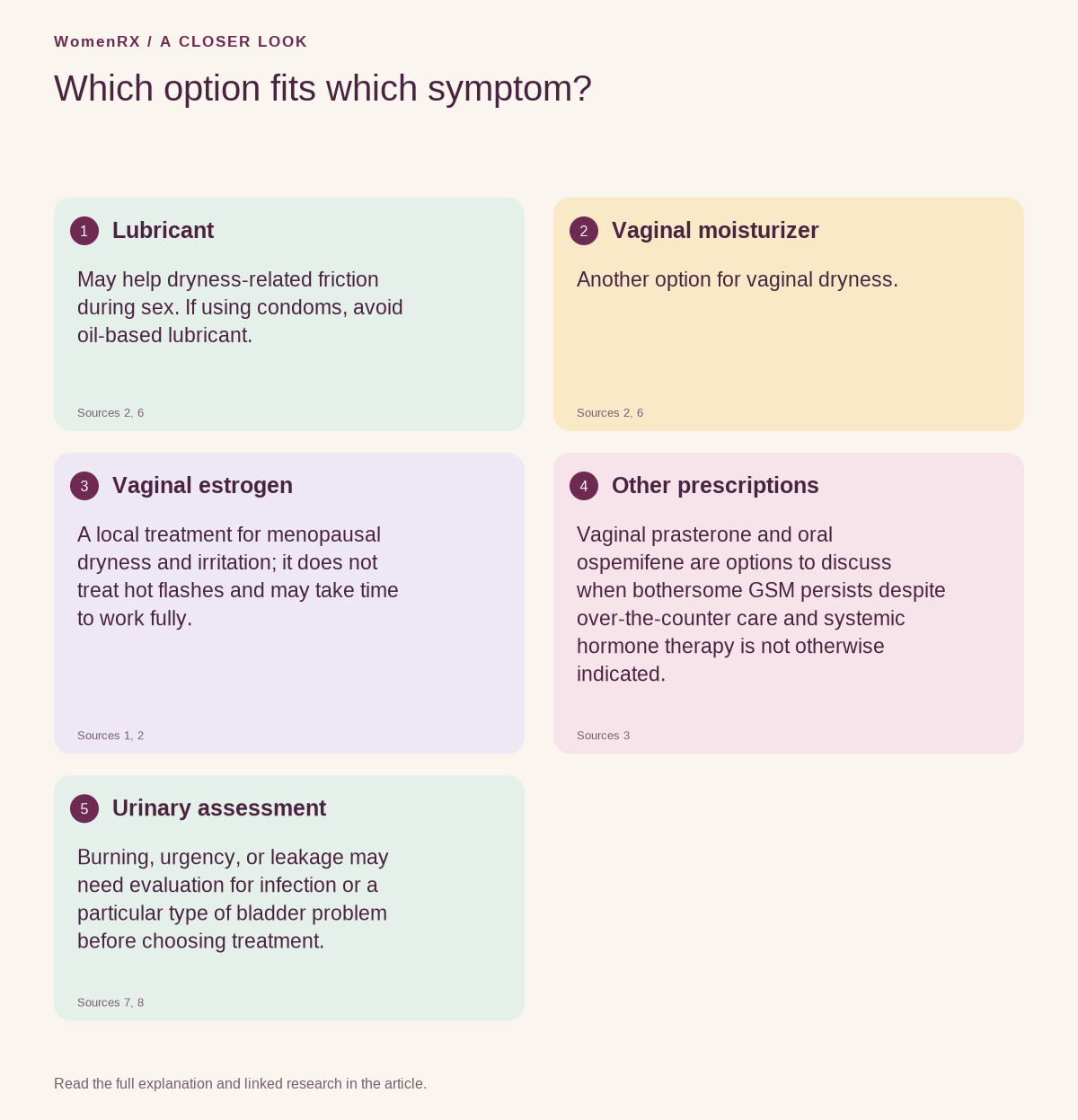
Which option fits which symptom?
Lubricant: May help dryness-related friction during sex. If using condoms, avoid oil-based lubricant.26
Vaginal moisturizer: Another option for vaginal dryness.26
Vaginal estrogen: A local treatment for menopausal dryness and irritation; it does not treat hot flashes and may take time to work fully.12
Other prescriptions: Vaginal prasterone and oral ospemifene are options to discuss when bothersome GSM persists despite over-the-counter care and systemic hormone therapy is not otherwise indicated.3
Urinary assessment: Burning, urgency, or leakage may need evaluation for infection or a particular type of bladder problem before choosing treatment.78
Read the figure as text
A symptom-first view of what each option is meant to address, without treating urinary complaints as automatically menopausal.- Lubricant: May help dryness-related friction during sex. If using condoms, avoid oil-based lubricant.26
- Vaginal moisturizer: Another option for vaginal dryness.26
- Vaginal estrogen: A local treatment for menopausal dryness and irritation; it does not treat hot flashes and may take time to work fully.12
- Other prescriptions: Vaginal prasterone and oral ospemifene are options to discuss when bothersome GSM persists despite over-the-counter care and systemic hormone therapy is not otherwise indicated.3
- Urinary assessment: Burning, urgency, or leakage may need evaluation for infection or a particular type of bladder problem before choosing treatment.78
More questions, answered
Will vaginal estrogen also help my hot flashes?
No. Vaginal estrogen is used for local symptoms such as dryness and irritation; it doesn’t treat hot flashes or other whole-body menopause symptoms. If you have both, bring up both when discussing treatment options.1
Sources you can check
- About vaginal oestrogen - NHSAccessed 2026-09-25Return to first citation
- Common questions about vaginal oestrogen - NHSAccessed 2026-09-25Return to first citation
- The 2022 hormone therapy position statement of The North American Menopause Society.“The 2022 Hormone Therapy Position Statement of The North American Menopause Society” Advisory Panel. · Menopause (New York, N.Y.) · 2022Return to first citation
- Vaginal Estrogen: Pearls for the Practitioner A Practical Review of Evidence, Guidelines, and Prescribing Strategies for Genitourinary Syndrome of Menopause.Perelmuter S, Srivastava M, Freedman KP, Hanfling S, Rubin RS. · Journal of women's health (2002) · 2026Return to first citation
- Intravaginal radiofrequency versus local estrogen and prasterone for genitourinary syndrome of menopause: a comparative study of clinical outcomes.Llaneza IP, Parugues BD, de la Noval BD, Aldecoa Álvarez MB, Doblas PV, Chiminazzo V, Llaneza Coto ÁP. · European journal of obstetrics, gynecology, and reproductive biology · 2026Return to first citation
- Things you can do to help menopause and perimenopause symptoms - NHSAccessed 2026-09-25Return to first citation
- Urinary incontinence - Diagnosis - NHSAccessed 2026-09-25Return to first citation
- Urinary tract infections (UTIs) - NHSAccessed 2026-09-25Return to first citation