Traction Alopecia: Spot the Pull and Protect Your Hairline
Thinning where a hairstyle repeatedly pulls can be a clue to traction alopecia, especially when you also notice breakage or scalp tenderness.
Traction alopecia is hair loss caused by repeated pulling on hair roots. It often appears at the temples or in front of the ears, where a style puts tension. Broken hairs, thinning, tenderness, or inflamed follicles can add to the suspicion, but they don’t confirm the cause. Ease the pull now, and get worsening or persistent loss assessed. 2 3

Look for a match between the style and the thinning
Traction alopecia develops when hair roots are repeatedly strained. It commonly affects tension-bearing areas such as the temples and the hairline in front of the ears. Braids or ponytails that pull on those areas can be part of the picture. The clue is where the tension lands, not the name of the hairstyle or your hair texture. 2 3
Look beyond the shape of your hairline. Reduced density, broken hairs, and inflamed follicles can occur with traction alopecia; some women also report scalp tenderness. A clinician may see hair casts. None of these signs proves that pulling is the only cause, but thinning in a repeatedly strained spot makes it worth changing the tension. 2 3 5
If you wear a head covering, consider how your hair is secured beneath it. Is a braid or gathered section pulling at the same place that’s thinning? That’s a more useful question than assuming the covering itself explains the loss. The same principle applies to any style: pay attention to whether it repeatedly strains the affected hairline. 2 4
Change the pull, not necessarily the whole style
You don’t have to rule out every braid or ponytail. Focus on reducing strain where you see thinning or feel tenderness. For example, that might mean asking for a looser braid near your temples or wearing a ponytail in a way that doesn’t tug at the same hairline area. If a style hurts, easing that tension is more useful than trying to get used to it. Reducing hair tension is the central early step described in a clinical reference on traction alopecia. 2
When caught early, traction-related hair loss may be reversible, but regrowth isn’t guaranteed. Reducing tension is an early management step; continued traction can progress to scarring alopecia. 2 3
Know when the pattern needs a closer look
Hairline thinning isn’t automatically traction alopecia. Female-pattern hair loss, shedding disorders, and inflammatory or scarring conditions can also affect the temples, sometimes alongside traction. In a study of adults already experiencing hair loss at both temples, researchers found a range of accompanying hair disorders. That selected group can’t tell you the odds of any diagnosis for your own hairline, but it shows why location alone isn’t enough. 1
Arrange a scalp assessment if thinning keeps worsening, tenderness or inflammation persists, or the loss doesn’t line up with where your hair is pulled. Mention any styling tension you’ve noticed and whether the pattern has changed. A clinician can examine the scalp and may use a magnifying tool called a dermoscope to look for features associated with traction and other causes. Those findings are interpreted alongside your history, not used as a stand-alone test. 1 2 5
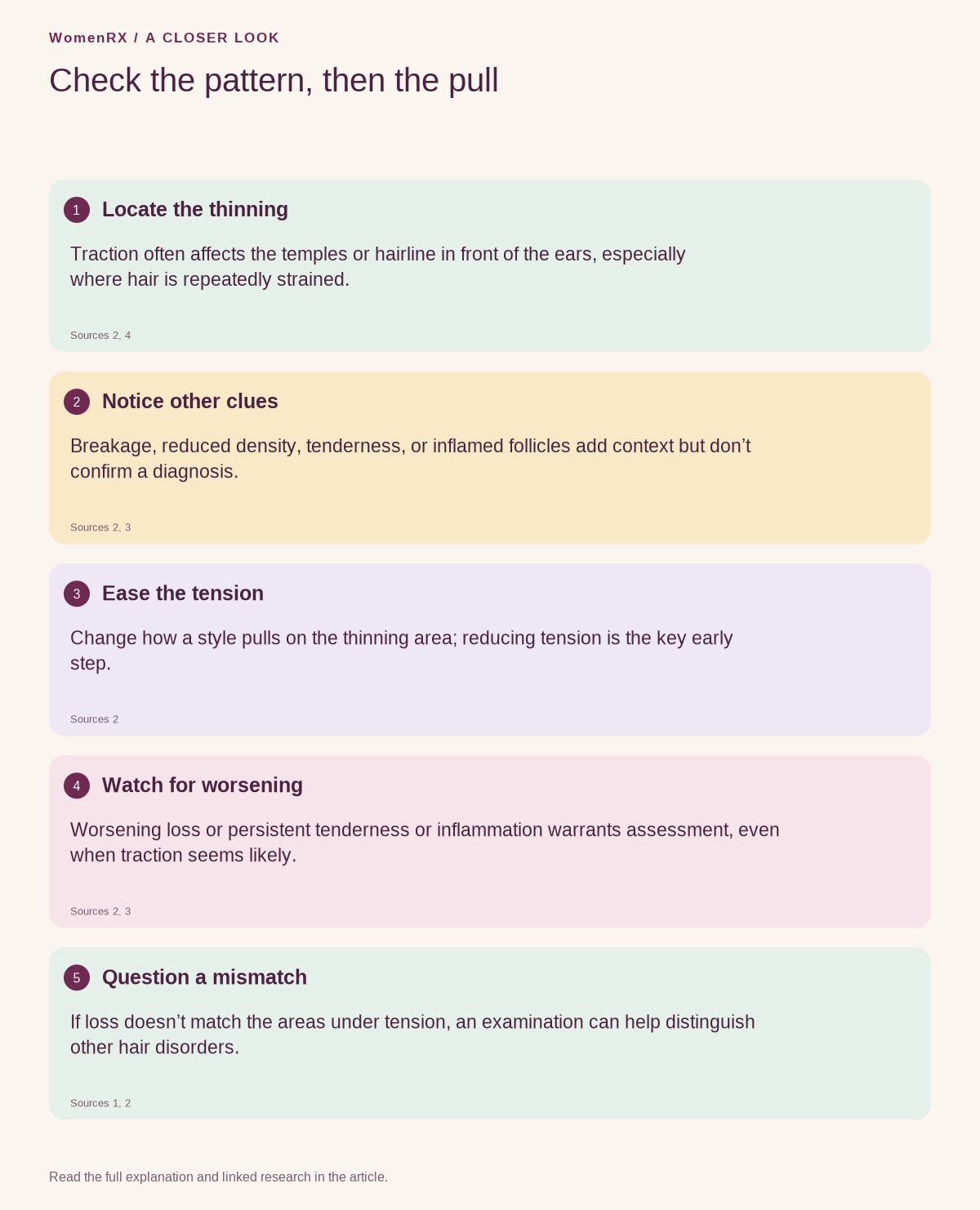
Check the pattern, then the pull
Locate the thinning: Traction often affects the temples or hairline in front of the ears, especially where hair is repeatedly strained.24
Notice other clues: Breakage, reduced density, tenderness, or inflamed follicles add context but don’t confirm a diagnosis.23
Ease the tension: Change how a style pulls on the thinning area; reducing tension is the key early step.2
Watch for worsening: Worsening loss or persistent tenderness or inflammation warrants assessment, even when traction seems likely.23
Question a mismatch: If loss doesn’t match the areas under tension, an examination can help distinguish other hair disorders.12
Read the figure as text
Use these checks to connect hairline changes with possible tension and decide when an examination would help.- Locate the thinning: Traction often affects the temples or hairline in front of the ears, especially where hair is repeatedly strained.24
- Notice other clues: Breakage, reduced density, tenderness, or inflamed follicles add context but don’t confirm a diagnosis.23
- Ease the tension: Change how a style pulls on the thinning area; reducing tension is the key early step.2
- Watch for worsening: Worsening loss or persistent tenderness or inflammation warrants assessment, even when traction seems likely.23
- Question a mismatch: If loss doesn’t match the areas under tension, an examination can help distinguish other hair disorders.12
More questions, answered
Can hair grow back after traction alopecia?
When caught early, traction alopecia can be reversible, but regrowth isn’t guaranteed. Reducing tension is an early management step; continued pulling can progress to scarring alopecia. 2 3
Sources you can check
- Investigation of Hair Diseases Accompanying Bitemporal Alopecia: An Observational Cross-Sectional Study.Menteşoğlu D, Soran G, Sali N, Akçam A, Erol ŞN, Kartal SP. · Journal of clinical practice and research · 2026Return to first citation
- Traction AlopeciaSyed HA, Kaliyadan F. · 2026Return to first citation
- Prevalence and Associated Factors of Traction Alopecia in Women in North Sudan: A Community-Based, Cross-Sectional Study.Abdallah S, Hassan AA, Alotaibi MK, Adam I. · Medicina (Kaunas, Lithuania) · 2025Return to first citation
- What is traction alopecia?Pediatric dermatology · 2024Return to first citation
- Dermoscopy of Traction Alopecia in Black Scalp Patients: Insights from a Literature Review.Boas TV, de Almeida RFC, Tortelly VD, Starace M, Melo DF. · Dermatology practical & conceptual · 2025Return to first citation