Alopecia Areata: Recognizing Patches and Choosing Next Steps
A distinct patch can suggest alopecia areata, but the pattern, scalp examination, and extent of hair loss guide what happens next.
Alopecia areata often causes distinct patches of non-scarring hair loss, though it can affect larger areas. A patch alone can’t confirm the cause. A clinician can examine your scalp and may use magnification to look for associated features. Treatment discussions depend on the diagnosis and extent of loss; pregnancy or breastfeeding can also change which options make sense. 3 5 6 8
Start with the pattern, not a product
Alopecia areata is an immune-related form of hair loss that usually doesn’t scar the scalp. It often appears as one or more well-defined patches, but it can also involve most or all scalp hair, and sometimes body hair. A new patch is a useful clue, not a diagnosis you have to settle on by yourself. 3 5
The distinction matters because hair loss in women doesn’t follow just one pattern. Female pattern hair loss involves gradual changes in hair follicles and often looks like thinning rather than an isolated bare patch. Widespread shedding raises other possibilities, including telogen effluvium; alopecia areata can sometimes be diffuse, too. Medical conditions, medicines, and nutrition can also contribute to hair loss. The right treatment depends on which process is happening. 1 7
For example, if you notice one sharply defined patch while the rest of your hair seems unchanged, that’s a different starting point from finding more hair than usual in your brush across your whole scalp. Either deserves an assessment if it concerns you, but they may lead to different questions and treatments. 2 3 7
What a scalp examination adds
A clinician can look at where hair is missing and how much of the scalp is affected. They may use trichoscopy, a magnified view of the hair and scalp, to check for features associated with alopecia areata. These can include short, tapered “exclamation-mark” hairs, damaged-looking hairs, and yellow dots. Those findings help inform an assessment; they aren’t an at-home test. 5
One useful question is, “What about my pattern or scalp examination points to alopecia areata rather than another cause?” If you have both a patch and widespread shedding, ask whether more than one kind of hair loss might be contributing.
Match the treatment conversation to the extent of loss
Corticosteroids are among the medicines used for alopecia areata, including treatments applied to or injected into patches. In a retrospective study at one Polish university center, glucocorticosteroids were the most commonly prescribed drug group among its patients with alopecia areata. That tells us what clinicians there used, not which approach will work best for an individual patch. 2 5
For severe or extensive alopecia areata, the conversation may include systemic JAK inhibitors. The background discussion in that retrospective study names baricitinib and ritlecitinib as treatments for severe disease. They’re not a default next step for every new patch; the extent of loss and your health circumstances matter. 5
Regrowth is possible, but its timing varies. In a small retrospective study of baricitinib treatment for severe alopecia areata, 30 people, including 20 women, were followed. Initial regrowth was observed after a mean of four months, with individual times ranging from one to 15 months. Sixteen people had complete regrowth, after a mean of 10 months among those people. This group had severe disease, so its results aren’t a forecast for someone with a small patch or a different treatment. 4
Minoxidil is worth asking about by name if it comes up. It appears among medicines used off-label for alopecia areata, but its inclusion in a treatment list doesn’t establish how well it works for this condition. Topical minoxidil is also a treatment for female pattern hair loss, which is a different diagnosis. Ask what a proposed medicine is meant to treat in your case. 5 7
If you’re pregnant, postpartum, or breastfeeding
Mention pregnancy, breastfeeding, or plans to conceive before choosing a hair-loss medicine. Safety information in pregnancy is limited for many alopecia treatments, and breastfeeding raises separate questions about possible transfer into breast milk. That calls for a discussion about the particular treatment, rather than assuming that all hair-loss medicines carry the same considerations. 6 8
The pattern can shift around pregnancy, too. Increased hair growth during pregnancy may be followed by postpartum shedding, which can make another kind of hair loss more noticeable. If you have diffuse shedding as well as a defined patch, tell the clinician about both. 6
Before settling on a plan, make sure you understand three things: what diagnosis the examination supports, how extensive the hair loss is, and what the suggested treatment is expected to address. Those answers make it easier to weigh an option without treating every form of hair loss as interchangeable.
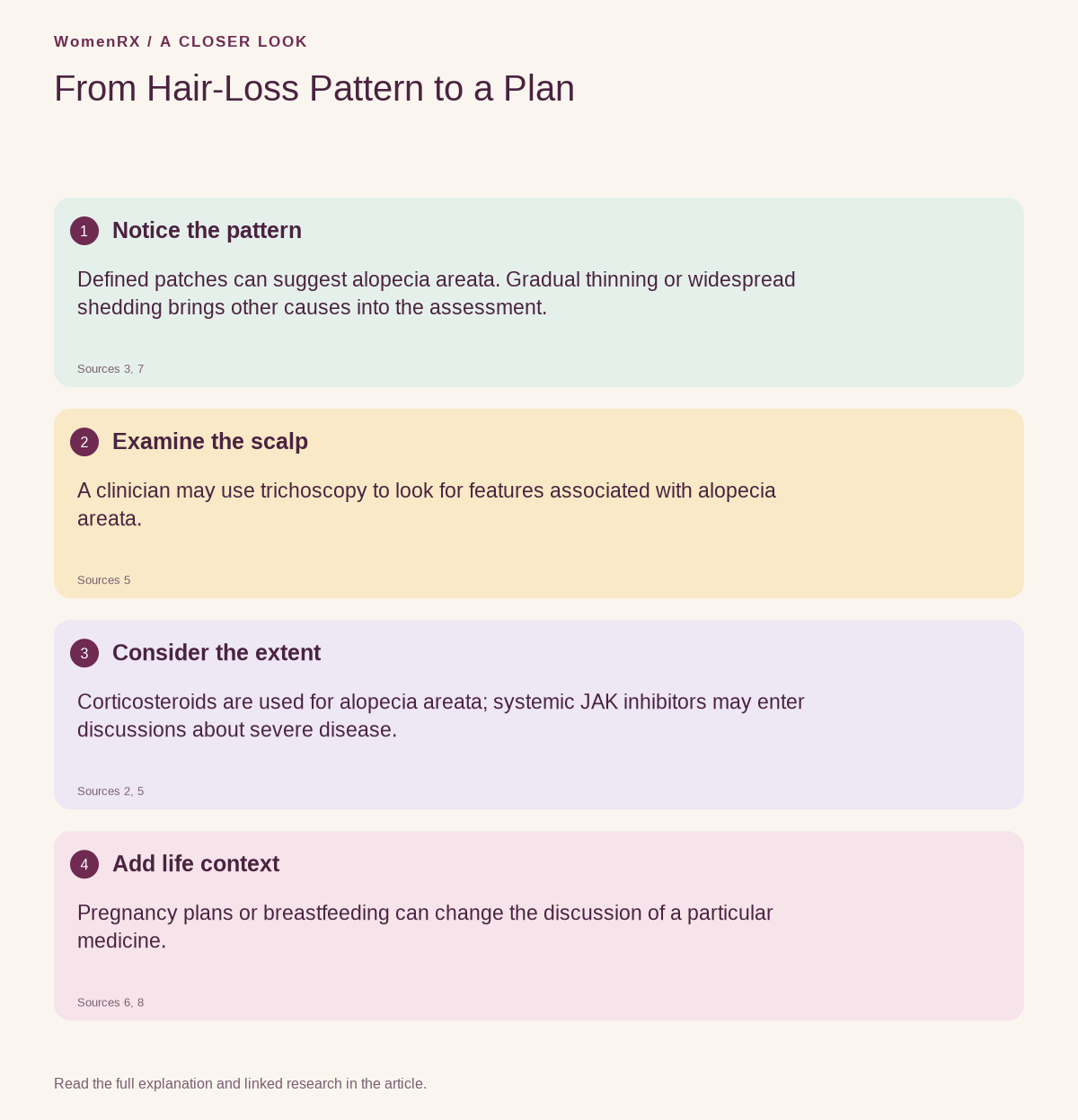
From Hair-Loss Pattern to a Plan
Notice the pattern: Defined patches can suggest alopecia areata. Gradual thinning or widespread shedding brings other causes into the assessment.37
Examine the scalp: A clinician may use trichoscopy to look for features associated with alopecia areata.5
Consider the extent: Corticosteroids are used for alopecia areata; systemic JAK inhibitors may enter discussions about severe disease.25
Add life context: Pregnancy plans or breastfeeding can change the discussion of a particular medicine.68
Read the figure as text
The pattern starts the conversation; examination findings, extent of loss, and life context help shape the next decision.- Notice the pattern: Defined patches can suggest alopecia areata. Gradual thinning or widespread shedding brings other causes into the assessment.37
- Examine the scalp: A clinician may use trichoscopy to look for features associated with alopecia areata.5
- Consider the extent: Corticosteroids are used for alopecia areata; systemic JAK inhibitors may enter discussions about severe disease.25
- Add life context: Pregnancy plans or breastfeeding can change the discussion of a particular medicine.68
Sources you can check
- Hair Loss | Alopecia | Alopecia Areata | MedlinePlusAccessed 2026-09-25Return to first citation
- Hair loss - NHSAccessed 2026-09-25Return to first citation
- Retrospective Evaluation of the Impact of the COVID-19 Pandemic on the Incidence of Alopecia Areata in a Single Dermatological Department.Chętko Ł, Hofmann J, Brzychcy K, Matych M, Sobolewska-Sztychny D, Noweta M, Zakrzewski B, Dominiak M, Narbutt J, Lesiak A. · Journal of clinical medicine · 2026Return to first citation
- [Efficacy and safety of baricitinib treatment in alopecia areata: a retrospective analysis].Rózsa P, Szász Z, Asztalos L, Kemény L, Gyulai R. · Orvosi hetilap · 2025Return to first citation
- Off-Label Treatment of Alopecia Areata-Retrospective Study.Sternicka-Rohde J, Bieniaszewski L, Krzyżaniak N, Nowicki RJ, Purzycka-Bohdan D. · Biomedicines · 2026Return to first citation
- Safety and clinical considerations of alopecia therapies during pregnancy, fertility treatment, and polycystic ovary syndrome workup.Brinks AL, Lawrence CN, Kearney CA, Rachko G, Bieber AK, DeVore S, Shapiro J, Lo Sicco KI, Majerson D. · International journal of women's dermatology · 2026Return to first citation
- Androgenetic Alopecia in Women: A Narrative Review of Pathophysiology, Clinical Evaluation, and Treatments.Kearney CA, Brinks AL, Lawrence CN, Maas DE, Spindler AJ, Coric C, Gener-Pangilinan LA, Lasheras-Pérez MA, Shapiro J, Lo Sicco KI. · American journal of clinical dermatology · 2026Return to first citation
- Alopecia Treatments in Breastfeeding: Safety and Clinical Considerations.Needle CD, Brinks AL, Kearney CA, Rachko G, Bieber AK, Shapiro J, Nachtigall M, Lo Sicco KI, Majerson D. · International journal of dermatology · 2025Return to first citation