Topical Tretinoin Reactions: When to Call or Get Help
Brief stinging and mild peeling can happen, but severe irritation needs a call, and signs of a serious allergic reaction need emergency care.
Brief warmth, slight stinging, or mild peeling can happen with topical tretinoin. Stop using it and contact your prescriber for severe or persistent irritation, especially swelling, blisters, or crusting. Call your doctor immediately about a new rash, hives, or pain at the treated area. If your throat or tongue swells or you struggle to breathe, seek emergency care now, whatever the cause. 1456

Start with what your skin is doing
Topical tretinoin can cause a brief feeling of warmth or slight stinging when you apply it. Some peeling or discomfort can also occur in the early days. Those effects are not a reason to assume that every reaction is harmless. The useful distinction is whether the reaction is limited and tolerable, or severe, persistent, or damaging the skin. 14
For example, a little flaking around a treated area is different from skin that is swollen and crusted. The product instructions say to stop tretinoin and contact your prescriber if irritation is severe or persistent. They also identify excessive redness, swelling, blistering, and crusting as reactions that may require stopping treatment until the skin recovers or changing the treatment plan. Don’t keep applying it to see whether a severe reaction will settle on its own. 14
A new rash or hives, or pain or discomfort at the treated area, calls for an immediate call to your doctor, according to MedlinePlus. Itching appears in its guidance among both general side effects and symptoms that warrant an immediate call, so don’t dismiss itching when it comes with a rash or hives. This is a call-now distinction, not a reason to treat every flake as an urgent reaction. 5
Get emergency help now if you develop sudden swelling of your throat or tongue, trouble breathing or swallowing, or feel faint. These can be signs of a serious allergic reaction, whatever triggered it. Use local emergency services rather than waiting for your prescriber to call back. This is a general emergency warning, not a claim that topical tretinoin commonly causes anaphylaxis. 6
Look at what else is touching your skin
If your skin is irritated, your routine may be adding to it. Medicated or abrasive cleansers, strongly drying cosmetics, and products containing alcohol or astringents can increase irritation alongside tretinoin. The labeling calls for particular caution with products containing salicylic acid, sulfur, or resorcinol. In a study of 324 people assigned to use tretinoin cream on the face and ears, use of other topical medications at enrollment was associated with more reported local adverse effects. That association doesn’t tell you which product caused an individual reaction, but it gives you a practical place to look. 13
Keep cleansing gentle rather than scrubbing away flakes. The topical instructions also recommend a moisturizer that won’t aggravate acne and caution against applying more tretinoin than directed: extra product can increase redness, peeling, or discomfort without producing faster results. If irritation is more than you can comfortably manage, ask your prescriber whether the formulation or frequency needs to change rather than trying to force your skin through it. 14
Sunburn needs its own pause
Skin treated with tretinoin may be more susceptible to sunlight. Protect treated areas with sunscreen and clothing when you’re outside. If you become sunburned, the product instructions say not to use tretinoin again until your skin has recovered. Wind and cold can also make treated skin feel more irritated. 4
A temporary change in skin color, either darker or lighter, has also been reported with topical tretinoin. Tell your prescriber about a change that concerns you, particularly if irritation is occurring in the same area. 14
Pregnancy changes the treatment conversation
If you’re pregnant or think you might be pregnant, contact your prescriber about whether to use topical tretinoin. The topical product instructions advise speaking with a physician before using it in either situation. If you’re planning a pregnancy, that’s also a practical time to discuss your treatment plan. If you’ve already applied tretinoin before learning you were pregnant, that exposure is a reason for a conversation, not a reason to assume an adverse outcome. 45
In a prospective study, researchers followed 106 pregnancies with first-trimester topical tretinoin exposure and 389 without it. They found no statistically significant difference in the pregnancy outcomes they evaluated, including major structural defects. The study offers some reassurance after inadvertent exposure, but its size cannot establish that use during pregnancy is risk-free. 2
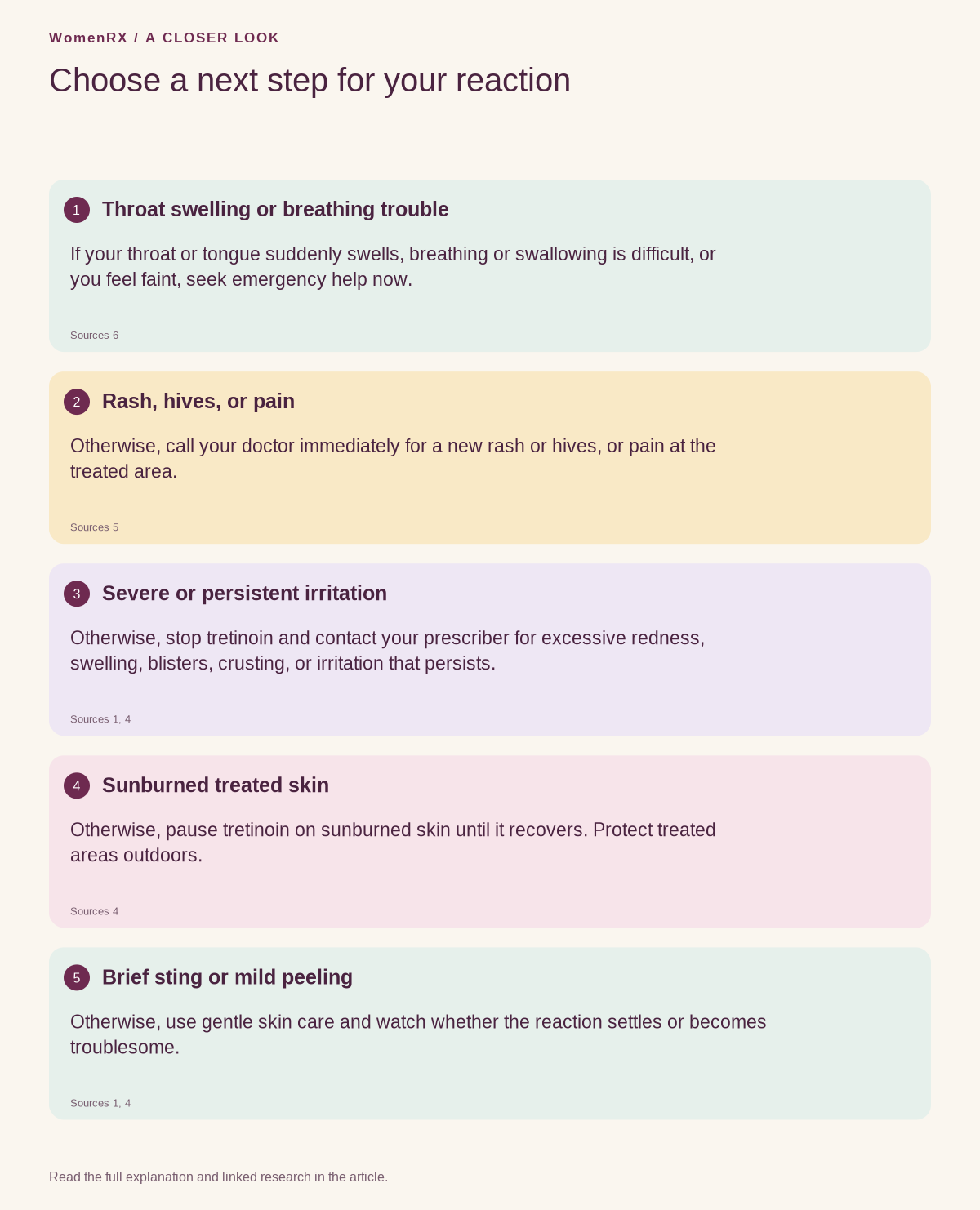
Choose a next step for your reaction
Throat swelling or breathing trouble: If your throat or tongue suddenly swells, breathing or swallowing is difficult, or you feel faint, seek emergency help now.6
Rash, hives, or pain: Otherwise, call your doctor immediately for a new rash or hives, or pain at the treated area.5
Severe or persistent irritation: Otherwise, stop tretinoin and contact your prescriber for excessive redness, swelling, blisters, crusting, or irritation that persists.14
Sunburned treated skin: Otherwise, pause tretinoin on sunburned skin until it recovers. Protect treated areas outdoors.4
Brief sting or mild peeling: Otherwise, use gentle skin care and watch whether the reaction settles or becomes troublesome.14
Read the figure as text
Check for emergency signs first, then match what’s happening on your skin to an action.- Throat swelling or breathing trouble: If your throat or tongue suddenly swells, breathing or swallowing is difficult, or you feel faint, seek emergency help now.6
- Rash, hives, or pain: Otherwise, call your doctor immediately for a new rash or hives, or pain at the treated area.5
- Severe or persistent irritation: Otherwise, stop tretinoin and contact your prescriber for excessive redness, swelling, blisters, crusting, or irritation that persists.14
- Sunburned treated skin: Otherwise, pause tretinoin on sunburned skin until it recovers. Protect treated areas outdoors.4
- Brief sting or mild peeling: Otherwise, use gentle skin care and watch whether the reaction settles or becomes troublesome.14
More questions, answered
Does topical tretinoin cause more irritation in women?
Local irritation is a recognized effect, but the study abstract on local adverse effects does not report a women-specific risk estimate. It would be misleading to present redness or peeling as a side effect unique to women. Pregnancy is a separate treatment-safety consideration. 134
Sources you can check
- TRETINOIN CREAM [REDPHARM DRUG] | US prescribing information and patient instructionsAccessed 2026-09-25Return to first citation
- Minor malformations characteristic of the retinoic acid embryopathy and other birth outcomes in children of women exposed to topical tretinoin during early pregnancy.Loureiro KD, Kao KK, Jones KL, Alvarado S, Chavez C, Dick L, Felix R, Johnson D, Chambers CD. · American journal of medical genetics. Part A · 2005Return to first citation
- Predictors of local adverse effects caused by topical tretinoin cream 0·1% in the Veterans Affairs Topical Tretinoin Chemoprevention trial.Pomerantz H, Weinstock MA, Veterans Affairs Topical Tretinoin Chemoprevention (VATTC) Group. · The British journal of dermatology · 2014Return to first citation
- TRETINOIN GEL TRETINOIN CREAM [PADAGIS US LLC] | US prescribing information and patient instructionsAccessed 2026-09-25Return to first citation
- Tretinoin Topical: MedlinePlus Drug InformationAccessed 2026-09-26Return to first citation
- Anaphylaxis - NHSAccessed 2026-09-26Return to first citation