TB-500 for Injury Recovery: What Human Research Shows
Animal healing results and studies of related peptides don’t show that a TB-500 product will help a person recover from an injury.
Human research hasn’t established that TB-500 helps people heal tendon, muscle, or other orthopedic injuries. TB-500 is a fragment of thymosin beta-4, but findings for the full peptide or other related molecules can’t establish a benefit for TB-500. Its safety for injury recovery is also unclear, and a product’s name doesn’t verify what it contains.245

Why the healing claims sound plausible
TB-500 is discussed alongside thymosin beta-4, often shortened to TB-4. They’re related, but they aren’t interchangeable: the FDA identifies TB-500 as a fragment of thymosin beta-4. A review of injectable peptides reports tissue-repair effects for TB-4 and its derivative TB-500 in preclinical models. That gives researchers a reason to investigate them. It doesn’t tell you whether TB-500 shortens recovery from a torn muscle, tendon injury, or surgery in people.25
The step from a promising mechanism to a useful treatment is bigger than it may seem. Cells moving into a laboratory wound, or tissue changing in an animal experiment, isn’t the same outcome as a person regaining strength, having less pain, or returning to activity sooner. A scoping review of emerging peptides found that most of the identified musculoskeletal publications used animal models. The reviewers concluded that claims of improved human musculoskeletal recovery remain unsubstantiated by current trials.1
Three different questions often get blurred together
Can a related peptide affect repair processes? Yes, in experimental settings. For example, researchers studying an engineered tandem version of TB-4 reported cell-migration findings and better corneal wound healing in an experimental alkali-burn model. The engineered tandem peptide is not TB-500, and a corneal experiment cannot establish that an injectable TB-500 product heals a human tendon.3
Has TB-500 improved recovery in people with orthopedic injuries? The injectable-peptide review reports that human orthopedic data for TB-4 and TB-500 are lacking. A separate scoping review found that human studies across several emerging peptides were limited and generally lacked strong controls. Those reviews support a narrow conclusion: the claimed injury-recovery benefit hasn’t been established in people. They do not prove that no study of TB-500 exists anywhere.21
Do we know what to expect from a product offered as TB-500? A study of TB-4, an engineered version of it, or an animal model cannot establish the identity or performance of a particular product. The injectable-peptide review also says the indications, dosing, frequency, and duration of treatment remain unknown. Neither a “for research” nor a “for healing” claim establishes a human injury outcome. The cited research does not verify the identity or contents of any particular product.2
What the US compounding information tells you
The FDA identifies TB-500 specifically as thymosin beta-4 fragment (LKKTETQ) in its information on bulk substances nominated for use in compounding. It flags potential immune reactions associated with aggregation and peptide-related impurities and says it has not identified human exposure data for drug products containing this fragment. That is a safety concern and a gap in knowledge, not an adverse-event rate for people using TB-500.5
For compounding under section 503A, the FDA sets requirements for bulk substances, including a valid certificate of analysis and manufacture by an FDA-registered establishment. TB-500 is not on the final 503A bulk-substances list. That list is one pathway under the compounding rules, however, not a complete ruling on every product or transaction. The FDA’s separate safety listing is not an approval of a finished TB-500 product.675 None of this verifies whether a particular vial sold as TB-500 contains the stated fragment or meets applicable requirements.
What the safety evidence can and can’t tell you
The absence of a demonstrated benefit isn’t the only consideration. Without adequate human data on TB-500 for injury recovery, there’s no reliable basis here for estimating its adverse-effect rates or deciding that a particular way of using it is safe. The scoping review flags safety concerns across the broader group of emerging peptides, but risks reported for another peptide should not be presented as proven TB-500 risks.12
The evidence doesn’t establish a distinct response in women, either. It would be misleading to turn general tissue-repair findings into a claim about women’s healing, whether you’re cycling, postpartum, or postmenopausal. The practical decision is the same: weigh an unproven recovery claim against the uncertainty about TB-500 itself, rather than relying on results from a related molecule or another peptide.25
If you’re considering it for a specific injury, start with the outcome that matters to you. For example, “Will this help me return to running sooner after a tendon injury?” is a different question from “Did a peptide affect tissue repair in an animal?” The reviews don’t establish a human TB-500 result that answers the running question.12
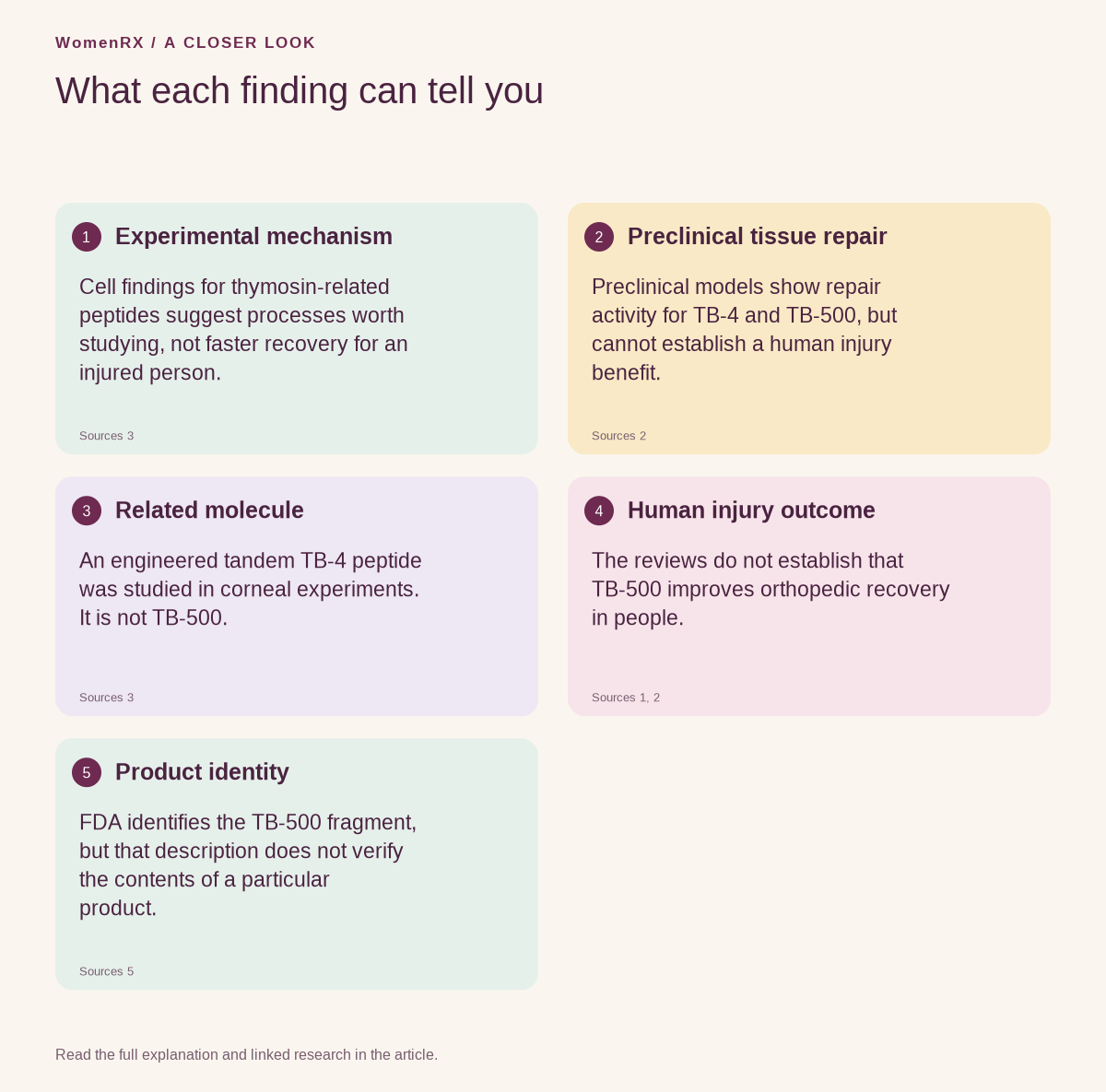
What each finding can tell you
Experimental mechanism: Cell findings for thymosin-related peptides suggest processes worth studying, not faster recovery for an injured person.3
Preclinical tissue repair: Preclinical models show repair activity for TB-4 and TB-500, but cannot establish a human injury benefit.2
Related molecule: An engineered tandem TB-4 peptide was studied in corneal experiments. It is not TB-500.3
Human injury outcome: The reviews do not establish that TB-500 improves orthopedic recovery in people.12
Product identity: FDA identifies the TB-500 fragment, but that description does not verify the contents of a particular product.5
Read the figure as text
These findings answer different questions. Only a human study of the relevant substance and injury outcome could directly test the advertised recovery claim.- Experimental mechanism: Cell findings for thymosin-related peptides suggest processes worth studying, not faster recovery for an injured person.3
- Preclinical tissue repair: Preclinical models show repair activity for TB-4 and TB-500, but cannot establish a human injury benefit.2
- Related molecule: An engineered tandem TB-4 peptide was studied in corneal experiments. It is not TB-500.3
- Human injury outcome: The reviews do not establish that TB-500 improves orthopedic recovery in people.12
- Product identity: FDA identifies the TB-500 fragment, but that description does not verify the contents of a particular product.5
More questions, answered
Do human studies of other peptides show that TB-500 works?
No. Results for another peptide cannot establish TB-500’s benefit or safety. Human musculoskeletal findings across the emerging peptides reviewed were limited and did not substantiate the broader recovery claims.12
Sources you can check
- Peptide Supplements and Their Therapeutic Applications in Sports Medicine.Tewari K, Liu TP, Im C, Hamad C, Petrigliano F, Cheung EC, Kremen TJ. · The American journal of sports medicine · 2026Return to first citation
- Injectable Peptide Therapy: A Primer for Orthopaedic and Sports Medicine Physicians.Mayfield CK, Bolia IK, Feingold CL, Lin EH, Liu JN, Rick Hatch GF, Gamradt SC, Weber AE. · The American journal of sports medicine · 2026Return to first citation
- Engineered Tandem Thymosin Peptide Promotes Corneal Wound Healing.Nguyen J, Verma S, Vuong VT, Queener H, Coulson-Thomas VJ, Gesteira TF. · Investigative ophthalmology & visual science · 2025Return to first citation
- Safety and Efficacy of Approved and Unapproved Peptide Therapies for Musculoskeletal Injuries and Athletic Performance.Mendias CL, Awan TM. · Sports medicine (Auckland, N.Z.) · 2026Return to first citation
- Certain Bulk Drug Substances for Use in Compounding that May Present Significant Safety Risks | FDAAccessed 2026-09-26Return to first citation
- Bulk Drug Substances Used in Compounding Under Section 503A of the FD&C Act | FDAAccessed 2026-09-26Return to first citation
- 21CFR216.23, displayed current through September24,2026Accessed 2026-09-26Return to first citation