BPC-157 for Tendon or Gut Problems: What Evidence Shows
BPC-157 has encouraging animal findings, but human research hasn’t established that it heals tendons or treats intestinal disease.
BPC-157 is an experimental peptide, not an established treatment for tendon injuries or gut problems. Animal studies report tissue-repair effects, but they don’t show that the peptide helps people recover from these conditions. Small human studies in knee pain, bladder symptoms, and safety don’t answer the tendon or intestinal-disease questions, and women-specific results haven’t been established. 1 2 3 8
Why animal results don’t settle the question
BPC-157 is a synthetic peptide promoted for tissue repair. In animal experiments, it has been associated with changes in processes such as blood-vessel growth, collagen formation, and tissue healing. These findings can give researchers a reason to investigate a treatment. They don’t show that a person will heal faster, regain tendon strength, or get relief from a gut condition. 1 2
That distinction matters for tendons in particular. Tissue can look better under a microscope without returning to normal strength or function. A 2026 systematic review describes BPC-157 findings across rat injury models, but says definitive clinical validation is still pending. Promising repair in an animal model is a starting point, not evidence that the same effect happens in people. 1
Tendon claims: what the human findings actually address
The musculoskeletal evidence is largely preclinical. Human research has not established that BPC-157 repairs a torn, strained, or otherwise injured tendon. 1 3
One human report discussed in a sports-medicine review involved knee pain after injections into the knee joint. It was a case series without a control group, and the review notes substantial methodological limitations. Even if people report less pain, that does not establish that BPC-157 caused the change, repaired a tendon, or restored tissue strength. Knee pain can have different causes, and pain relief is not the same outcome as tendon healing. 8
So a claim like “it helped knee pain” should not be treated as proof that it heals an injured tendon. Reviews of peptide therapies describe human musculoskeletal studies as limited and often lacking rigorous designs; they conclude that marketed recovery benefits aren’t established by current human trials. 3 5
Gut claims: animal healing isn’t treatment evidence
BPC-157 has been studied in animal models involving injury to parts of the gastrointestinal tract. Those results do not establish that it treats intestinal disease or heals gut injuries in people. 2
A 2024 review mentions phase II research in ulcerative colitis, but its account does not give trial methods or results that establish whether the treatment helped. The mention of a study is not itself evidence of benefit. 4
There is also a small pilot study involving interstitial cystitis, a bladder condition. It cannot answer whether BPC-157 treats intestinal problems: the condition and the organ being studied are different. 2
What small human safety studies can tell you
Human research has included small pilot studies in areas such as knee pain, bladder symptoms, and intravenous safety. Some reported no adverse effects, but small studies cannot establish safety for wider use or identify less common and longer-term harms. 2 3
The product itself raises a separate question. A review of unapproved injectable peptides describes potential risks from unregulated products, including contamination, manufacturing impurities, and inaccurate dosing. These are possible quality concerns, not proof that any particular product is contaminated. Still, an online product’s label or marketing does not establish what is in it or whether it has been adequately tested. 6
What is known about women
Human research has not established whether BPC-157’s effects differ for women. Published accounts of the small human studies do not report sex-specific outcomes that answer whether it helps female athletes, or whether findings apply during pregnancy, postpartum, perimenopause, or postmenopause. That is an evidence gap, not proof that women were never included in a study. 2 3 8
Approval is not the same as every product’s legal status
A 2025 review reports that BPC-157 is not approved by the FDA for standard medical use. That does not, by itself, determine the legal status of every product, sale, or use. And being offered for sale does not establish FDA approval, proven benefit, or established safety. 7
For a tendon injury or intestinal condition, the practical takeaway is straightforward: animal findings and small or indirect human studies do not establish BPC-157 as an effective treatment. It shouldn’t be treated as a proven replacement for established care or as a proven add-on. 1 2 5
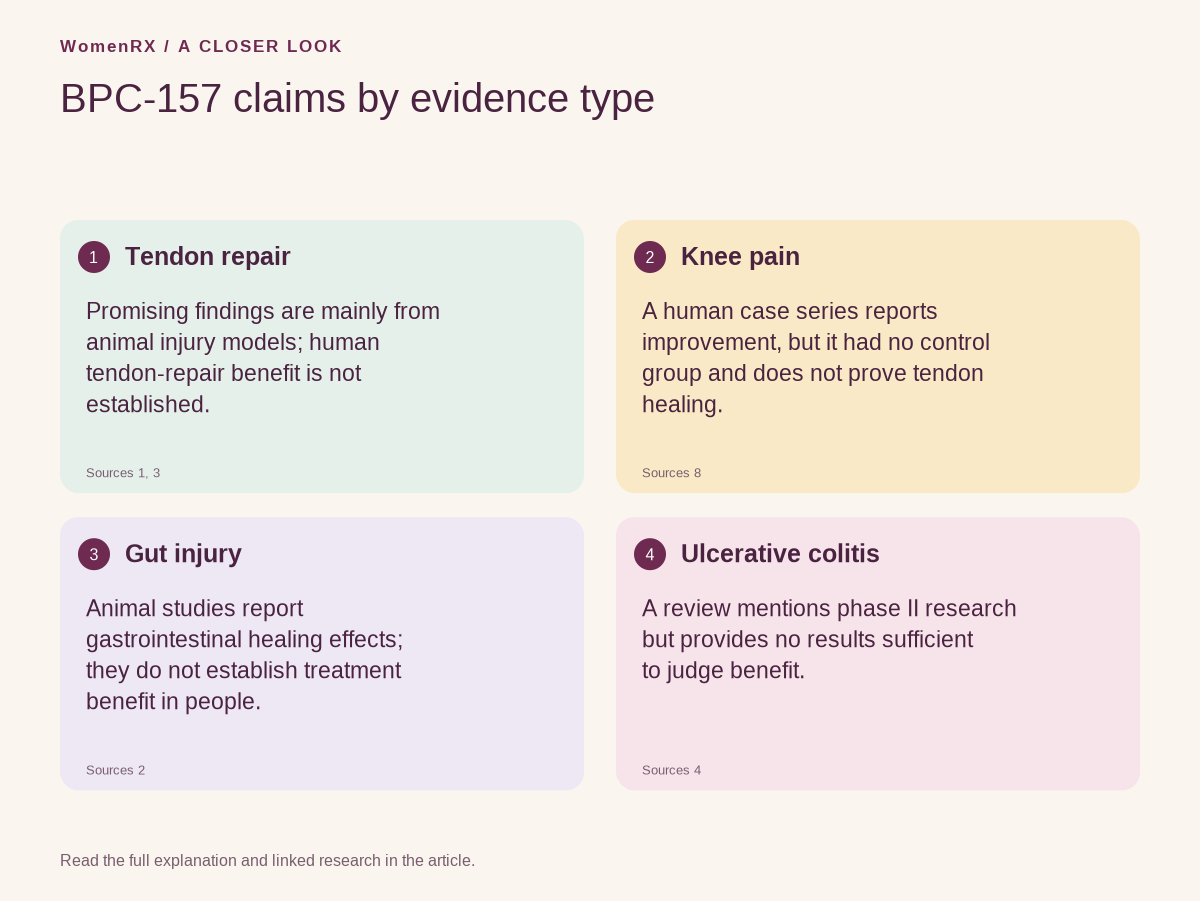
BPC-157 claims by evidence type
Tendon repair: Promising findings are mainly from animal injury models; human tendon-repair benefit is not established.13
Knee pain: A human case series reports improvement, but it had no control group and does not prove tendon healing.8
Gut injury: Animal studies report gastrointestinal healing effects; they do not establish treatment benefit in people.2
Ulcerative colitis: A review mentions phase II research but provides no results sufficient to judge benefit.4
Read the figure as text
The promoted uses differ from the human outcomes studied. This comparison shows what each type of finding can and cannot establish.- Tendon repair: Promising findings are mainly from animal injury models; human tendon-repair benefit is not established.13
- Knee pain: A human case series reports improvement, but it had no control group and does not prove tendon healing.8
- Gut injury: Animal studies report gastrointestinal healing effects; they do not establish treatment benefit in people.2
- Ulcerative colitis: A review mentions phase II research but provides no results sufficient to judge benefit.4
More questions, answered
Does not being FDA-approved mean every BPC-157 product is illegal?
No. A review’s statement that BPC-157 is not FDA-approved for standard medical use does not settle the legal status of every product or situation. It does mean that a product being offered for sale is not proof of FDA approval or established medical benefit. 7
Sources you can check
- Tendon, Ligament, and Muscle Injury, Osteotendinous, Myotendinous, and Muscle-to-Bone Junction Therapy Perspectives with Growth Factors and Stable Gastric Pentadecapeptide BPC 157-A Review.Matek D, Matek I, Japjec M, Matek M, Prenc J, Staresinic B, Staresinic E, Prtoric A, Sikiric S, Beketic Oreskovic L, Oreskovic I, Strbe S, Kordic M, Tvrdeic A, Seiwerth S, Sikiric ... · Pharmaceuticals (Basel, Switzerland) · 2026Return to first citation
- From Regeneration to Analgesia: The Role of BPC-157 in Tissue Repair and Pain Management.Yuan C, Demers A, Silva-Ortiz V, Hasoon JJ, Lee W, Dave K, Amirdelfan K, Burke HW, Christo PJ, Robinson CL. · International journal of molecular sciences · 2026Return to first citation
- Regeneration or Risk? A Narrative Review of BPC-157 for Musculoskeletal Healing.McGuire FP, Martinez R, Lenz A, Skinner L, Cushman DM. · Current reviews in musculoskeletal medicine · 2025Return to first citation
- New studies with stable gastric pentadecapeptide protecting gastrointestinal tract. significance of counteraction of vascular and multiorgan failure of occlusion/occlusion-like syndrome in cytoprotection/organoprotection.Sikiric P, Sever M, Krezic I, Vranes H, Kalogjera L, Smoday IM, Vukovic V, Oroz K, Coric L, Skoro M, Kavelj I, Zubcic S, Sikiric S, Beketic Oreskovic L, Oreskovic I, Blagaic V, Brc... · Inflammopharmacology · 2024Return to first citation
- Peptide Supplements and Their Therapeutic Applications in Sports Medicine.Tewari K, Liu TP, Im C, Hamad C, Petrigliano F, Cheung EC, Kremen TJ. · The American journal of sports medicine · 2026Return to first citation
- Dangers of Injectable Peptides and Other Unregulated "Biohacking" Drugs.Moiz A, O'Keefe EL, O'Keefe JH. · Missouri medicine · 2026Return to first citation
- Multifunctionality and Possible Medical Application of the BPC 157 Peptide-Literature and Patent Review.Józwiak M, Bauer M, Kamysz W, Kleczkowska P. · Pharmaceuticals (Basel, Switzerland) · 2025Return to first citation
- Injectable Peptide Therapy: A Primer for Orthopaedic and Sports Medicine Physicians.Mayfield CK, Bolia IK, Feingold CL, Lin EH, Liu JN, Rick Hatch GF, Gamradt SC, Weber AE. · The American journal of sports medicine · 2026Return to first citation