Is BPC-157 Legal in 2026? What the U.S. FDA Record Shows
An advisory meeting, permission to compound and approval of a medicine are different milestones.
For U.S. readers, BPC-157 should not be described as an FDA-approved medicine. FDA’s July 2026 briefing says neither the free-base nor acetate form is a component of an approved drug. 13 The July advisory process concerns compounding, and its recommendations are nonbinding. 14 Those records do not provide a blanket yes-or-no answer about every product, purchase or country.
What changed in 2026?
FDA's July 23, 2026 advisory agenda included BPC-157 free base and BPC-157 acetate for possible inclusion on a list used in pharmacy compounding. The use FDA evaluated was ulcerative colitis. 14
Its briefing described no applicable USP or National Formulary drug-substance monograph and no FDA-approved drug containing either form. The staff assessment recommended against inclusion on the compounding list. The document explicitly distinguished that assessment from a final agency determination. 13
These details matter when a headline says a peptide was “approved.” Ask what was approved, by whom and in which document. An advisory recommendation and a final FDA action are different events. FDA explains that advisory recommendations do not bind the agency. 14
Checked September 26, 2026: the official records cited here document the evaluation and meeting, not an approval of a finished BPC-157 medicine. This is a dated U.S. source check, not a promise that rules will never change.
Three meanings of “legal” that should stay separate
| The question | What would answer it |
|---|---|
| Is this an approved medicine? | The exact finished-product approval record. |
| Can a particular pharmacy prepare it? | The current rules and circumstances applying to that pharmacy and preparation. |
| Can I import, possess or use it where I live? | The rules of that jurisdiction and the specific activity. |
FDA's general guidance confirms that a compounded medicine is not an FDA-approved finished product. 16 A prescription or an online listing therefore cannot, by itself, answer every row in the table.
If a provider claims that a new decision changed access, ask for the official document and effective date. A link to a meeting agenda demonstrates that a topic was scheduled for discussion; it does not establish the result of every later step.
Does a different form change the answer?
FDA evaluated free base and acetate separately. Its briefing also describes problems with inconsistent naming of substances sold under the BPC-157 name. 13 That is a practical reason to ask what is actually in a proposed product, rather than accepting the familiar name as a complete identity.
Keep the pharmacy name, formulation and intended route together when asking about access. Do not assume that a statement about one preparation applies to a capsule, injection or nasal product with different details.
Approval status and clinical benefit are separate questions
Even if a pharmacy can explain a lawful route for a particular preparation, the next question is what benefit has been established for your condition. The FDA safety page identifies limited safety information and concerns involving peptide impurities and possible immune reactions. 15
That is not evidence of a women-specific recovery benefit or a proven safe pregnancy regimen. A legal-access argument cannot fill a clinical evidence gap. Ask the clinician to explain those two questions separately, especially when a proposal involves repeated treatment.
What to do with an online claim
Save the exact claim and ask the prescriber or pharmacist for its current primary source. Make the question concrete: “Does this document apply to this preparation, for this use, today?”
For travel or purchases across borders, get a destination-specific answer before ordering. This article does not determine personal import or possession rules outside the U.S. Its purpose is to help you read the U.S. record accurately, without turning a committee headline into a promise about treatment access.
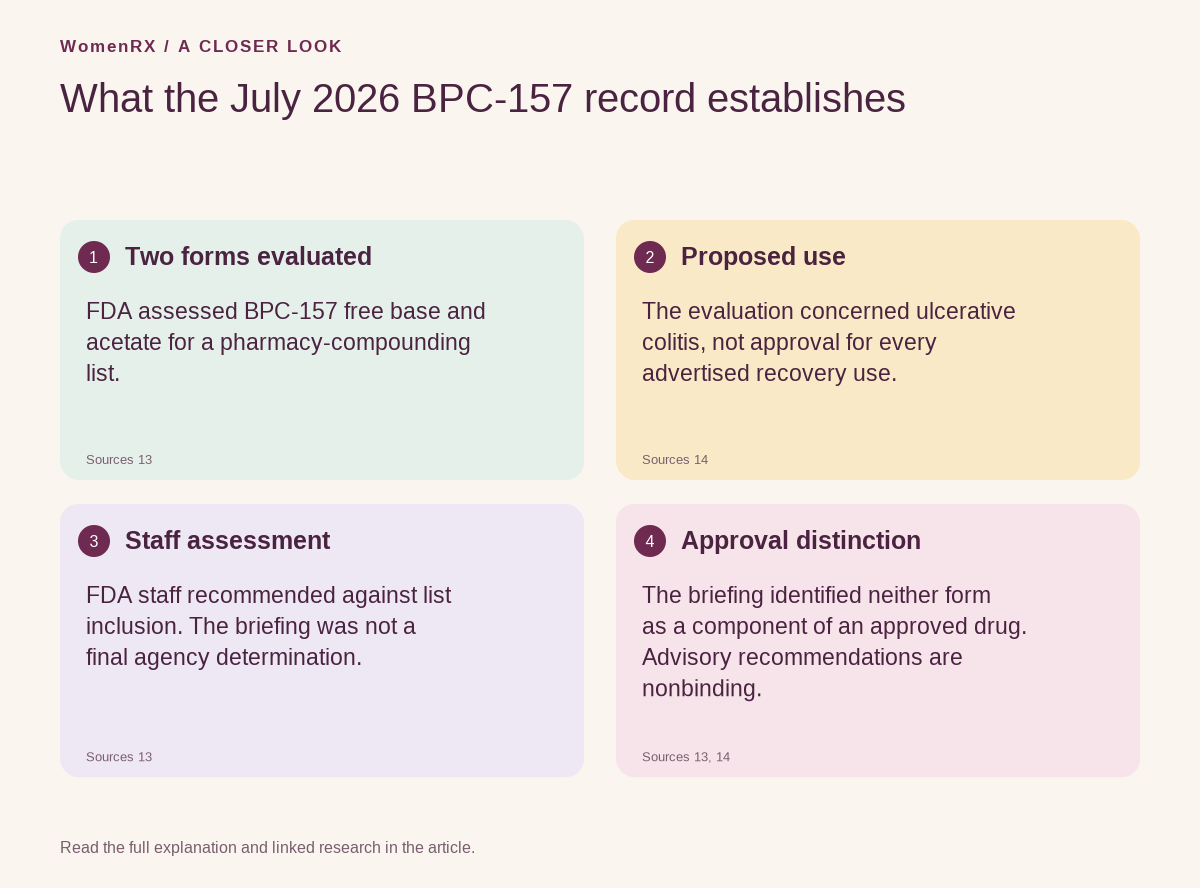
What the July 2026 BPC-157 record establishes
Two forms evaluated: FDA assessed BPC-157 free base and acetate for a pharmacy-compounding list.13
Proposed use: The evaluation concerned ulcerative colitis, not approval for every advertised recovery use.14
Staff assessment: FDA staff recommended against list inclusion. The briefing was not a final agency determination.13
Approval distinction: The briefing identified neither form as a component of an approved drug. Advisory recommendations are nonbinding.1314
Read the figure as text
U.S. official documents checked September 26, 2026.- Two forms evaluated: FDA assessed BPC-157 free base and acetate for a pharmacy-compounding list.13
- Proposed use: The evaluation concerned ulcerative colitis, not approval for every advertised recovery use.14
- Staff assessment: FDA staff recommended against list inclusion. The briefing was not a final agency determination.13
- Approval distinction: The briefing identified neither form as a component of an approved drug. Advisory recommendations are nonbinding.1314
Sources you can check
- FDA: July 2026 BPC-157 Briefing DocumentAccessed 2026-09-26Return to first citation
- FDA: July 23-24, 2026 Pharmacy Compounding Advisory CommitteeAccessed 2026-09-26Return to first citation
- FDA: BPC-157 Safety InformationAccessed 2026-09-26Return to first citation
- FDA: Understanding Compounded DrugsAccessed 2026-09-26Return to first citation