AOD-9604: What the Human Evidence Actually Shows
AOD-9604 was studied as a possible obesity treatment, but a proposed fat-loss mechanism is not the same as a demonstrated benefit.
AOD-9604 is a synthetic fragment of human growth hormone investigated for obesity. A review reports that an analysis of six randomized human studies found no effect on serum IGF-1, but its brief account does not give weight-loss results or enough adverse-event detail to judge benefit and safety. FDA also flags potential risks with compounded AOD-9604. A particular product’s status needs separate verification.345
Why AOD-9604 draws interest
If you’ve seen AOD-9604 described as a “fat-burning peptide,” the first distinction to make is between why researchers studied it and what people experienced in a trial. AOD-9604 is a synthetic fragment of human growth hormone. It was investigated for potential effects on fat metabolism and as a possible treatment for obesity; phase IIa trials were underway by February 2002.34
That history shows it reached human research. It doesn’t, by itself, show that people taking it lost more weight than people in a comparison group, or that any weight change lasted. Likewise, the fact that it’s a fragment of growth hormone doesn’t let you assume it has either the benefits or the risks of full-length growth hormone.3
What the human finding does, and doesn’t, answer
A 2026 review describes an analysis of six randomized human studies that found no effect on serum IGF-1, a hormone researchers can measure in blood. In its brief discussion of that analysis, the review does not specify the participants’ weight-loss results, a breakdown of adverse events, or outcomes analyzed separately for women. That discussion also doesn’t give enough detail to judge whether the study conditions resemble a product being offered to you now.3
That makes “doesn’t raise IGF-1” a much narrower claim than “works for weight loss” or “has no hormonal risks.” If a seller cites those six studies, ask for the actual trial report and look for the number and characteristics of participants, the comparison group, the amount of weight change in each group, how long participants were followed, and adverse events. Ask whether women were included and whether their results were reported separately. Without those details, a mention of randomized trials is not a usable estimate of benefit or risk for you.
You may also see claims about joints or recovery. The cartilage finding described in the review came from rabbits given AOD-9604 together with hyaluronic acid. It cannot establish that AOD-9604 alone repairs cartilage or relieves joint symptoms in women.3
Safety is more than a blood-test result
FDA’s AOD-9604 safety description raises potential concerns about immune reactions with certain routes of administration and about peptide-related impurities and characterization of the ingredient used in compounded drugs. FDA says it has no or only limited safety-related information to determine whether administration to humans would cause harm. It also notes serious adverse events that may be associated with AOD-9604, while saying causality is unclear.5
These statements don’t prove that every use causes harm. They do mean that a seller’s claim of “proven safe” goes further than the information supports. The route and the identity and quality of the actual preparation matter when assessing a safety claim, especially for a product intended for injection.5
For pregnancy or breastfeeding, the IGF-1 finding offers no reassurance about fetal or infant exposure. The cited discussion of the human studies does not establish AOD-9604 safety in either situation. Medicines and supplements can present different risks during pregnancy, and some substances can pass into breast milk; those general facts cannot be used to predict what AOD-9604 specifically would do.321
A regulatory claim needs a specific question
“Legal peptide” is too vague to tell you what you’re being offered. In the US, approval of a drug, the rules for making a compounded drug, and the status of an individual product are different questions. FDA’s compounding information distinguishes patient-specific compounding under section 503A from compounding under section 503B. Its interim bulk-substance categories are not drug approvals.63
FDA’s safety-risk page names AOD-9604 and describes concerns about its use in compounded drugs. That warning alone does not establish the status of a seller’s finished product. This US information cannot establish a product’s status in another country.56
Before accepting a sales page’s regulatory claim, ask what specific product, route, intended use, and jurisdiction it covers. Then separate that answer from the clinical question: Where are the human results showing the benefit being advertised? Neither a regulatory-sounding label nor a proposed mechanism supplies those results.
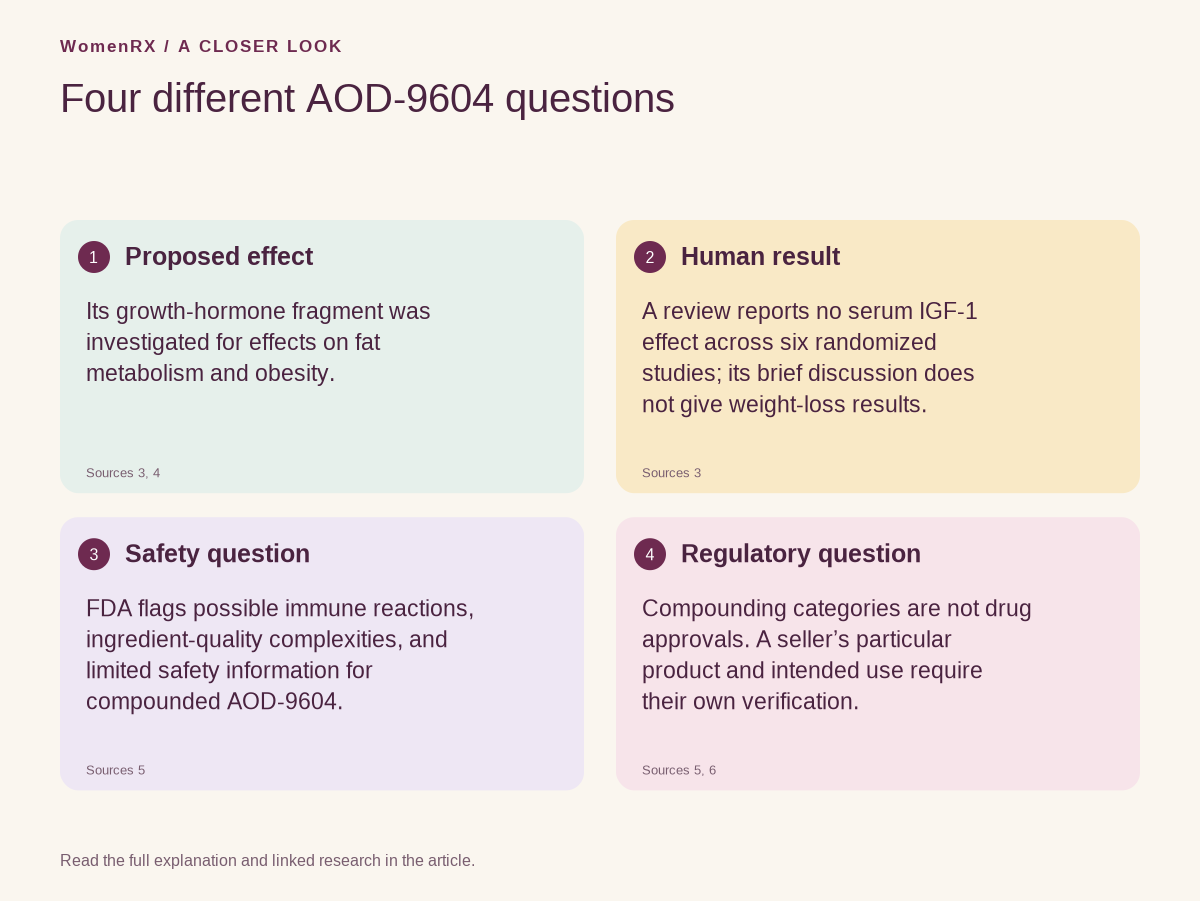
Four different AOD-9604 questions
Proposed effect: Its growth-hormone fragment was investigated for effects on fat metabolism and obesity.34
Human result: A review reports no serum IGF-1 effect across six randomized studies; its brief discussion does not give weight-loss results.3
Safety question: FDA flags possible immune reactions, ingredient-quality complexities, and limited safety information for compounded AOD-9604.5
Regulatory question: Compounding categories are not drug approvals. A seller’s particular product and intended use require their own verification.56
Read the figure as text
A claim about how a peptide might work cannot stand in for a human outcome, a safety finding, or a product-specific regulatory answer.- Proposed effect: Its growth-hormone fragment was investigated for effects on fat metabolism and obesity.34
- Human result: A review reports no serum IGF-1 effect across six randomized studies; its brief discussion does not give weight-loss results.3
- Safety question: FDA flags possible immune reactions, ingredient-quality complexities, and limited safety information for compounded AOD-9604.5
- Regulatory question: Compounding categories are not drug approvals. A seller’s particular product and intended use require their own verification.56
Sources you can check
- Breastfeeding | Benefits of Breastfeeding | MedlinePlusAccessed 2026-09-25Return to first citation
- Pregnancy and Medicines | MedlinePlusAccessed 2026-09-25Return to first citation
- Therapeutic Peptides in Orthopaedics: Applications, Challenges, and Future Directions.Rahman OF, Lee SJ, Seeds WA. · Journal of the American Academy of Orthopaedic Surgeons. Global research & reviews · 2026Return to first citation
- AOD-9604 Metabolic.Wilding J. · Current opinion in investigational drugs (London, England : 2000) · 2004Return to first citation
- Certain Bulk Drug Substances for Use in Compounding that May Present Significant Safety Risks | FDAAccessed 2026-09-26Return to first citation
- Bulk Drug Substances Used in Compounding Under Section 503A of the FD&C Act | FDAAccessed 2026-09-26Return to first citation