Gut and Hormones: What Human Studies Actually Show
Gut microbes can process estrogen, but that pathway alone doesn’t show that changing your microbiome will improve a cycle, fertility, or menopause symptoms.
Human research supports a plausible gut-estrogen pathway: some microbes can reactivate estrogen compounds that have entered the gut. Analyses of human microbiome data have examined how that microbial capacity varies, but they don’t establish that a particular gut profile changes a woman’s hormone levels or improves reproductive health. Menstrual-cycle findings from a lab model aren’t evidence of clinical effects in women. 23
A pathway is not the same as a health benefit
The gut-hormone connection is best understood as a chain of questions, not a single proven claim. First: can microbes interact with hormones? Second: does that interaction change hormone levels in people? Third: does changing the microbes improve a health outcome? Evidence for one step doesn’t automatically answer the next.
One proposed pathway concerns estrogen. The liver can attach chemical groups to estrogen as part of processing it. Some gut microbes make enzymes that can remove those groups, potentially making estrogen available for reabsorption. That is a plausible route by which gut microbes could affect estrogen recycling. 2
A human-data analysis looked at microbial estrogen-recycling capacity across populations. But capacity inferred from microbiome data is not the same as measuring a woman’s circulating estrogen, and neither measure by itself shows a change in symptoms, fertility, or disease risk. The study therefore offers evidence about a microbial function, not proof that manipulating that function benefits women. 2
What the evidence says across life stages
Menstrual cycle: A 2025 study used a laboratory fermentation model made with stool samples from four donors, including men and women, and exposed the model to hormones intended to represent menstrual-cycle phases. The model showed shifts in microbial composition. That’s useful early mechanistic work, but it didn’t follow women through cycles or test whether microbiome changes affected periods, ovulation, or symptoms. 3
Pregnancy: These studies don’t establish that changing the gut microbiome improves pregnancy outcomes or reproductive hormones during pregnancy. Findings about a possible estrogen pathway shouldn’t be treated as evidence for a fertility or pregnancy benefit.
Perimenopause and postmenopause: The pathway is relevant to estrogen biology, but this evidence doesn’t show that a microbiome test or supplement can improve hot flashes, sleep, bone health, or other menopause-related outcomes. A mechanism involving estrogen isn’t a menopause treatment study.
These distinctions matter because reproductive hormones and health outcomes differ by life stage. A result about a microbial enzyme, a simulated cycle, or a cancer-related hypothesis can’t be carried over automatically to menstrual symptoms, pregnancy, or menopause.
A practical way to assess a test or supplement claim
Before paying for a microbiome test or a product advertised to “balance hormones,” ask:
- What did the study actually measure? Microbial genes or enzyme capacity, blood hormone levels, symptoms, or a health outcome? These are different endpoints.
- Was it a study in people, or a lab model? A controlled laboratory model can help explain a mechanism, but it doesn’t establish what happens in a person. 3
- Did researchers test a treatment? An association between microbes and a hormone-related condition doesn’t show that changing the microbes will change the condition.
- Did the study include women at your life stage and measure an outcome you care about? Results about one population or endpoint may not apply to menstrual symptoms, pregnancy, or menopause.
- Does the test result guide a proven next step? A result can sound precise without showing that acting on it improves health. For chronic endometritis specifically, a 2026 narrative review describes gut-related mechanisms as hypothetical and says current evidence doesn’t support routine gut microbiome testing or microbiome-directed treatment for that condition. That finding is specific to chronic endometritis, not a verdict on every gut test. 1
The most useful takeaway is modest but clear: gut microbes can participate in estrogen processing, and researchers are studying what that means in people. That is a reason to keep investigating, not yet a reason to assume that a commercial test or supplement can correct a hormone problem.
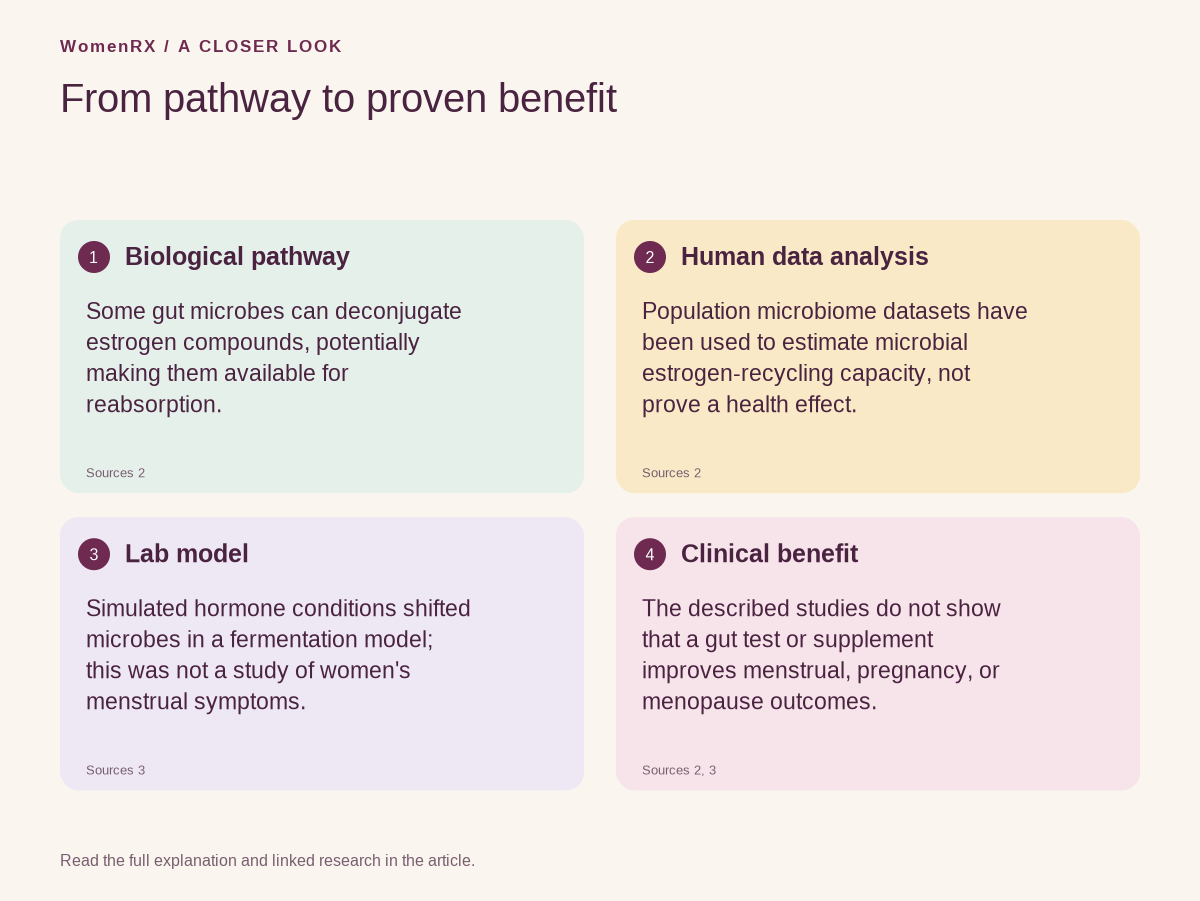
From pathway to proven benefit
Biological pathway: Some gut microbes can deconjugate estrogen compounds, potentially making them available for reabsorption.2
Human data analysis: Population microbiome datasets have been used to estimate microbial estrogen-recycling capacity, not prove a health effect.2
Lab model: Simulated hormone conditions shifted microbes in a fermentation model; this was not a study of women's menstrual symptoms.3
Clinical benefit: The described studies do not show that a gut test or supplement improves menstrual, pregnancy, or menopause outcomes.23
Read the figure as text
These evidence levels answer different questions. A biological mechanism or lab result does not by itself demonstrate a clinical benefit.- Biological pathway: Some gut microbes can deconjugate estrogen compounds, potentially making them available for reabsorption.2
- Human data analysis: Population microbiome datasets have been used to estimate microbial estrogen-recycling capacity, not prove a health effect.2
- Lab model: Simulated hormone conditions shifted microbes in a fermentation model; this was not a study of women's menstrual symptoms.3
- Clinical benefit: The described studies do not show that a gut test or supplement improves menstrual, pregnancy, or menopause outcomes.23
More questions, answered
Does an estrobolome test tell me my estrogen level?
Not on its own. A result about microbial genes or estimated estrogen-recycling capacity describes a possible gut function; it isn’t a direct measurement of circulating estrogen or proof of a health effect. 2
Do gut bacteria change during the menstrual cycle?
A lab fermentation model found microbial shifts when researchers simulated menstrual-cycle hormone conditions. That does not establish that the same shifts happen in women across a cycle or affect menstrual symptoms. 3
Sources you can check
- The gut-endometrium axis in chronic endometritis: the role of bacterial translocation, the estrobolome, and estrogen metabolism - A narrative review.Rodrigues RS, Rocha JC, Fontenele PA, Setti AS. · European journal of obstetrics, gynecology, and reproductive biology · 2026Return to first citation
- Industrialization increases the estrogen-recycling capacity of the gut microbiome.Brittain RSA, Bribiescas RG, Jasienska G. · Proceedings of the National Academy of Sciences of the United States of America · 2026Return to first citation
- In vitro modeling of the female gut microbiome: effects of sex hormones and psychotropic drugs.Leao L, Esmail GA, Miri S, Mottawea W, Hammami R. · Microbiology spectrum · 2025Return to first citation