IBS, Bloating, and the Gut Microbiome: What Connects
Gut microbes may be one part of IBS, but a microbiome finding isn’t a diagnosis or a proven guide to treatment.
IBS can involve abdominal pain, bloating, and changes in bowel habits, with several possible contributors, including gut sensitivity, motility, and gut-brain signaling. Microbes may also play a role, but current findings don’t show that one microbiome pattern causes IBS or tells you which treatment will work. IBS is assessed through symptoms, with tests sometimes used to check for other conditions. 126
Bloating is real, but it doesn’t point to one cause
IBS can bring abdominal pain, bloating, constipation, diarrhea, or a mix of bowel changes. Symptoms often vary over time, and IBS can be uncomfortable without damaging the intestines. 12
The microbiome is one possible piece of a larger picture. Gut microbes interact with food, and researchers are studying how microbial activity and its byproducts might affect gas production, bowel movement, and signals between the gut and nervous system. IBS is also associated with changes in motility and sensitivity, among other possible contributors. These are proposed connections, not proof that one microbial imbalance explains a person’s symptoms. 567
That distinction matters when you read about “dysbiosis” or a supposedly unhealthy mix of bacteria. A difference observed in a group of people with IBS doesn’t establish that the difference caused their symptoms, applies to everyone with IBS, or points to a particular treatment.
What treatment studies suggest, and what they don’t
A randomized trial compared a low-FODMAP diet with rifaximin in 65 adults with diarrhea-predominant IBS over five weeks. Both groups had improvements in abdominal pain and bloating. The researchers also found microbial features associated with response to each approach, but said those findings need validation before they can guide personalized treatment. The study is a useful example of the difference between a possible predictor and a dependable way to choose care. 4
Diet may affect symptoms and the microbes measured in stool, but those outcomes aren’t interchangeable. A review of low-FODMAP research describes symptom benefits and raises the possibility that restriction may reduce some beneficial microbial populations. In other words, a diet can help symptoms without proving that it has “fixed” the microbiome. 5
Probiotic findings also depend on the specific product studied. In a small, eight-week randomized trial, 30 people with constipation-predominant IBS received either one particular strain, Lacticaseibacillus rhamnosus IDCC 3201, or a placebo. The study reported improvements in some bowel and bloating measures in the probiotic group, along with changes in certain fecal microbes. That result doesn’t establish that probiotics generally work for IBS or that the microbial changes caused the symptom changes. 3
A microbiome report isn’t an IBS diagnosis
There isn’t one specific test for IBS. Assessment is based on symptoms, and a clinician may use other tests to check for conditions that can cause similar problems. 1 Microbial patterns linked with treatment response are still being studied; the IBS-D trial’s researchers said their findings need validation before they guide individual treatment choices. 4
So a stool report describing bacteria as “good,” “bad,” or out of balance shouldn’t be treated as proof that you have IBS or as a reliable prescription for what to do next. A practical question to ask is: would this result change a care decision supported by clinical evidence? If not, the report may offer information without a clear next step.
Put your own pattern in context
IBS affects about twice as many women as men. That difference in how commonly IBS occurs doesn’t show that microbiome findings or treatments work differently in women. The treatment findings described here don’t establish whether effects differ by sex. 134
If you notice your bloating or bowel symptoms around a particular part of your menstrual cycle, you can mention that as an observation about your own experience. It isn’t a universal IBS feature, and noticing a pattern by itself doesn’t establish its cause.
For a useful conversation about next steps, consider asking:
- What in my symptoms supports IBS, and is there a reason to check for another condition?
- Which symptom should we focus on first: pain, bloating, constipation, diarrhea, or more than one?
- If we consider a diet or probiotic, what evidence applies to my symptoms, and how will we know if it’s helping?
- Would a microbiome test change the plan, or would it mainly describe what’s in a stool sample?
For now, symptom assessment and treatment studies offer more practical guidance than trying to correct a microbiome result. Research may eventually help match treatments to individual patterns, but the microbial signals studied so far aren’t ready to make that choice on their own. 14
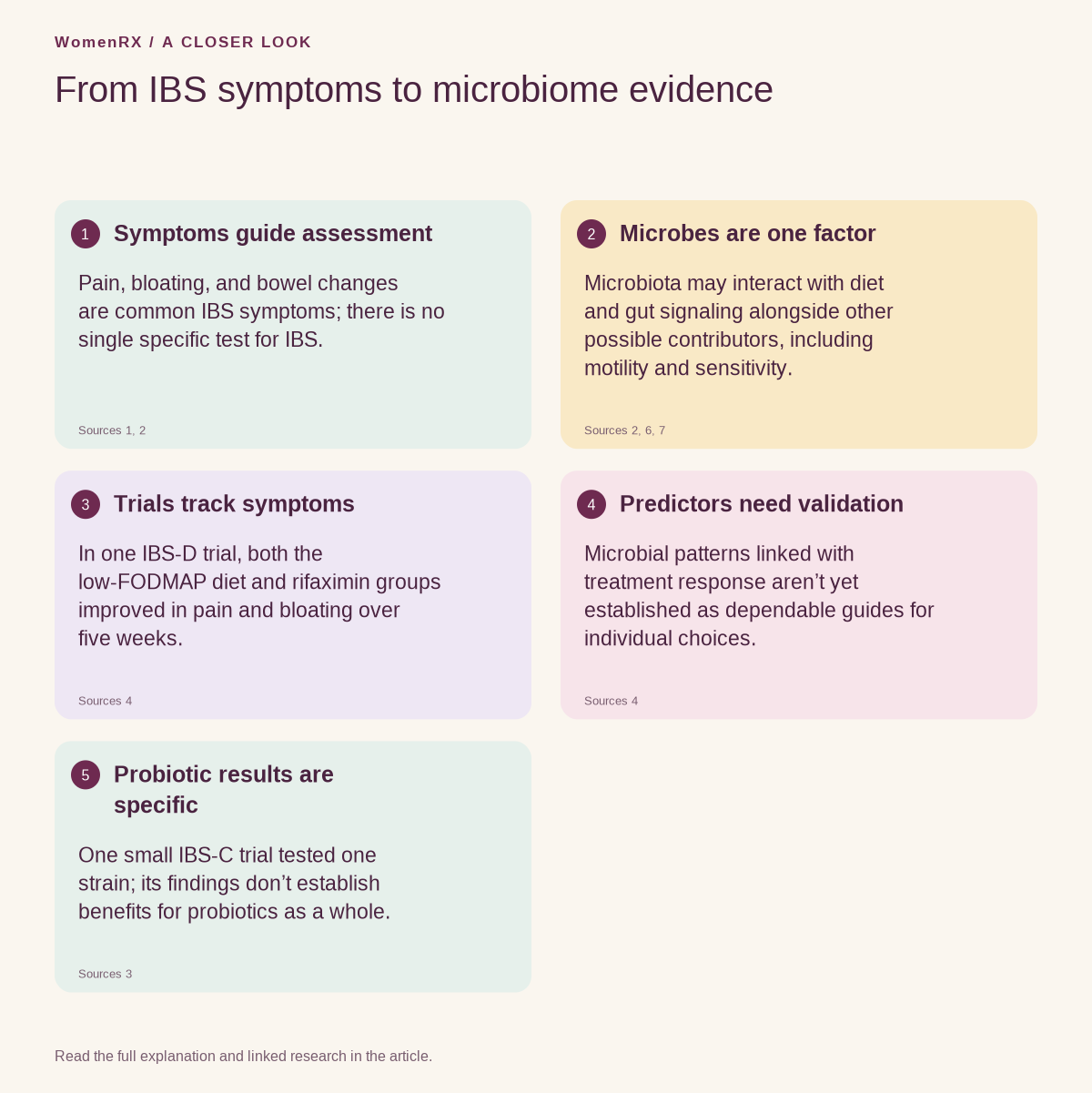
From IBS symptoms to microbiome evidence
Symptoms guide assessment: Pain, bloating, and bowel changes are common IBS symptoms; there is no single specific test for IBS.12
Microbes are one factor: Microbiota may interact with diet and gut signaling alongside other possible contributors, including motility and sensitivity.267
Trials track symptoms: In one IBS-D trial, both the low-FODMAP diet and rifaximin groups improved in pain and bloating over five weeks.4
Predictors need validation: Microbial patterns linked with treatment response aren’t yet established as dependable guides for individual choices.4
Probiotic results are specific: One small IBS-C trial tested one strain; its findings don’t establish benefits for probiotics as a whole.3
Read the figure as text
Separate what symptoms can show from what microbiome research suggests and what still needs validation.- Symptoms guide assessment: Pain, bloating, and bowel changes are common IBS symptoms; there is no single specific test for IBS.12
- Microbes are one factor: Microbiota may interact with diet and gut signaling alongside other possible contributors, including motility and sensitivity.267
- Trials track symptoms: In one IBS-D trial, both the low-FODMAP diet and rifaximin groups improved in pain and bloating over five weeks.4
- Predictors need validation: Microbial patterns linked with treatment response aren’t yet established as dependable guides for individual choices.4
- Probiotic results are specific: One small IBS-C trial tested one strain; its findings don’t establish benefits for probiotics as a whole.3
More questions, answered
Does bloating mean my gut microbiome is out of balance?
No. Bloating is a common IBS symptom, but it doesn’t identify its cause. Microbes are one possible contributor among several, and a symptom alone can’t establish a particular microbial explanation. 127
Do probiotics help IBS?
Some studies report symptom improvements with specific probiotics, but results from one strain shouldn’t be assumed to apply to all probiotics. For example, one small trial tested a particular strain in people with constipation-predominant IBS; it doesn’t establish a class-wide effect. 3
Sources you can check
- Irritable Bowel Syndrome | IBS | MedlinePlusAccessed 2026-09-25Return to first citation
- What is IBS (irritable bowel syndrome) - NHSAccessed 2026-09-25Return to first citation
- Effect of Lacticaseibacillus rhamnosus IDCC 3201 on irritable bowel syndrome with constipation: a randomized, double-blind, and placebo-controlled trial.Kwon H, Nam EH, Kim H, Jo H, Bang WY, Lee M, Shin H, Kim D, Kim J, Kim H, Lee J, Jung YH, Yang J, Won DD, Shin M. · Scientific reports · 2024Return to first citation
- A Randomized Trial of Rifaximin vs Low Fermentable Oligosaccharides, Disaccharides, Monosaccharides, and Polyols Diet for Symptom Outcomes and Microbiome Changes in Irritable Bowel Syndrome.Lee AA, Rao K, Singh P, Fehlman J, Gao J, Takakura W, Lynett A, Haller E, Ball S, Marand A, Liu A, Shah E, Menees S, Punglia R, Nojkov B, Eswaran S, Baker J, Chey WD, Owyang C, You... · Clinical gastroenterology and hepatology : the official clinical practice journal of the American Gastroenterological Association · 2026Return to first citation
- Low-FODMAP Diet for Irritable Bowel Syndrome: Insights from Microbiome.Zhang H, Su Q. · Nutrients · 2025Return to first citation
- Pathophysiological Mechanisms and Nonpharmacological Interventions in Irritable Bowel Syndrome: Current Insights and Future Directions.Cheung SLY, Kenway LC. · Journal of nutrition and metabolism · 2026Return to first citation
- [Microbiome-Gut-Brain Axis in Irritable Bowel Syndrome: Pathophysiology and Therapeutic Approaches].Diaz Fernandez W, Salolin Vargas VP, Padilla-Zambrano HS, Cerino-Penaloza MS, Saldaña Ruiz MA, Leggett C. · Revista de gastroenterologia del Peru : organo oficial de la Sociedad de Gastroenterologia del Peru · 2026Return to first citation